WoW Classic Armor Calculator
Estimate Classic physical damage reduction from armor, attacker level, class stance, shield armor, block value, buffs, effective health, and the 75% mitigation cap.
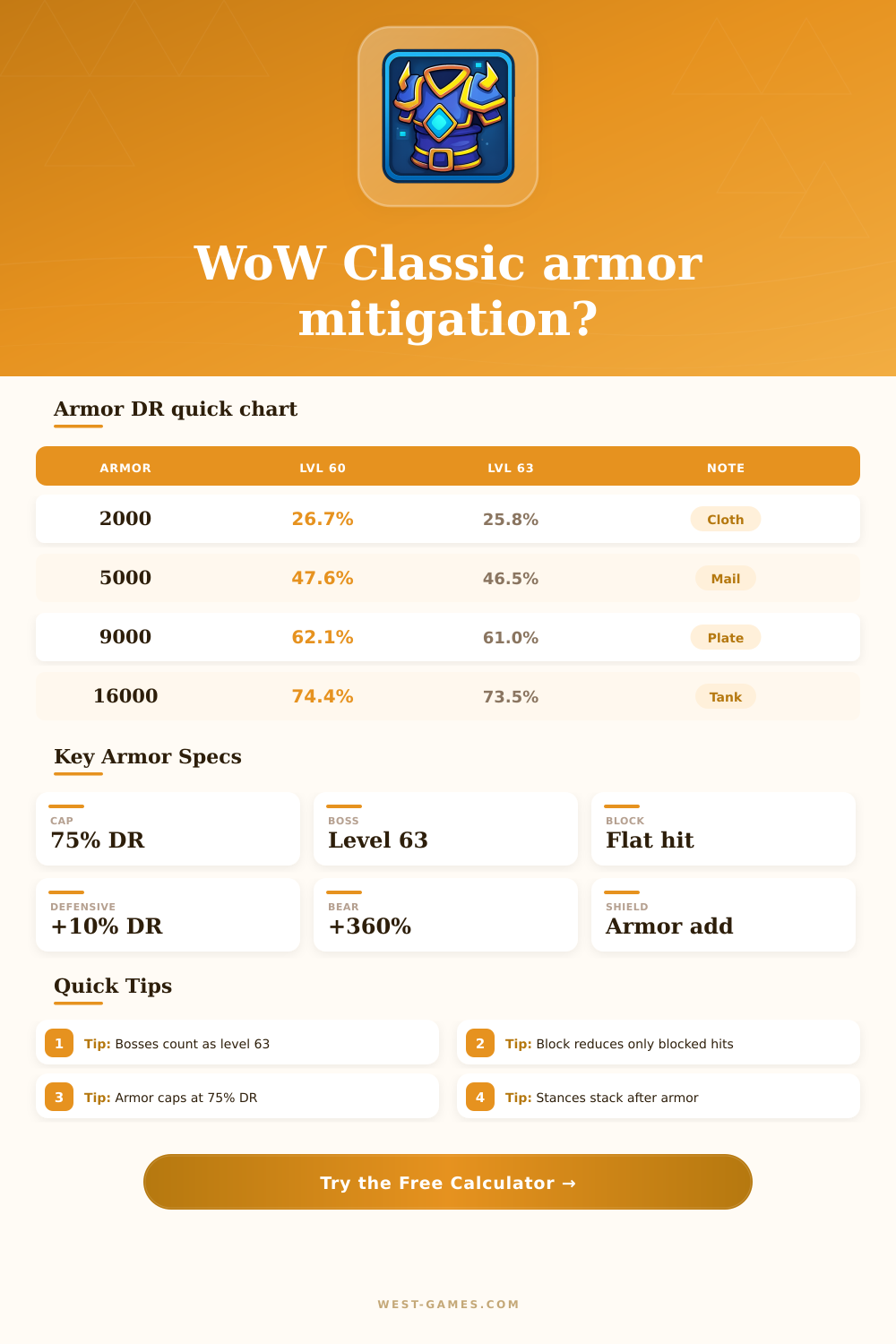
| Total armor | Vs level 60 | Vs level 62 | Vs level 63 boss | Typical feel |
|---|---|---|---|---|
| 1,500 | 21.4% | 20.9% | 20.7% | Light caster gear, heavy damage taken |
| 3,000 | 35.3% | 34.6% | 34.3% | Leather or low mail, still fragile |
| 5,000 | 47.6% | 46.9% | 46.5% | Mail or early plate durability |
| 8,000 | 59.3% | 58.5% | 58.2% | Dungeon tank territory |
| 12,000 | 68.6% | 67.9% | 67.6% | Strong raid armor profile |
| 17,265 | 75% cap | 75% cap | 75.0% | Near cap versus boss swings |
| Profile | Armor modifier | Damage modifier | Calculator use | Important note |
|---|---|---|---|---|
| Cloth or no stance | 100% | 100% taken | Baseline armor math | No stance reduction is added |
| Leather or mail melee | 100% | 100% taken | Rogue, hunter, shaman style tests | Class avoidance is not included |
| Plate wearer | 100% | 100% taken | Paladin or non-defensive warrior | Shield can be added separately |
| Warrior Defensive Stance | 100% | 90% taken | Tank stance planning | Applied after armor reduction |
| Warrior Berserker Stance | 100% | 110% taken | Risk check for physical hits | Raises final physical damage taken |
| Druid Bear Form | +180% | 100% taken | Classic bear armor planning | Multiplier applies to armor base |
| Druid Dire Bear Form | +360% | 100% taken | Level 40+ bear tanking | Can approach the 75% DR cap |
| Input | How it is modeled | Best use | Stacking behavior |
|---|---|---|---|
| Shield armor | Added before armor formula | Warrior and paladin shield swaps | Benefits from same armor formula |
| Mark of the Wild | Flat armor planning value | Common group or raid buff | Included before cap check |
| Armor scroll | Flat armor planning value | Consumable comparison | Included with other flat armor |
| Greater defense elixir | Flat armor planning value | Raid or dungeon preparation | Included before mitigation |
| Inspiration effect | Percentage armor increase | Healer proc uptime checks | Multiplies armor before formula |
| Shield Wall or cooldown | Extra physical DR percent | Emergency hit planning | Applied after armor and stance |
| Preset | Total armor style | Expected DR vs 63 | Block role | Best question answered |
|---|---|---|---|---|
| Fresh 60 Cloth Caster | Very low armor | Low | None | How hard does a melee hit land? |
| Pre-Raid Rogue | Moderate leather | Low to medium | None | How much does armor help without a shield? |
| Hunter Mail Kit | Mail armor | Medium | None | How sturdy is mail against elites? |
| Paladin Shield Pack | Plate plus shield | Medium to high | Meaningful | How much does block trim each hit? |
| Warrior Dungeon Tank | Plate and shield | High | Strong | How safe is dungeon tank gear? |
| Dire Bear Dungeon | Bear multiplier | High | None | How close is bear armor to plate tanking? |
| Molten Core Main Tank | Raid plate and buffs | Very high | Strong | How much EHP do raid buffs create? |
| Raid Bear With Buffs | Dire bear plus raid armor | Near cap | None | Is extra armor being capped? |
Armor is a critical component to the game of Classic World of Warcraft, as armor determine the amount of damage that players will take from every physical hit to the characters, and armor dictates the lifespan of players in the game. The small difference in armor will create differences in the amount of damage that players will take. For instance, players that wear cloth armor will take more damage than players that wear plate armor, and players that wear plate armor will take less damage than players that wear cloth armor.
The difference between cloth and plate armor determine the difference in the amount of damage that players will take, which directly affect the amount of health that the players will need to survive damage. The armor calculator utilize a variety of different inputs to determine how armor and the other variables in the game will work in dungeons or raid instances. For instance, players can input their base armor, which is the armor value on the player characters sheet without any temporary buffs, armor, or shields.
How the Armor Calculator Works
The level of the attacker in the instance or raid can be entered into the calculator because the amount of armor that is provided to players will reduce less damage if the level of the attacker is more higher than the level of the player; boss monsters in raids tend to have very high attacker levels. Additionally, players can enter their health for the game and the size of the hit that they will take; these two values will calculate the amount of effective health that the player has. These variables and others will calculate the amount of physical damage that players will take from bosses in the game.
The stance and form that players select is another input that the player must enter into the armor calculator; the amount of damage that is taken with stance and form is applied after the calculator has performed the armor calculations. For instance, the defensive stance will reduce the damage of hits by 10%, while berserker stance will increase the amount of damage that players take. Additionally, bear form and dire bear form will multiply the amount of armor that players have; as a result of these stances, druids is able to take very high amounts of mitigation.
These calculations the calculator performs automatically. Block value and chance is another separate input within the calculator; block value isnt a percentage of the damage that is taken by players. Instead, the value will subtract from the damage that is taken by players if the damage is blocked.
For instance, if a player has a block value of 100, the value will remove 100 damage from a hit to a player if the hit is blocked. However, if the player takes a very large amount of damage from an enemy, the 100 damage will only remove a portion of that damage. Additionally, players can utilize the hit-mode selector to change the type of hits that are entered into the calculator.
These hit modes include average hit, guaranteed blocked hit, and unblocked hit. In addition to the other inputs for armor, there are also separate inputs for buffs and temporary armor. Some buffs will add to the armor of the player, while other buffs will multiply the armor that the player already has.
The raid-mix option will calculate the effects of a variety of the buffs that are commonly used in raid instances. Additionally, extra physical damage reduction skills, such as Shield Wall, are applied after armor and stance are applied. The mitigation that is provided by other means is generally percentage-based, but only applied to the amount of damage after armor is applied to the hit.
The tables at the end of the armor calculator include a variety of information that is useful for players. For instance, the armor benchmarks will show how different amounts of armor will reduce the damage from attacks that have different levels of power; these tables is useful for understanding how armor and attacker levels interact. Additionally, the stance and buff tables will provide information about how damage will be reduced by each stance and buff, as well as what the calculator will do with those different amounts of mitigation.
These tables are not a replacement for the armor calculator, but provide additional information for players about the various stats of the game. One of the most common mistake made by players is to believe that armor is the only form of mitigation in the game. Other forms of mitigation include avoidance stats, glancing blows, and the strength of the attacks that enemies perform.
Another of the common mistakes that players make is the attempting to reach the 75% armor cap without first determining if it is an achievable amount of armor for that player; the armor calculator can help to avoid this mistake. The use of the armor calculator will allow players to determine which changes to their stats will result in more armor and mitigation, as well as which changes will not provide more armor. For instance, adding armor may seem unimportant; however, that small addition to armor may increase the chance that a player will reach a high amount of mitigation against the enemies in instances.
Additionally, using the hit mode selector to calculate the difference between average hits and blocked hits will allow players to determine if a player’s block value is effective protecting them from the most important and damaging hits from the monsters in the raid instances. Finally, the armor calculator will determine a value of effective health for the player. This value of effective health is the amount of raw damage that can be taken by players before the players die in-game.
Additionally, this value is based off the assumption that the mitigation calculations for players is the only form of mitigation that players have. The higher the value of effective health for a player, the more health and time that players have to react to additional damage to the player. Additionally, higher values of effective health allow more time to use cooldowns for damage reduction.
Low values of effective health mean that every other means of mitigation for players must be stronger to compensate for the lack of effective health. The calculation for effective health is provided for players to allow them to easily judge which game upgrades will be the best for that player over others. Regardless of the type of player that an individual is within the game, whether that player is of the dungeon or raid tank categories, the armor calculator will be of use.
Each of the players will have to adjust the attacker level, the size of the hit that is dealt to the player, the buffs that the player has, and the stance that the player utilizes. These adjustments will allow the armor calculator to provide the results of those changes for the player. Additionally, players can utilize the armor calculator to determine the amount of damage that can be taken before the fight with a boss by an amount of health, allowing the player to prepare for the encounter and the amount of damage that will be dealt to them in raid instances.
It’s alot of work to get it right, but it’s worth it for the moddern player who wants to recieve maximum benefit from their furnitures and gear.