🎮 Wild Rift MMR Calculator
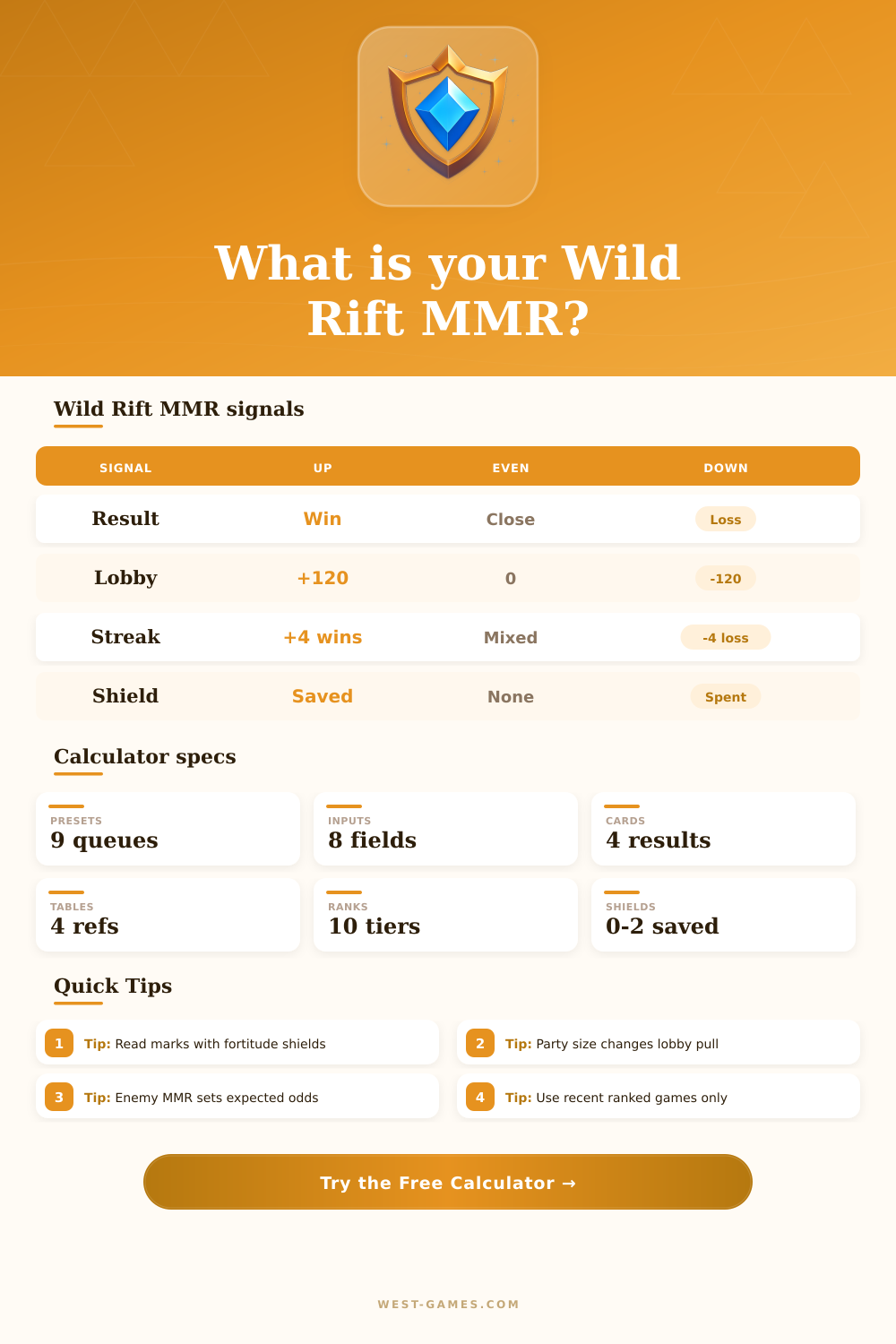
Estimate hidden MMR, expected mark movement, fortitude shield context, lobby strength, result impact, streak pressure, and party-size adjustment.
| Rank | MMR anchor | Fort cap | Use |
|---|---|---|---|
| Iron | 500 | 250 | Sorting |
| Bronze | 800 | 300 | Learning |
| Silver | 1100 | 350 | Repair |
| Gold | 1450 | 400 | Climb |
| Platinum | 1800 | 450 | Stable |
| Emerald | 2250 | 500 | Pressure |
| Diamond | 2750 | 550 | High |
| Master+ | 3300+ | 600 | Marks |
MMR anchors are calculator estimates. Fortitude caps follow the published tier cap pattern used by the model.
| Result | Mark read | Fortitude | MMR read |
|---|---|---|---|
| Win | +1 mark | Gain points | Up |
| MVP win | +1 mark | More gain | Strong up |
| Loss | -1 or shield | May gain | Down |
| SVP loss | -1 or shield | More gain | Small down |
| Remake | 0 marks | Flat | Ignored |
A shield can prevent visible mark loss, but the hidden MMR estimate can still move after a real loss.
| Enemy gap | Odds | Movement | Read |
|---|---|---|---|
| -180 or less | 60%+ | Small win | Favored |
| -80 to -179 | 55%-59% | Normal | Slight edge |
| -79 to +79 | 45%-54% | Normal | Even |
| +80 to +179 | 41%-44% | Bigger win | Enemy edge |
| +180 or more | Under 40% | Upset value | Hard lobby |
The calculator uses an Elo-style odds curve so harder lobbies reward wins more and punish losses less.
| Context | MMR pull | Confidence | Read |
|---|---|---|---|
| Solo mixed | 1.00x | High | Clean signal |
| Win streak | 1.12x | High | Momentum |
| Loss streak | 1.08x | Medium | Pressure |
| Duo or trio | 0.92x | Medium | Team context |
| Five-stack | 0.82x | Lower | Party noise |
Party modifiers adjust estimate confidence, not whether a queued party is good or bad.
On your profile are some numbers and a rank. But there is also an invisible number called MMR that matchmaking rely upon to decide who plays in your game and how bad of a loss was it? Knowing distinction between the two shifts how you ascend, instead of paying attention to what’s in front of you (the symbol), you pay attention to what lies beneath (the data).
To get there, it takes all of your recent streaks, lobby strength, saved shields, your fortitude progress, and your marks and rank into a single estimate. This is important since most players tend to forget about context of a game and only care whether they won or lost. An upset win over a stronger opponent has more weight then a boring win against someone at a lower average MMR. That’s why the tool shows this detail, allowing you to know if you’re making any kind of progress or merely staying the same.
Understanding Hidden MMR and Rank Progress
Many folks don’t understand what fortitude and shields does. So you can retain a couple of loss shields in case an opponent tries to go for your marked spots, while the unseen MMR continue to shift with results. This is where people are confused because they believe that having one or more shield means a loss doesn’t impact anything.
Even so, the system updates its perception of your skill based off who you played against. That’s how it knows whether the invisible MMR has shifted, which explains why you may be looking at steady division but find certain lobbies difficult. The system also adapts based on party size and streaks.
Momentum, indicated by a win streak, signal a potential rise in skills to the system. However, it views this as temporary good luck if the streak isn’t consistent or a true boost in your skill. Larger groups lead to less confidence from the algorithm in each game because team synergy can hides differences between individual player. It’s a small detail but will help set expectations for ranked play. Don’t expect every win to result in an aggressive bump in MMR when playing in group of five, since the system will reduce points awarded for coordinated teams to thwart cheating efforts.
Riot doesn’t display the numbers, so take all this with a grain of salt. Instead, you can use them as a guide to help find some trends across 10-20 matches. If your hidden MMR is lower than your displayed rank, then you’re being matched against people that are statistically better than what your profile reflect, which makes it feel like it takes longer to climb. If your hidden MMR is higher than your rank, you still have room to grow before reaching the elite players where you would of been at risk of falling rapidly.
This section covers shield usage and mark movement (see the reference tables). You can lose with a support vote to hold onto marks for the time being, but that doesn’t prevent the background rating adjustment from starting. So you remain in the same div for weeks yet play tougher games. The hidden MMR balancing matches continue even if you think you aren’t making any more visible progress.
Wild Rift is a long game, as all climbing games are. There’s always going to be short term variance. You’ll sometimes feel like it doesn’t matter how well you’re playing but that the system isn’t treating you fairly in matchmaking. And sometimes it all clicks and the wins comes easily. Learning to tell the difference between those two things, your ego and the immediate outcome, and focusing more on your long-term consistency rather than trying to rig each match is what will realy help you climb.
The system adjusts too fast for any human to predict. However, once you know this, putting those numbers into the calculator helps you understand where you stand in the ranked system. It removes the blind guessing game and makes climbing a strategic endeavor; each match provide more information about how well (or poorly) you’re doing towards your long term goals. When you lose, it’s not seen as a statement of your inability but instead something you measure yourself against so you fear it less. Until you can interpret what those numbers do to the marks on the screen, they might as well be decorations.