🎯 Valorant MMR Calculator
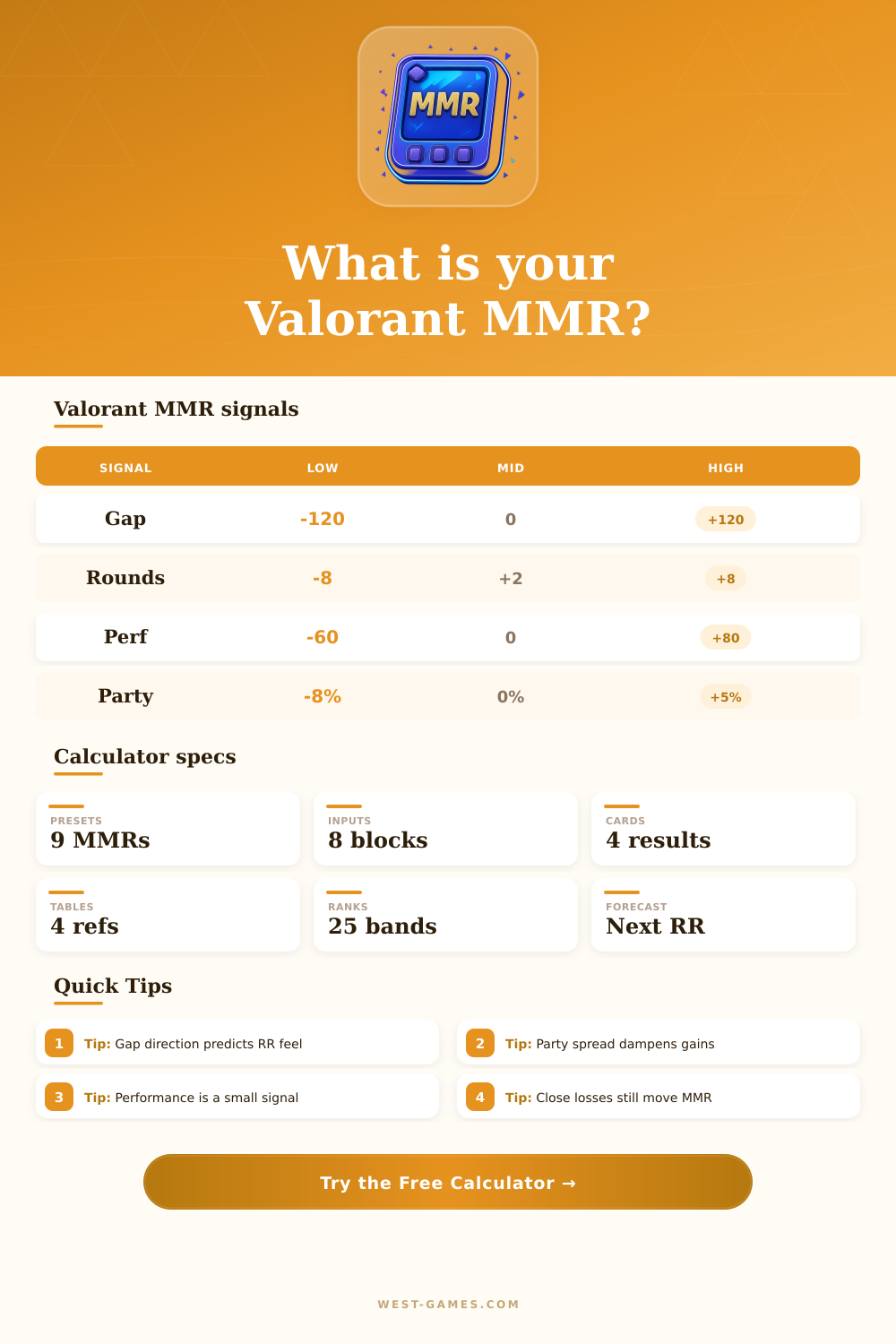
Estimate hidden MMR from visible rank, RR, encounter strength, performance signal, round differential, party modifier, convergence gap, and the next-match RR forecast.
| Rank group | Model MMR | RR range | Gap feel |
|---|---|---|---|
| Iron | 100-399 | 0-99 | Fast correction |
| Bronze | 400-699 | 0-99 | Loose movement |
| Silver | 700-999 | 0-99 | Normalizing |
| Gold | 1000-1299 | 0-99 | Moderate |
| Platinum | 1300-1599 | 0-99 | Balanced |
| Diamond | 1600-1799 | 0-99 | Sharper |
| Ascendant | 1800-2099 | 0-99 | Tight |
| Immortal+ | 2100+ | 0-99 | Very tight |
These bands are calculator anchors, not official Riot hidden MMR values.
| Lobby gap | Match feel | Win signal | Loss signal |
|---|---|---|---|
| -200 | Favored | Small | Heavy |
| -80 | Slight favored | Soft | Firm |
| 0 | Even | Normal | Normal |
| +80 | Underdog | Strong | Soft |
| +200 | Hard lobby | Very strong | Very soft |
Encounter MMR compares the lobby average against your starting hidden estimate.
| Signal | Input | MMR effect | Forecast use |
|---|---|---|---|
| Rough | -70 | Down | Lower confidence |
| Below | -35 | Slight down | Soft penalty |
| Even | 0 | Neutral | Baseline |
| Team MVP | +70 | Up | Boosts win RR |
| Match MVP | +100 | High up | Stronger signal |
Performance MMR stays smaller than result and encounter strength in this model.
| Party type | Signal weight | RR weight | Use case |
|---|---|---|---|
| Solo or duo | 100% | 100% | Stable read |
| Three-stack | 94% | 96% | Mild dampen |
| Even five | 88% | 92% | Stack context |
| Wide five | 76% | 84% | Mixed ranks |
| Boosted spread | 70% | 80% | Low confidence |
Party spread lowers confidence because the lobby signal is shared unevenly.
But sometimes, you’ll find yourself dominating a round and then see your Ranked Rating go down four points. How could that be? The game doesn’t hate you, it’s likely just forcing a correction to align your rank with your hidden MMR, right? That’s because your actual ranking (or MMR) is probably higher than what you see on screen, and the game needs to fix this so they matches.
That disconnect drives each ranked match in Valorant. It decides if you’re climbing steadily or plateauing in same tier for weeks. To understand what this pressure feels like, imagine a graph of your “hidden” skill level vs your displayed rank (the one on your screen). You can use the calculator above to see how your hidden skill might be ranked.
How Your Hidden Skill Works
This is realy about convergence. There’s a hidden number for how you’re performing over time and there’s your visible RR. When those two numbers differ greatly, it changes your RR quickly until they get back into alignment. This means if you’re grinding out Diamond 2 and dominating like an Ascendant player, it sees that too. It give you easier matchups and pushes you up the ranks.
Eventually, you beat the other team so convincingly that their hidden MMR catches up to yours. Then the gravy train ends and the grind begins. Use this to help see where you stand in this cycle. Are you performing below or above what is expected based off your rank? Enter in what tier you can see, how recently it affected your games, and how strong of a player you are in the lobby. Based on that, it’ll tell you whether your RR gain was a sustainable result or simply a blip due to soft matchmaking environment.
If your hidden estimate is far higher or lower than your current rank, prepare for steep RR changes. You will see generous RR gains when winning and harsh RR penalties when losing. This will continue until the system believe you’ve settled into your new level.
The nature of parties adds a problem which can trip up more competitive players: While playing with friends is enjoyable, it also adds randomness into the MMR equation. If the skill distribution among your party mates is fairly wide, then the average skill of the lobby will be less indicative of any one player’s actual ability. This weakens the signal strength and leaves the system unsure whether you were carrying or being carried, or somewhere in between. Because of this, the confusion results in smaller RR swings both ways. The signal is cleaner, but you are out of control of the factors that determine your win-rate.
Stats is important, it’s how you measure your performance: impact rating and combat score. But as players will tell you, they’re too heavily weighted by people looking for instant gratification. The system values the strength of the encounters above all else, followed closely by the overall outcome. Beating a strong lobby at a higher MMR matters much more than having an MVP game that gets stomped. Individual performance is relegated to a secondary signal like KDA, sitting behind the match outcome and the strength of your opposition.
That’s what makes it seem that some players carry games and still get overlooked; others skate into promotion with middling mechanics. But those reference tables gives you a sense of where you should be on each rank in terms of what normal movement feels like. There’s more wiggle room in lower ranks because there’s less certainty about how good players are. Higher ranks is narrower… Every win needs to come from true domination and any mistake is costly. Understanding that change will help you adjust your mindset as you rise up. What felt volatile enough to get you out of Iron now feels smothering in Immortal, but it’s just the system getting better at understanding you.
The conversation about Ranked play is one between the matchmaking algorithm and your own performance. Throw in some data and let it respond by adjusting where it puts you. If it’s got you stuck: Look at who the game thinks you are vs. It is about who you think you are. That’s the gap. You should of closed it by playing consistently good (not just good) games.
It doesn’t lie, and while it can sting, knowing how it works makes frustration a map of how to improve. Stop fighting the system. Start using its logic to get yourself to where you deserve to be.