🎮 TFT Roll Odds Calculator
Estimate Teamfight Tactics hit probability from level shop odds, champion pool size, copies already out, gold available, reroll count, and target copies needed.
| Metric | Value | Meaning |
|---|
| Step | Formula | Output |
|---|
| Gold Spent | Rerolls | Shop Slots | At Least Needed Copies | Expected Copies |
|---|
Multi-roll results use a binomial approximation with the current per-slot specific-target rate. Actual TFT outcomes can shift as shops appear, units are bought, units are sold, and opponents change the shared pool.
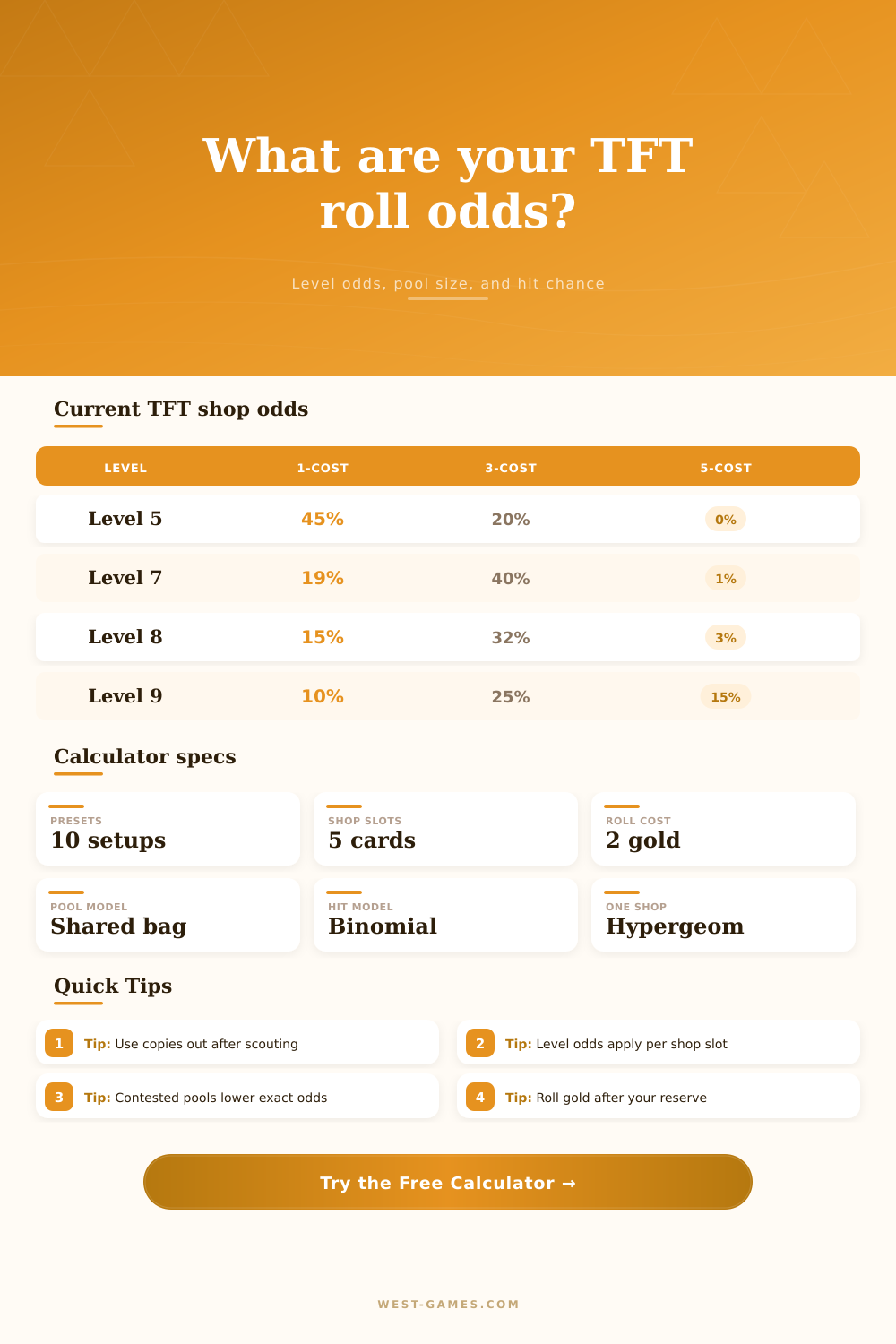
| Level | 1-cost | 2-cost | 3-cost | 4-cost | 5-cost |
|---|---|---|---|---|---|
| 1 | 100% | 0% | 0% | 0% | 0% |
| 2 | 100% | 0% | 0% | 0% | 0% |
| 3 | 75% | 25% | 0% | 0% | 0% |
| 4 | 55% | 30% | 15% | 0% | 0% |
| 5 | 45% | 33% | 20% | 2% | 0% |
| 6 | 30% | 40% | 25% | 5% | 0% |
| 7 | 19% | 30% | 40% | 10% | 1% |
| 8 | 15% | 20% | 32% | 30% | 3% |
| 9 | 10% | 17% | 25% | 33% | 15% |
| 10 | 5% | 10% | 20% | 40% | 25% |
| 11 | 1% | 2% | 12% | 50% | 35% |
| Cost | Copies | Best roll levels | Common target |
|---|---|---|---|
| 1-cost | 30 each | 4 to 5 | 3-star reroll |
| 2-cost | 25 each | 6 | 3-star reroll |
| 3-cost | 18 each | 7 | 3-star carry |
| 4-cost | 10 each | 8 to 9 | 2-star carry |
| 5-cost | 9 each | 9 to 10 | Legendary upgrade |
| Preset | Level | Cost | Goal |
|---|---|---|---|
| 1-Cost Slow Roll | 5 | 1-cost | 9 copies |
| 2-Cost Level 6 | 6 | 2-cost | 9 copies |
| 3-Cost Level 7 | 7 | 3-cost | 9 copies |
| 4-Cost Level 8 | 8 | 4-cost | 3 copies |
| 5-Cost Level 9 | 9 | 5-cost | 2 copies |
But then there’s this scenario: You’re down to forty gold and desperately need one particular card to fill out your board. You roll the shop only to find that you don’t get the card in question. Why? Because it’s a shared pool system, with each roll a separate event; your prior failures don’t matter to probability.
Learn math of the cards. The math is available from a shop calculator, but knowing how to interpret that math are essential for saving some gold. Players frequently confuse “chance to see this cost tier” with “chance to see this champion.” Depending off the number of shared-cost cards, you should adjust your hopes accordingly. Getting any of three roughly-similar champs? Your chances improves. Needing an exact card? That reduces your odds. Win/lose scenarios depends on whether you’re targeting broadly or narrowly.
How to Use Math to Save Gold
Another factor that will impact your odds are contested pools. Remember this is a shared bag game. Buying multiple copies of your desired card remove them from the pool for everyone permanently. That means there is fewer cards overall in the pool. Even if you’re swimming in gold, if someone else wants that card too, you’re not getting as high a hit rate. Be observant and take note of what’s already been taken by checking out their bench. If you notice a couple copies of your target on one person’s bench, make a mental note and shift your plans. Better to go with lower odds then to pretend they don’t exist.
The other thing probability tables don’t account for, however, is gold management. I mean, sure, you can keep rolling until the cows come home; but then what? You has a finite supply of gold. With this calculator, you can plug in how much gold you have now as well as how much you want to reserve. How do you make a concrete decision based off “I’ve got a forty percent chance” when all you have is one roll’s worth of gold? How do you know which number of rolls will get you to a comfortabley confidence level? Plug it in and the tool tells you how deep you need to go before you feel comfortable dropping gold.
But when should you roll? How should you go about rolling? The answer is that your level will change the probability distributions on card prices. If you’re level eight, rolling on a five-cost unit has few rewards. The shop will mostly be giving out cheap cards. Instead, you want to be around levels nine and ten before your chances of pulling an expensive unit increases. Check out this table of references showing how the shop alter with each level up. Early leveling feels dangerous: It’ll cost you some health, sure, but it opens up the range of possibilities required for late game heroes.
Don’t try to win every roll (instead), look at your options and pick the decision that has the best average result. That might be rolling all your gold, or stopping early to play what’s on your board. It depend on the situation. The calculator gives you the numbers; then it’s up to you to supply the context. Count the number of copies on the board, watch for them, and manage your gold actualy. You’ll know why the cards didn’t show up when they don’t. Blaming luck is simply blaming lack of calculation on probability, you should of used math.