Tarkov Armor Damage Calculator
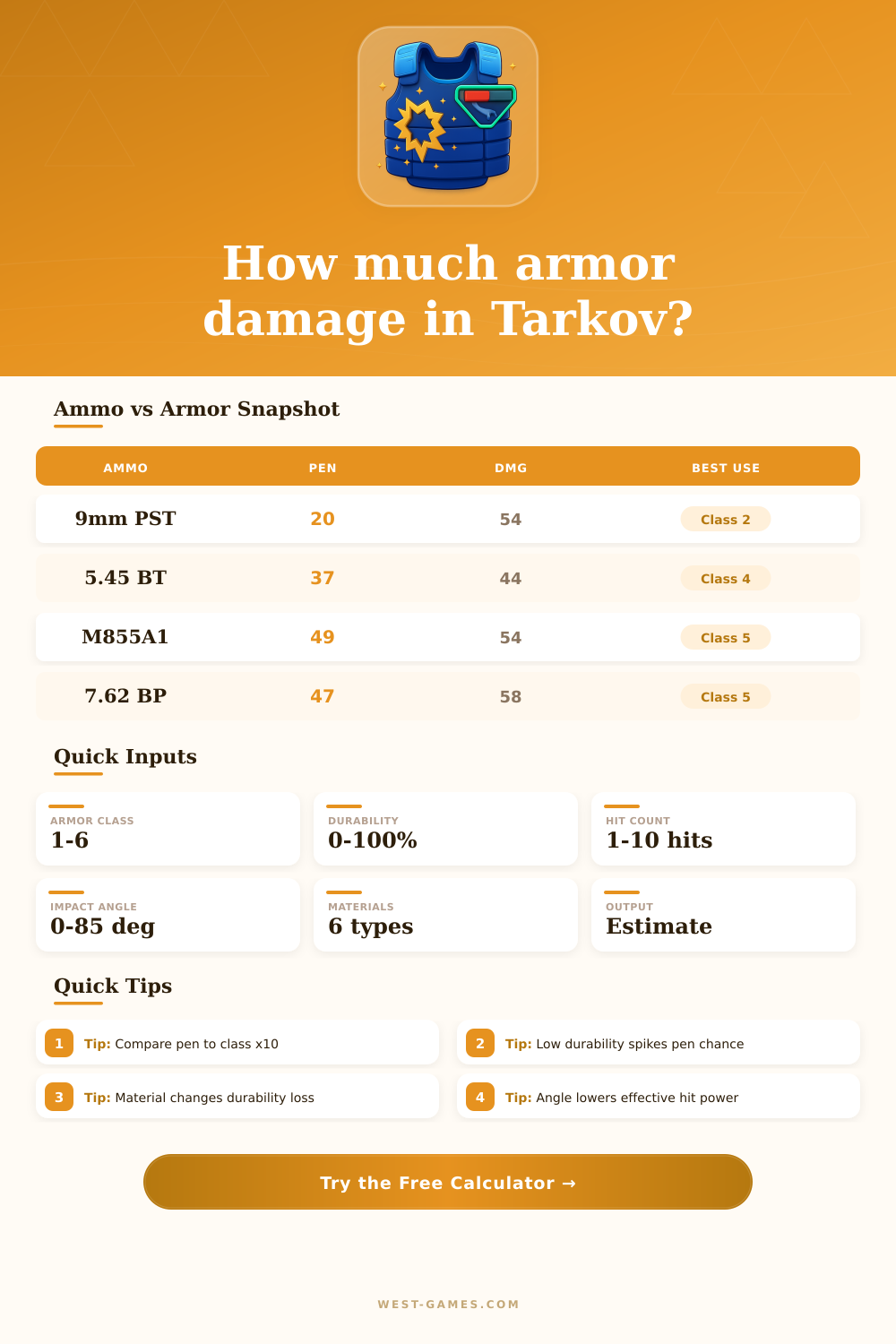
Estimate bullet penetration chance, armor durability loss, blunt trauma, post-armor flesh damage, and repair condition after repeated hits.
Full Damage Breakdown
| Pen vs Class | Likely Result | Armor Effect | Damage Note |
|---|---|---|---|
| Pen below class x10 by 15+ | Mostly stopped | Slow durability chip | Blunt damage only is common |
| Pen below class x10 by 5-14 | Low initial chance | Chance rises after hits | Repeated hits matter most |
| Pen near class x10 | Swingy outcome | Durability and material decide | Expect partial damage reduction |
| Pen above class x10 by 5-14 | Reliable penetration | Armor still shaves damage | High flesh damage reaches target |
| Pen above class x10 by 15+ | Overmatch | Armor loses relevance quickly | Most damage passes through |
| Material | Destructibility | Repair Behavior | Calculator Meaning |
|---|---|---|---|
| Aramid fabric | Very low | Usually forgiving | Lower durability loss, weaker class ceiling |
| UHMWPE | Low | Good retained condition | Strong effective durability for its class |
| Combined materials | Medium | Balanced | Middle durability loss and repair profile |
| Armor steel | Medium-high | Good repair recovery | Takes clear damage but repairs well |
| Titanium | Medium-high | Moderate recovery | Stable but not as efficient as poly |
| Ceramic | High | Poor recovery | Can crack down quickly after impacts |
| Ammo Profile | Flesh Damage | Pen Power | Armor Damage |
|---|---|---|---|
| 9x19 PST gzh | 54 | 20 | 33% |
| 9x19 RIP | 102 | 2 | 11% |
| 5.45x39 PS | 48 | 31 | 32% |
| 5.45x39 BT | 44 | 37 | 49% |
| 5.56x45 M855A1 | 54 | 49 | 44% |
| 7.62x39 BP | 58 | 47 | 63% |
| 7.62x51 M80 | 80 | 41 | 66% |
| 7.62x51 M61 | 70 | 64 | 83% |
| 12/70 AP-20 slug | 164 | 37 | 65% |
| Repair Input | Max Condition Factor | Estimator Effect | When to Use |
|---|---|---|---|
| Fresh or near-perfect max | 100% | Uses listed max durability | New armor, strong trader repair, clean found item |
| Lightly repaired max | 92% | Caps usable max slightly lower | One or two normal repairs |
| Heavily repaired max | 82% | Raises relative wear pressure | Repeatedly repaired armor |
| Scavenged poor max | 70% | Treats the plate as fragile | Damaged loot or emergency kits |
In the game Tarkov, the outcome of a bullet hitting armor depend on several different variables. These variables include the penetration of the bullet, the durability of the armor, the material type of the armor, and the number of hits that that armor has taken. Each of these variables can be entered into the provided calculator so that the calculator can provide an accurate estimation of the variables of that bullet hitting armor; spesifically, the penetration chance of the bullet, the remaining durability of the armor, and the flesh damage that the bullet can cause.
Each of these variables will combine to create a realistic representation of the interaction between armor and bullet during a fight. Penetration is not a value of the bullet alone, but also of the armors effective protection score. The armor’s effective protection score rely upon two factor: the armor durability and the armor material type.
How the Armor Calculator Works
Those who play the game often note that bullets can penetrate armor plates more easly after they have hit them multiple times. This is due to the fact that the material of that armor may crack after those shots. As a result, identical round may hit the same armor with different results; the first round may weaken the armor, but the second round may find an opening in the armor for the bullet to penetrate the armor.
Armor durability is one of the main factor in the outcome of bullet penetration because armor durability impacts the armor’s effective protection score. Armor that is fresh will have full durability listed for the armor; however, armor that is repaired will begin with a lower durability maximum. The repair condition for armor can be entered into the calculator for estimations of the difference between fresh armor and repaired armor.
Armor that has been heavily repaired may fail at a lower durability than armor that has not been repaired. Armor that has been scavenged may also fail earlier than armor that is new; scavenged armor typically has lower armor durability than armor that is new. Another of the factors that impacts the outcome of bullet penetration is material type.
Material type impacts the rate at which armor durability can be lost. Armor made of aramid or UHMWPE material will lose its armor durability slow. Ceramic and combined materials will typically stop high-penetration bullets on the first impact, but may degrade quickly after the first bullet impact.
These different types of armor can be factored into the calculator to provide an accurate estimation of durability loss and remaining armor condition for each material type. Another of the variables that may impact the outcome of penetration is angle and distance. Bullets that impact armor at an oblique angle will have less penetration power than bullets that are directly aimed at the armor; however, bullets that impact armor at a close range will have the same power as the original bullet.
The calculator accounts for these two variables in the penetration score that is displayed. By including these two variables, the armor penetration calculator can help prevent players from entering into engagements with opponents with the assumption that every fight will be at a point-blank range. The number of hits that an armor take is a variable that changes armor.
Armor may be able to stop a round and protect the wearer after one hit; however, armor will be weaker after that round impacts the armor. By entering the number of hits into the armor penetration calculator, the armor penetration calculator will model the outcome of each additional round. The outcome of each additional hit will show an increased level of flesh damage.
This sequence of events can help players to decide whether or not they should continue in the fight or whether they should reposition to avoid fire from the opponent. One last factor that you should of considered is blunt trauma. Blunt trauma impacts players even if it does not show up on the kill feed for the player.
Blunt trauma removes health points from a player, and may also impact the movement of that player. By separating blunt trauma from penetrating damage by armor, the armor penetration calculator can provide players with a true estimate of the health of a player after each engagement. This separation of blunt trauma and penetrating damage can help players to understand the difference between high damage, low penetration rounds as opposed to low damage, high penetration rounds.
Finally, players may utilize this penetration damage calculator to make repair decisions for armor after a fight has taken place. By entering the amount of armor durability that is remaining for each players armor, and by entering the armor repair condition, players can determine whether the armor is worth keeping or not. If armor drops below a certain durability after just a few rounds, the player should replace the armor.
The ability to understand each of these variables ensures that players wont guess at whether a bullet will be able to defeat armor. Instead, players can use the armor penetration calculator to determine the outcome of each round so that they can adjust their armor loadout or positioning on the battlefield.