Speedrun Pace Calculator
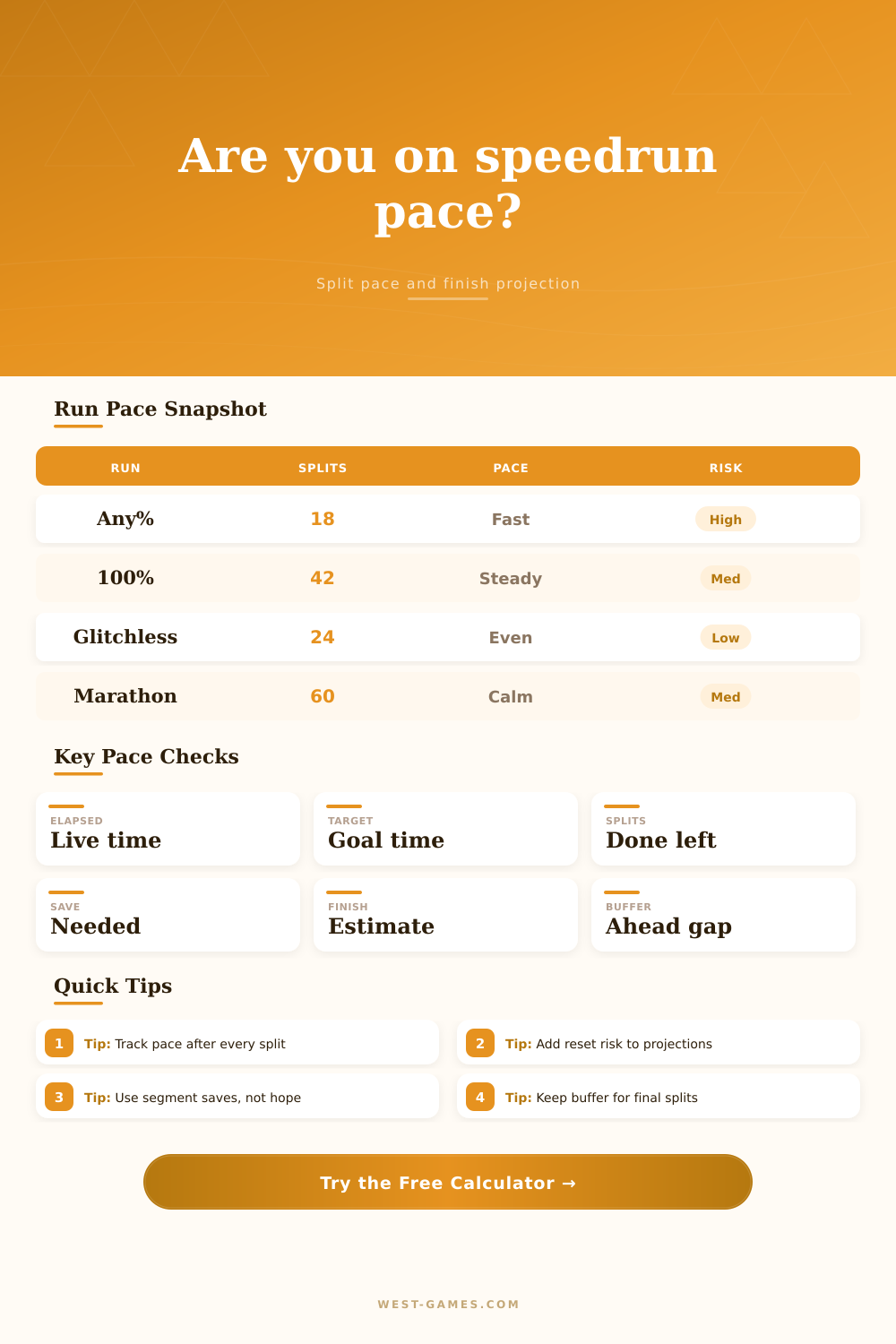
Compare current elapsed time, completed splits, average pace, remaining segments, possible time save, and projected finish against your target.
Run Breakdown
Any%
Short routes amplify every early mistake. A small late-game save pool can still rescue pace if the remaining splits are stable.
Glitchless
Even pacing matters more than spike saves. Compare projected finish to target before deciding whether to push risky movement.
100%
Longer split lists hide drift. Use current average pace and remaining segments to catch slow collection loops early.
Randomizer
RNG and routing variance make the risk buffer important. A strong projection still needs room for forced detours.
| Run Structure | Typical Splits | Best Pace Check | Projection Note |
|---|---|---|---|
| Short Any% | 8 to 18 | Elapsed versus target | Use small risk buffers because one mistake can dominate the finish. |
| Medium Glitchless | 18 to 30 | Average split pace | Remaining pace tends to be predictable when route order is fixed. |
| Long 100% | 30 to 70 | Run done percentage | Segment count matters because small losses repeat over many objectives. |
| Randomizer | Variable | Risk-adjusted finish | Keep extra buffer for routing, item logic, or encounter variance. |
| Pace State | Target Delta | Runner Read | Best Action |
|---|---|---|---|
| Green | 60s ahead or more | PB pace with usable buffer | Protect consistency and avoid unnecessary route risks. |
| Amber | 1s to 59s ahead | Good pace but fragile | Spend gold split attempts only where execution is familiar. |
| Even | Within 30s behind | Still salvageable | Compare required remaining pace to your realistic segment average. |
| Red | Over 30s behind | Needs major save | Continue for practice unless the save pool clearly covers the deficit. |
| Remaining Profile | Multiplier | Use Case | Calculation Effect |
|---|---|---|---|
| Clean endgame | 0.92x | Known final splits with strong execution | Reduces base remaining time before save and risk are applied. |
| Normal pace | 1.00x | Balanced run with no unusual risk | Uses average pace directly for the remaining split estimate. |
| Technical late splits | 1.08x | Late tricks, bosses, or tight cycles | Adds execution drag before subtracting possible time save. |
| Marathon fatigue | 1.25x | Long runs or multi-hour category attempts | Raises projected finish to reflect focus decay and safety strats. |
| Input | What It Measures | Common Mistake | Cleaner Entry |
|---|---|---|---|
| Elapsed time | Live timer at the latest split | Entering best possible time instead of actual time | Use the number currently shown by your timer. |
| Average pace | Expected time per remaining segment | Using a gold pace as the average | Use route average or realistic practice pace. |
| Time save | Seconds that can realistically be gained | Counting every theoretical save | Include only saves you can hit during attempts. |
| Risk buffer | Expected lost time from mistakes | Leaving it at zero on volatile runs | Add seconds for RNG, cycles, and safety movement. |
There’s also a kind of anxiety you get with three hours left on your run, and you’re realizing that maybe section four was a bit ambitious. Every second you don’t make a jump or hesitate a little the problem grows. It feels like an hourglass with sand dribbling down faster and faster, and gap is closing. Panic sets in, and you start rushing through sections where being precise are key. This results in mistakes, which lead to more rushing. Before you know it, you’ve gone full-on meta-loop. That’s how good runs turns into bad ones.
You want something that will help you remove yourself from all the madness and just look at numbers, without letting your feelings color what they tell you. Once you’ve input your goal finish time and your elapsed time, the calculator does all the math for you. It take into account the most important factors and predicts your finish time. That way, you don’t have to do any math in your head with adrenaline coursing through your veins (you can save that thinking for later).
How to Manage Your Speedrun Pace
It asks two questions: How far left do I have to go? And realistically, what is my pace going to be? The tool help you predict your finish time by looking at both of these factors. You’ll see if you’re on pace or if you should use your buffer. All too often, this is why runners miss their goal: they view each segment as an independent event instead of part of a bigger picture.
The other thing that trips folks up on this one is understanding the risk buffer. The tool allows you to enter in seconds to account for random cycles, deaths, and menu navigation. Why? Because speedruns aren’t about perfection. Speedruns are about damage control. When you have zero risk buffer, you’re setting yourself up to be thrown completely out of whack if there’s some kind of minor hiccup. In other words: you’re taking a gamble that everything’s going to go exactly right. In high-variance games, that’s a losing bet. Adding those seconds give you a margin of error that can absorbs what would of otherwise be a terribel mistake and turn it into something manageable.
Then there’s the segment profile setting. Late game segments can has complicated mechanisms or be fatiguing, which slows you down more than earlier segments. So not all time left are created equal. Your multiplier on the time left adjust based off the marathon fatigue or technical difficulty of the segment profile you choose. It doesn’t let you make the typical error of thinking that your current speed will just keep going like that until the finish. That naturaly decays over longer runs and this takes into account that reality.
The page includes reference tables to help put those inputs in context depending on what kind of run you’re doing. A hundred-percent long run will react very differently to mistakes compared to a short sprint of any intensity, where even a single bad segment can totaly blow your run. Small losses compound slowly over time during a long run, and there’s lots of opportunity for recovery. Understanding which bucket your run fits into will guide whether you should be aggressive with your reading of the projected finish. Seeing that you’re just slightly off the pace on a long RPG run? Sometimes it’s best to keep consistent rather than forcing risky moves that might cause you to reset from scratch.
The other input is gold split potential. This is the number of seconds you could save by pulling off saves that is repeatable under pressure. The temptation here is to inflate this based off highlight reel fantasy numbers which will skew the prediction towards false hope. Only add saves that you can repeat when pressured. If something comes up one time in ten, don’t add that to your standard pace calculation. Add that to your risk assessment.
The key here is that optimizing each second isn’t necessarily the objective: managing the run as a whole is what matters most. This tool give you a picture of how far along you are in the race compared to your world record or personal best goal. Are you ahead? Do you have wiggle-room for risk-taking, or should you play it safe? It takes the guesswork out of pace management and lets you worry less about whether you’re ahead or behind since you have the facts, letting you focus more on executing. Your instincts might be screaming one way or the other but trust the data; protect your buffer and allow the run to play itself out at a natural, steady pace.