RimWorld Armor Calculator
Estimate pawn protection from sharp, blunt, and heat armor after quality, material, apparel layers, body coverage, role needs, movement penalty, and raid hit-type mix.
This is a planning estimate using RimWorld-style armor roll behavior: armor after penetration can deflect, halve, or allow damage through.
Pawn Protection Estimate
| Armor suite | Typical sharp | Typical blunt | Movement profile |
|---|---|---|---|
| Flak vest plus duster | Good torso, weaker limbs | Moderate | Fast enough for shooters |
| Recon armor set | Reliable against firearms | Moderate to good | Strong mobility |
| Marine armor set | High all-around armor | Good | Noticeable penalty |
| Cataphract armor set | Very high | Very good | Slow but sturdy |
| Phoenix heat kit | High | Good | Best where fire is common |
| Quality or material | Sharp effect | Blunt effect | Heat effect |
|---|---|---|---|
| Good to excellent quality | Raises practical deflect odds | Helps against clubs and fists | Useful for fire weapons |
| Plasteel heavy armor | Strong sharp emphasis | Good blunt support | Average heat help |
| Devilstrand textile | Solid for outerwear | Limited blunt help | Excellent heat resistance |
| Hyperweave textile | High textile protection | Better than most cloth | Excellent heat resistance |
| Uranium armor material | Heavy and serviceable | Strong blunt emphasis | Low heat emphasis |
| Threat mix | Sharp share | Blunt share | Heat share |
|---|---|---|---|
| Tribal raid and manhunter pack | Medium | High | Low |
| Industrial firearm raid | High | Low to medium | Low |
| Breach raid with grenades | Medium | Medium | Medium |
| Mechanoid cluster | High AP sharp | Medium | Medium heat |
| Infestation melee hold | Low sharp | High blunt | Very low |
| Pawn role | Protection target | Movement target | Coverage priority |
|---|---|---|---|
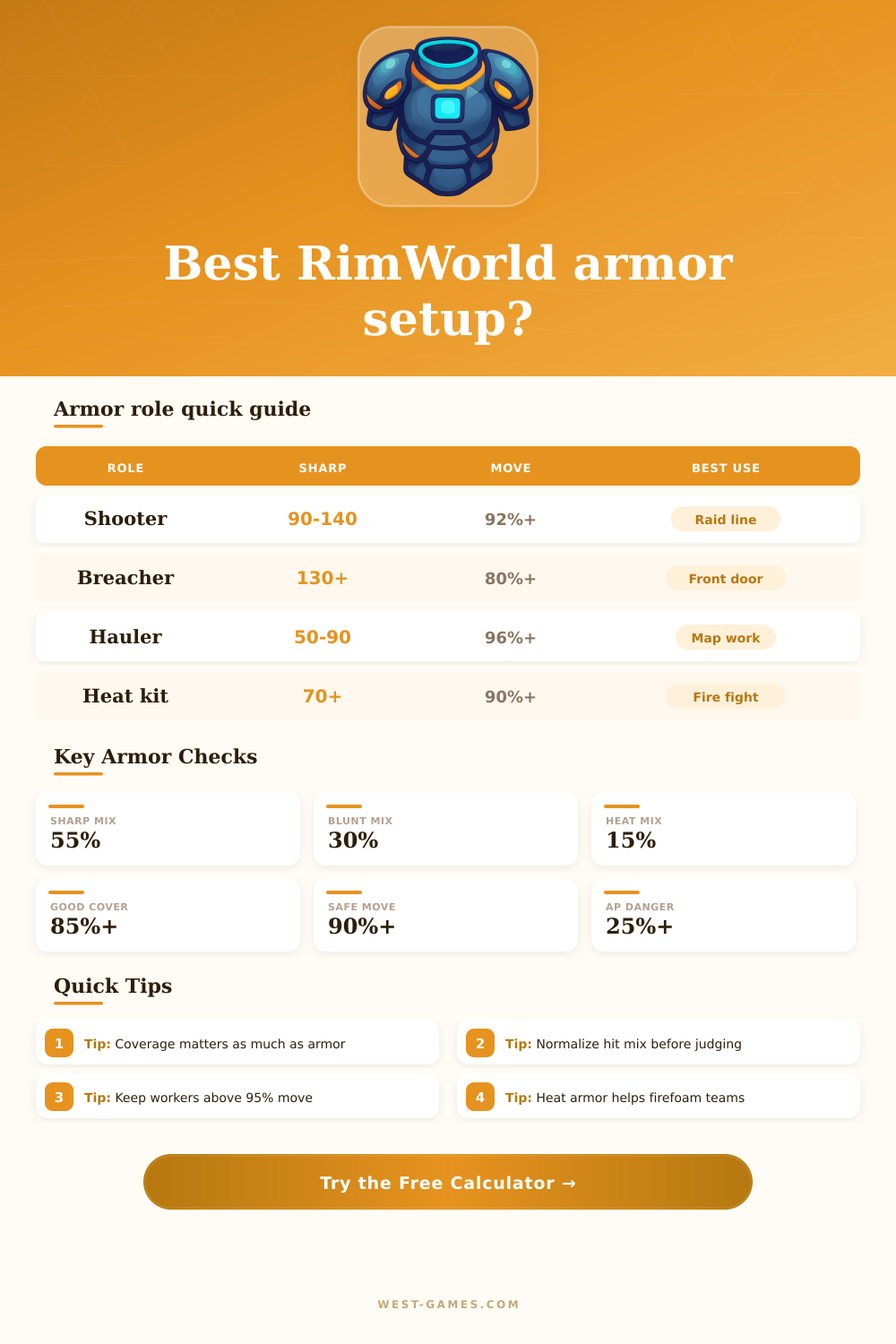
| Rifle line shooter | Balanced sharp reduction | At least 90% | Torso and head first |
| Door breacher | Maximum sharp and blunt | At least 80% | Full body coverage |
| Skirmisher | Enough to survive a mistake | At least 94% | Head and torso |
| Base worker | Light emergency protection | At least 96% | Torso first |
| Firefoam responder | Heat and burn control | At least 90% | Outer layer heat |
Armor is a system of protection that can be evaluate on the basis of several differently factors. Armor isnt a single number, but there are several different factor to consider regarding the armor that a player purchases for a pawn. For instance, you should consider the types of armor that a pawn will encounter (sharp, blunt, and heat armor), how much of the body is to be armor, and how the armor will impact the movement of that pawn.
Because armor can reduce the movement of a pawn, heavy armor for a pawn will reduce the speed at which that pawn can move across the maps. Thus, a slow pawn is more likely to take shots from enemy before it can reach the armor that it can use to protect itsels. Depending upon the type of damage that a player is likely to encounter, there are different type of armor that should be purchased for a pawn.
How to Choose Armor for Pawns
For instance, because sharp damage is the most common type of damage encountered from bullets, arrows, and mechanoid weapon, sharp protection is the type of armor that is the most important for most pawn to purchase. Blunt protection is important for those enemies with clubs, explosions, or those who attacks melee. Finally, heat protection is important for those who face fire-starting enemies.
Since most enemies will feature some form of sharp, blunt, and heat damage, players should adjust the percentage of protection that armor provide to these categories in a calculator to ensure that armor is purchased that reflects the type of threat that are common on that specific map. Another factor to consider is the degree to which armor will cover the body of the pawn. Armor of high protection level may not provide armor for the legs, for instance.
Should those body parts be exposed to incoming fire from enemies, the pawn may be injured. Thus, it is important to use a calculator to determine whether purchasing a helmet or armor that cover more of the body will provide enough protection for that pawns body, as protecting the body is more important than increase the armor level of a single type of armor. Finally, another category of factors to consider for armor includes the material of that armor and the quality of that armor.
For instance, plasteel will increase protection against sharp damage, while uranium will increase protection against blunt damage. Armor make of devilstrand and hyperweave will increase protection against heat damage, which is why many who work with firefoam use such armor even if the sharp protection provided by the armor is lower than other armor of the same quality. Additionally, higher quality armor will provide more protection than lower quality armor.
Thus, armor loadout can be compared with one another using a calculator to account for these factor. Additionally, the threat level of the enemies that a pawn will encounter will impact the effectiveness of armor. For instance, if the threat level is low in terms of armor piercing ability, then most of the armor rating of the pawn will survive the attacks of enemies.
However, if the threat level is high, as with mechanoids with high armor piercing abilities, then many of the armor rating of that pawn will be stripped away before the armor can begin to provide protection for the pawn. Thus, players can adjust the threat level in the armor calculator to reflect the type of pawn that will be playing, since adjustment of the threat level may have a greater impact upon the calculation than alteration of the armor material. Armor should also be match to the role of the pawn.
Thus, it is not necessary to purchase armor for each pawn that reflect the same level of protection. For instance, marine suit have high levels of sharp protection, but they may not be ideal for pawns that require those pawns to move quick. Additionally, breacher may be able to wear armor that is heavy in the protection of their body, since they will be standing in the breach.
However, a hauler, for instance, may not be able to wear armor of this type due to the need for that pawn to move quick. Thus, armor that provides excessive protection for the pawn may not be worth the cost of the reduction of the movement of the pawn if that armors movement restriction is to that pawns role requirement. It is important to avoid the mistake of trying to find one perfect armor loadout for every pawn in the game.
For instance, many may attempt to give every pawn the maximum level of armor against sharp damage. However, this armor will likely result in the death of hauler, for instance, who will be killed while they are moving across the open ground of the map. Instead, different armor kit can be created for different types of pawns and roles.
For instance, a shooter kit, breacher kit, or light worker kit can each have their own set of armor that is calculate using the armor calculator. By calculating the armor for each type of pawn, players can make certain that the armor that each pawn recieve is the armor that is most suited to that pawns role and responsibility.