Race Stint Length Calculator
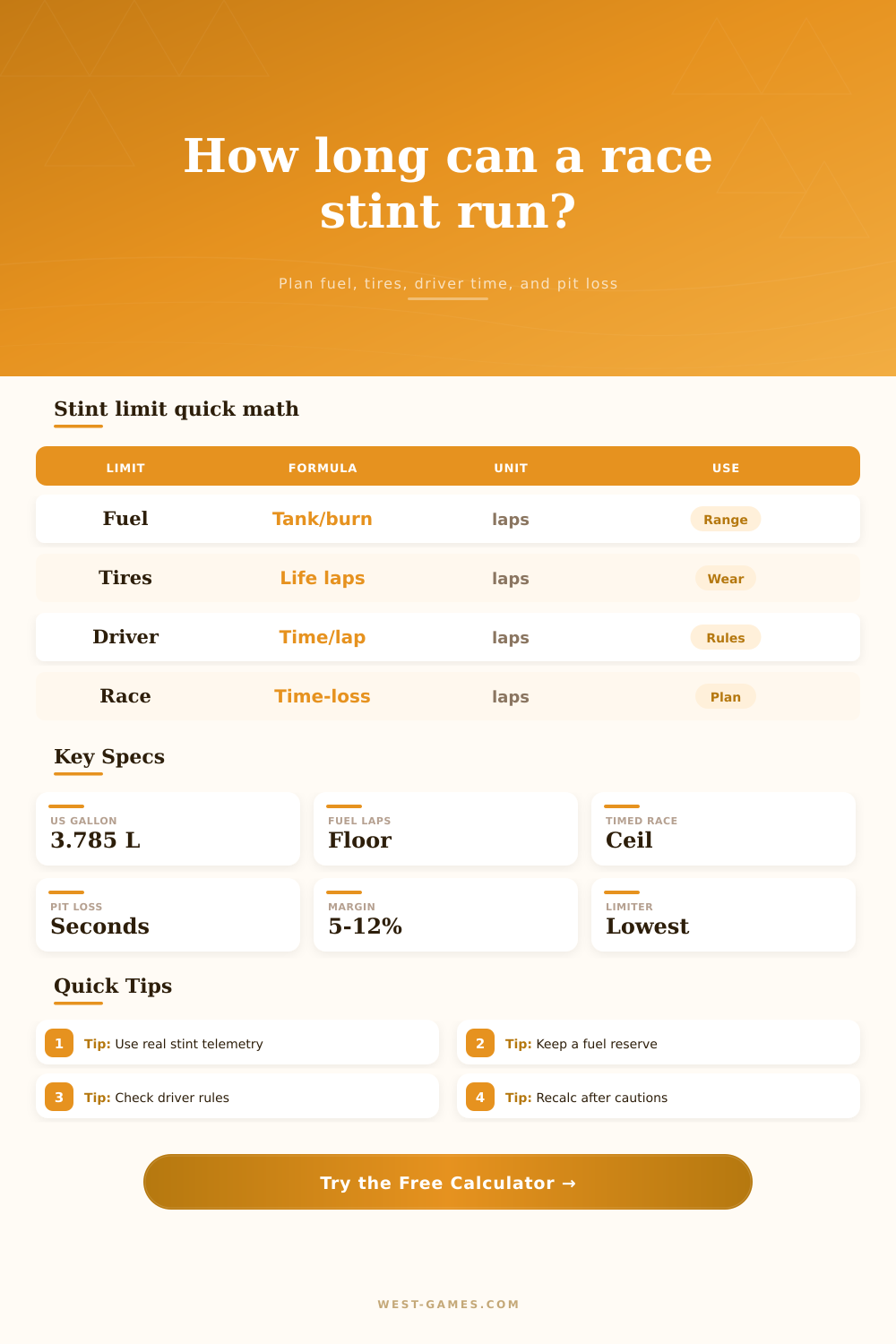
Find the practical laps per stint by comparing fuel tank range, tire life, driver time limit, race duration, mandatory stops, pit loss, and safety margin in liters or gallons.
Formula Breakdown
| Limiter | Formula | Rounding | Why it matters |
|---|---|---|---|
| Fuel tank range | floor((usable tank liters / fuel per lap) / (1 + safety margin)) | Down | Prevents planning a lap that cannot be fueled with reserve. |
| Tire life | entered tire life laps | Down | Caps stint length when tire drop-off arrives before fuel runs out. |
| Driver time | floor(driver limit seconds / average lap seconds) | Down | Converts a time rule into the maximum legal lap count. |
| Timed race laps | ceil((race seconds - pit loss seconds) / average lap seconds) | Up | Ensures the plan covers the likely last scored lap. |
| Fixed race laps | entered lap distance plus extra laps | Exact | Uses the race distance directly when the event is lap based. |
| Preset | Format | Tank / Burn | Tire and Driver | Strategy use |
|---|---|---|---|---|
| GT3 60 min | Timed | 120 L / 2.75 L lap | 34 laps / 65 min | Checks if fuel or tire life blocks a no-stop sprint. |
| GT4 sprint | Timed | 100 L / 2.10 L lap | 36 laps / 70 min | Useful for slower pace races with longer tire windows. |
| Formula fixed laps | Fixed | 95 L / 2.60 L lap | 28 laps / no limit | Shows whether tire life forces a split in a lap race. |
| Prototype double | Timed | 75 L / 2.95 L lap | 31 laps / 55 min | Balances driver stint length with a smaller usable tank. |
| Oval 100 laps | Fixed | 83 L / 1.85 L lap | 42 laps / 70 min | Highlights pit count in long lap-distance events. |
| Input type | Used for | Calculation behavior | Planning note |
|---|---|---|---|
| Timed race duration | Total expected race laps | Subtracts planned pit loss before dividing by lap time. | More stops can slightly reduce green-lap count in timed sessions. |
| Fixed race laps | Exact scored distance | Uses the lap count directly and adds extra formation laps for fuel. | Pit loss affects track position, not distance required. |
| Mandatory stops | Minimum pit count | Raises pit stop count when rules require more stops than math does. | Extra stops shorten the planned stint target. |
| Extra laps | Formation and cooldown fuel | Adds laps to the fuel plan after race-lap estimate. | Use 1 or 2 when the sim burns fuel outside green laps. |
| Reference | Value | Formula | When to use |
|---|---|---|---|
| US gallons to liters | 1 gal = 3.785 L | gallons x 3.785411784 | Convert tank and per-lap burn into the calculator base unit. |
| Liters to US gallons | 1 L = 0.264 gal | liters / 3.785411784 | Display stint fuel in gallons after calculation. |
| Safety margin fuel | 5% to 12% | planned laps x burn x margin | Add reserve for traffic, weather, cautions, and lift variations. |
| Usable tank | 90% to 100% | tank x usable percent | Use lower values if the sim has pickup or reserve behavior. |
Your meeting with strategy is over and the green flag flies. You’re on track chasing your lap times as needle on the fuel gauge ticks down. The difference between a frustrating spin and front row finish can be just a handful of laps.
You don’t drive hard all race long. Knowing when to make that stop comes down to these 3 thing. These are your tire wear, your fuel level, and clock ticking down until it’s time to hand off to someone else.
How to Plan Your Race Strategy
There’s an obvious constraint: Fuel capacity. However, this is also where many people gets confused. They think they can squeeze all of the fuel out of their tank. The truth is your fuel burn change depending on engine load and aerodynamics. Defending position burns more fuel then a clean lap. The calculator accounts for this when you input your average burn rate. That way you won’t have to guess at how much additional fuel you’ll require due to congestion. Inputting your burn rate based off qualifying speed will skew your data (qualifying laps are outliers). Use race pace as your benchmark.
Tires has a limited lifespan. Tire life is a subjective element of racing. Do you drive them until they’re down to the rim? Or do you pit out when they still have some meat left so as not to sacrifice front end stability? The tool allow you to set tire life limit that suits your comfort zone. Aggressive? Stretch the number for longer stints. Conservative? Reduce it to maintain consistent lap times. Is there a right answer? No. It’s a matter of choosing reliability versus speed per lap. How important is best lap time compared to protecting the final sector?
Endurance races also throw in driver time limits. Many of these multi-driver event have time limits on each driver. So even though you may have decent tires and fuel, the time limit will soon arrive. Violating that causes penalties which are a race killer. To determine whether your driver window is limiting your stint, the calculator factors in your specific driver window. And sometimes yes it does. And other times no it doesn’t. Either way knowing what’s capping your run allows you to modify your approach. If it’s tires, then you start focusing on tire saving. If it’s fuel then you’re managing the lift.
Timed races is hurt by pit loss. A second spent in the pit lane is a second that isn’t spent on track. That time will be reducing your green flag time in a 60-minute sprint race. Your estimate of how long it takes to stop means that you take out estimated pit loss and subtract it from overall length of the session. So now you have a realistic count of how many laps you’ll run based on number of laps you’re planning. You don’t want to plan for too many laps just because you forgot about all the dead time. It’s a small adjustment in spreadsheet but it makes a big difference on the timing screen.
Ultimately, racing is a game of resource management. Light rain or overcast skies affect tires. Fuel consumption goes up too. When the track surface has changed, you’ll find the top teams recalculating their plan. They will no longer stick with the morning game plan.
Light rain or overcast skies affect tires. Fuel consumption goes up too. When the track surface has changed, you’ll find the top teams recalculating their plan. No more sticking with the morning game plan. See the reference table on the page to understand what those presets do in changing conditions. How does that dry profile compare to a wet profile? That’s not a drive-harder issue. It’s an adapting-the-numbers-to-conditions issue.
Resource management. Every race is a game of resource management. How much tire grip do I need? How much gas do I have left in the tank? Stretch them as far as possible but not so far that you break one or the other and lose. The calculator frames this up for you. Take the guesswork out of simple math.
But it doesn’t know what it’s like behind the wheel when the back end starts to slide in that last corner. That takes instinct and experience. Set your starting strategy with the tool. And go with your gut when things get crazy out there.
You should of used this sooner. It is actualy very helpful for racing.