⚔ Pathfinder Stat Calculator
PF1e ability scores, point-buy totals, AC, saves, HP, and combat math in one build planner.
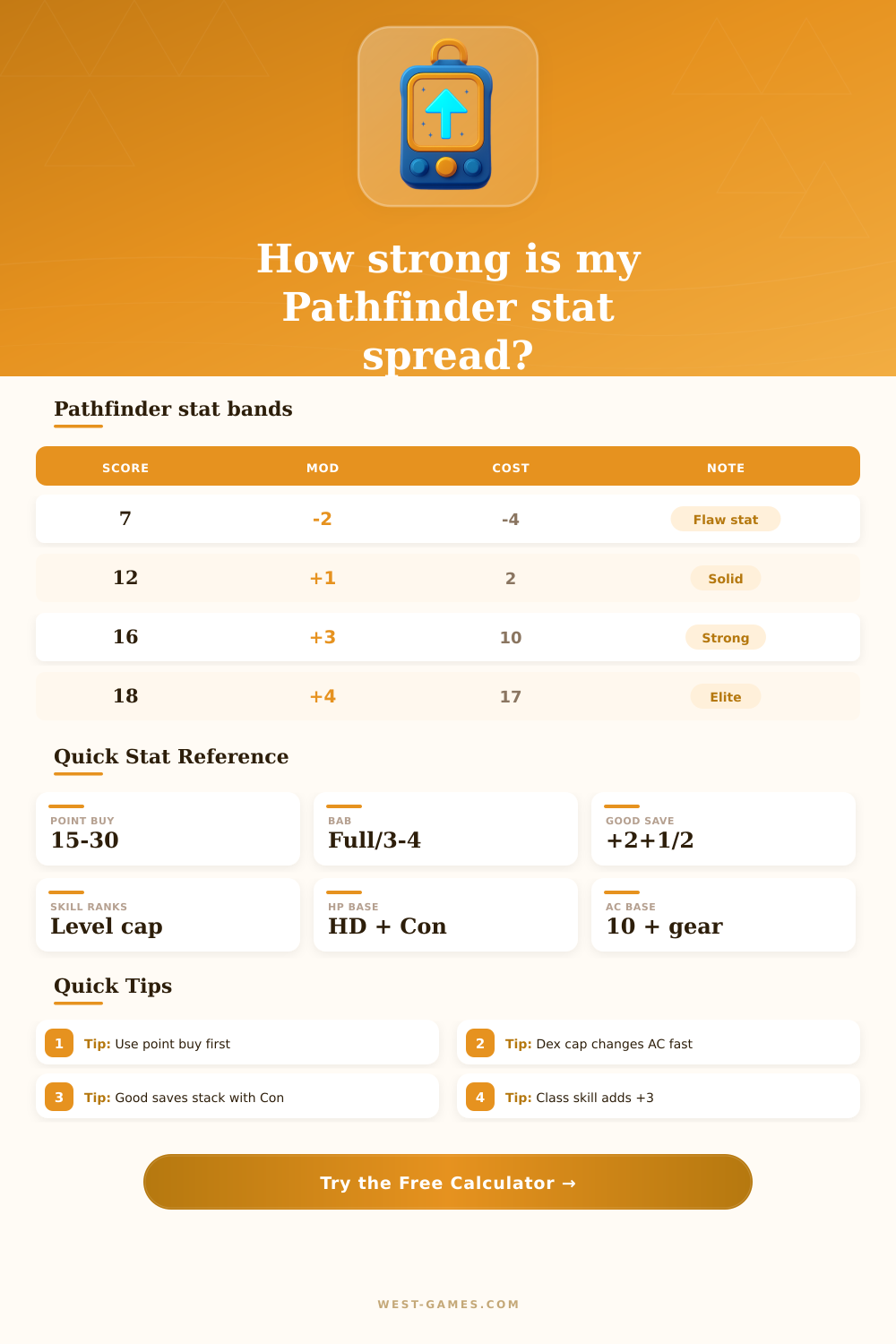
| Score | Modifier | Point-buy | Use case |
|---|---|---|---|
| 7 | -2 | -4 | Flaw stat |
| 10 | +0 | 0 | Baseline |
| 14 | +2 | 5 | Strong |
| 18 | +4 | 17 | Elite |
Pathfinder ability modifiers use the standard floor((score - 10) / 2) formula, so even changes matter fast around odd scores.
| Type | Formula | Level 5 | Level 20 |
|---|---|---|---|
| Full BAB | Level x 1 | +5 | +20 |
| 3/4 BAB | Floor(.75L) | +3 | +15 |
| Good save | 2 + half L | +4 | +12 |
| Poor save | Floor(L/3) | +1 | +6 |
These progressions are the backbone of most Pathfinder class stat blocks, especially when you compare martials, hybrids, and full casters.
| Role | Array | Focus | Feel |
|---|---|---|---|
| Melee | 18/14/14 | STR | Direct |
| Skirmish | 12/18/14 | DEX | Agile |
| Caster | 8/14/12 | INT | Control |
| Leader | 14/12/14 | WIS | Support |
Use these stat line patterns as a quick reality check when your point-buy budget starts squeezing too hard.
| Armor | Bonus | Dex cap | Notes |
|---|---|---|---|
| Padded | +1 | +8 | Very light |
| Chain shirt | +4 | +4 | Mobile |
| Breastplate | +6 | +3 | Balanced |
| Full plate | +9 | +1 | Heavy |
Dexterity cap matters most when your build is agile enough to outgrow the armor's ceiling.
When creating a character for the game Pathfinder, there are a few different aspect that must be considered to ensure that the character is effective. Most notably, the character must have an appropriate distribution of there ability scores, as each of these ability scores will determine the character’s effectiveness in the game. Each of these ability scores provide some benefit to the character, but increasing one ability score will require decreasing another ability score due to the budget that is provided to purchase those scores.
Strength is an ability score that can improve a character’s melee attack performance, as well as provide bonuses to various combat maneuver. Dexterity is an ability score that can improve ranged attack performance, as well as provides bonuses to dodging attacks from enemy. However, the armor that they wear also limits a characters dexterity.
Choosing Ability Scores for a Pathfinder Character
Constitution is an ability score that increase the number of hit points that a character has, as well as provides bonuses to Fortitude save. Intelligence, Wisdom, and Charisma all relate to the number of skill rank that a character has, as well as effectiveness with spells (if a spellcasting character) or social interaction. The point-buy system for Pathfinder is used to ensure that all characters is balanced in their capabilities.
Each score has a base value of 10, but each additional point cost more points in the budget. For instance, a score of 14 will cost relatively few point to purchase with the character’s budget, but a score of 18 will cost more points in the budget. It is generally recommended to avoid odd number for ability scores unless those scores are to be increased later with another game bonus.
A character’s effectiveness in combat rely upon a few different mathematical calculation. One calculation is for Base Attack Bonus, which vary by character class, and is used to add to attack roll to determine if the character hits the designated target. Armor bonus can be added to a character’s Armor Class to improve their defense against incoming attacks, but any bonus to Armor Class due to Dexterity can be limited by armor type.
For instance, a character with high Dexterity but wearing heavy armor will not benefit from their high Dexterity score. Additionally, Touch Attack Bonus is separate from armor and ignore armor bonuses, and only value bonuses to Dexterity and deflection ability. Each character has various types of save that their ability scores must determine.
Fortitude saves are based upon Constitution score, Reflex saves are based upon Dexterity score, and Will saves are based upon Wisdom score. A low score for any of these abilities will result in a poor saving throw value, exposing the character to potentially dangerous enemy attack. Finally, hit points determine a character’s chance at survive combat.
The character calculates hit points with their hit die, their Constitution score, and their level. The role that a character will play within the game will indicate which ability should be prioritized when building the character. For instance, a melee fighter will want higher score for Strength and Constitution.
A ranged character or skirmisher will want higher score for Dexterity for both attack accuracy and Armor Class. Finally, a spellcaster will want to prioritize the mental ability score required for their spells to have a higher success rate; the higher the score for that mental ability, the lower the Difficulty Class for their spells. Finally, attempting to increase each of an character’s abilities at once will result in an average score for each ability score; the character may not be strong enough in any one area for their role.
There are some common mistake that should be avoided when building a character. For instance, decreasing an ability score too low could make a character unable to pass some skill check. Increasing Dexterity but wearing armor that limits Dexterity bonus to Armor Class is another mistake.
Finally, not utilizing all available skill rank is yet another mistake; failing to use these bonuses will create an inefficient character build. Thus, before finalizing a character build, each of these aspect should of been tested to ensure effectiveness.