⛏ OSRS Delve Drop Rate Calculator
Estimate Doom of Mokhaiotl Delve reward odds from claimed depth, unique denominator, target reward, personal team share, planned completions, dry streak, and completions per hour.
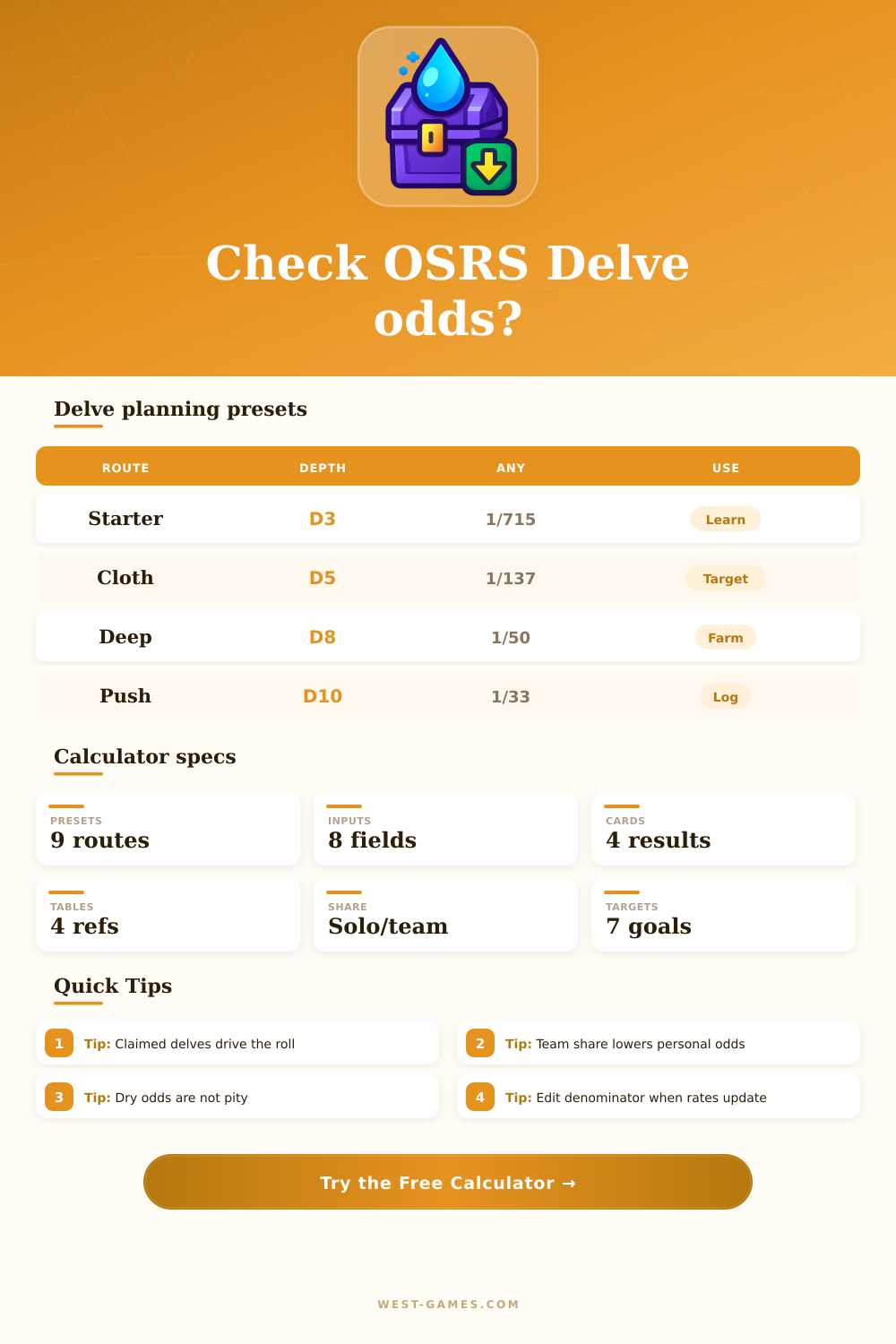
| Claim depth | Planning denominator | Route feel | Typical use |
|---|---|---|---|
| Delve 3 | 1 in 715 | Learning claim | Demon Tears start |
| Delve 5 | 1 in 137 | Early farm | First unique chase |
| Delve 8 | 1 in 50 | Deep claim | Any unique farming |
| Delve 9 | 1 in 39 | Riskier chain | Efficient stop point |
| Delve 10 | 1 in 33 | Deep push | Log progression |
These are editable planning defaults drawn from commonly shared community-style Delve calculators. Always replace the denominator if your source or patch notes differ.
| Goal | Weight used | Formula | When to use |
|---|---|---|---|
| Any Doom unique | 100% | 1 / denom | No specific target |
| Mokhaiotl cloth | 33.33% | Any / 3 | Single unique chase |
| Eye of Ayak | 33.33% | Any / 3 | Specific upgrade |
| Avernic treads | 33.33% | Any / 3 | Boot target |
| Two missing uniques | 66.67% | Any x 2/3 | Partial log hunt |
If a pet or special reward uses a separate roll, choose the special target option and enter that roll's denominator directly.
| Share divisor | Meaning | Personal effect | Best input |
|---|---|---|---|
| 1.0 | Solo or personal loot | Full chance | Solo Delves |
| 2.0 | Even duo split | Half chance | Duo share |
| 3.0 | Even trio split | One third | Small group |
| 4.0 | Four-way split | One quarter | Team split |
| Custom | Uneven share | Manual divisor | Clan rules |
Use the divisor that matches your personal expected share of the reward. For pure personal loot, keep the divisor at 1.
| Milestone | Attempts vs rate | Dry chance | Interpretation |
|---|---|---|---|
| 50% | 0.69 x rate | 50% | Coin-flip point |
| 63.2% | 1.00 x rate | 36.8% | Expected-rate mark |
| 90% | 2.30 x rate | 10% | Strong chance |
| 95% | 3.00 x rate | 5% | Very high chance |
| 99% | 4.60 x rate | 1% | Extreme grind |
A dry streak can be unlikely and still happen. This calculator does not model pity because standard independent-drop math has no memory.
| Term | Counts in odds? | Calculator field | Practical note |
|---|---|---|---|
| Room completion | Only if claimed | Planned completions | Failed deeper chains add no reward claim here |
| Claimed depth | Yes | Claimed delve depth | Set denominator for the reward you actually collect |
| Unique roll | Yes | Any-unique denominator | One divided by denominator gives any-unique chance |
| Team split | Personal only | Share divisor | Divides the target chance for your personal expectation |
| Target quantity | Yes | Target quantity wanted | Uses binomial odds for at least that many drops |
For mixed sessions, calculate each claim-depth band separately, then combine dry probabilities by multiplying the no-drop chances for each band.
But that means we’re taking away the stress of raw guesswork, that’s what the calculator above does for you. But even more important is knowing what it spits out. After all, most people think about drop rates as a promise: “If there’s a one-in-thirty chance, then I should get something on my thirtieth try.” The problem with that reasoning? Probability doesn’t keep score. It’s a collection of independent events, each of which don’t remember (or care) about your previous wins or losses. And that’s why, despite being statistically normal, dry stretches can be so cruel to us.
And if you put in the reported depth in the tool, that’s the baseline rate of your experience. That changes the whole curve of outcomes, because going from Delve 5 stop to Delve 10 push is a very different denominator. You have to divide the reward roll by that lower number if you stopped at Delve 5, even though you got there by dying at Delve 8. A lot of people overlook that nuance. They assume the denominator will be how far they went rather than the depth they actualy paid out, which can inflate expectations. Because, when loot doesn’t come through suddenly, they gets frustrated. The tool forces them to enter what depth they actually stopped at, which makes their projections match up with real life instead of hope.
How to Use the Calculator Correctly
The extra wrinkle that comes from trying to target an item means there’s more than one thing it can be split between, as you are competing against other items in the same tier. So if you’re specifically after a particular piece of cloth or pair of boots, for example, then your effective rate will only be about a third of the base any-unique chance. (The calculator accounts for this split on your behalf when you choose the item.) Understandably, this means you’ll see very low numbers here as opposed to other guides, but keep in mind you aren’t just battling unique loot’s rarity. You’re also battling other unique loot within its own tier.
Shared reward brings a different type of friction when playing as a team. Your chance is halved when you divvy up loot equally with a buddy in a party. Now each claim is divided by 2 instead of 1, which completely changes what you get back compared to the time you spent getting there. You want double the number of claims (with half the chance) to have the same cumulative probability. The reference table on the page shows how team size affects your individual return on investment. Going deeper with a partner mean diluting the returns from each individual claim. Oftentimes, it’s better to farm solo at a moderate depth than to push deep in a group.
The last factor connecting probability to your real-life lifespan in the game is pacing. A high chance means nothing if it takes forty hours to achieve. The number crunchers among you can input how many times they thinks they’ll complete tasks per hour, translating those vague probabilities into concrete time investments. When evaluating whether you want to grind out a rare item or not, you have an answer: does this seem like it’s worth investing my time? Should I go do something else?
In general, understanding your likelihood lets you play intentionaly, not impulsively. You stop chasing ghosts and start managing expectations. Instead, luck becomes a calculated risk, not an emotional burden.