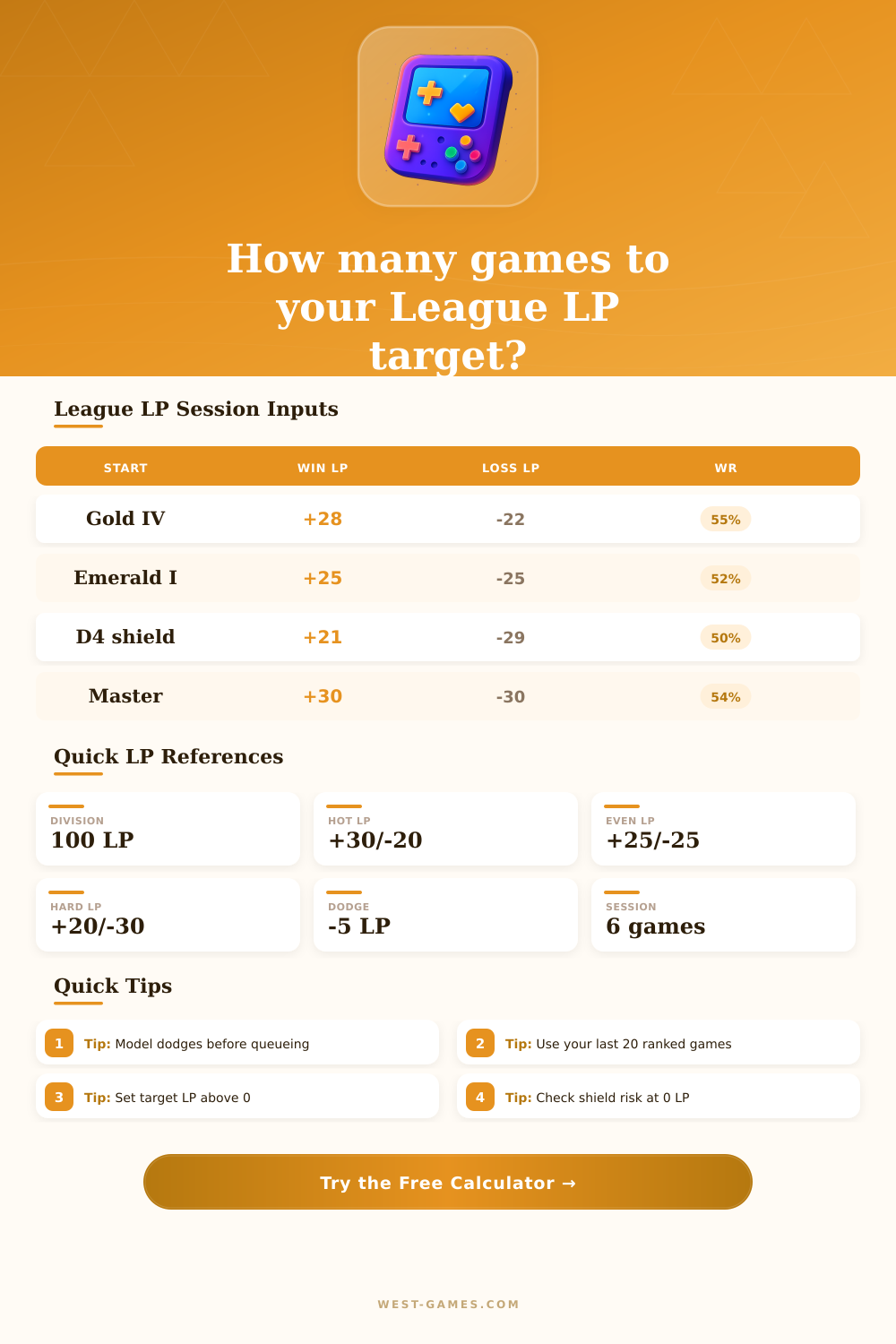
League LP Session Calculator
Forecast your next ranked block from current LP, win and loss values, expected winrate, dodge penalties, demotion shield risk, streak mood, and target rank.
| Rank band | Divisions used | LP span | Promotion behavior |
|---|---|---|---|
| Iron through Diamond | IV, III, II, I | 100 LP each division | Reaching 100 LP rolls into the next division or tier |
| Gold IV floor check | Tier floor | 0 LP plus shield context | Shield input estimates how many 0 LP losses remain |
| Emerald correction | Four divisions | Often modeled with uneven gains | Use your own +LP and -LP from recent ranked games |
| Master and above | Apex LP | Open LP above Master | Target LP works as an apex checkpoint |
| LP profile | Common input | Break-even winrate | Session read |
|---|---|---|---|
| Climb-favored MMR | +30 win, -20 loss | 40.0% | Even records still climb, targets need fewer games |
| Slightly positive MMR | +27 win, -23 loss | 46.0% | Good for compact sessions with modest winrate |
| Neutral ladder read | +25 win, -25 loss | 50.0% | Winrate decides the entire session outcome |
| Rank correction pressure | +21 win, -29 loss | 58.0% | Targets stretch unless winrate rises sharply |
| Apex baseline sample | +30 win, -30 loss | 50.0% | Volume matters, but bad streaks erase progress fast |
| Starting point | Target | LP needed | At +26/-24 and 55% |
|---|---|---|---|
| Bronze I 40 LP | Silver IV 0 LP | 60 LP | About 11 games expected |
| Gold II 75 LP | Platinum IV 0 LP | 125 LP | About 23 games expected |
| Emerald I 20 LP | Diamond IV 0 LP | 80 LP | About 15 games expected |
| Diamond I 40 LP | Master 0 LP | 60 LP | About 11 games expected |
| Factor | Calculator input | LP effect | Best use |
|---|---|---|---|
| Dodge penalty | Total LP penalty | Directly subtracts from session result | Model it before counting wins and losses |
| Demotion shield | Losses left at 0 LP | Changes risk label, not hidden MMR | Useful at IV divisions and tier floors |
| Hot streak | Positive streak state | Adds a small confidence LP adjustment | Represents sharper play and one more queue |
| Tilt streak | Negative streak state | Subtracts a small risk adjustment | Shows when stopping protects LP |
There’s no mystery about what you’re doing when you go on ranked. You might have a goal in mind, like wanting to hit Gold I by the end of the week. Or maybe you just need that next promotion to save your rank heading into new season. Winning more matches then losing seems like a straightforward equation. It is a mathematical certainty that will move you up in the ranks.
But, it turns out, the ranked ladder is a janky ecosystem. It is filled with streaks and dodges, secret MMR tinkering, and emotional burnout. These things transforms this basic math into an exercise of guesswork. That’s where the calculator comes in: It does the work for you. Knowing why the numbers behave as they do? That’s what sets apart the grinder from the climber.
How the Calculator Helps You Rank Up
People often see their LP as a static number. A win equals +25, a loss = -25. Not so much. Your true LP gain depends on your current rank (as well as your secret matchmaking rating). If it believes you’re more skilled than your displayed division, then it’ll grant you more like 30 for winning. However, it’ll only deduct 15 from you for a loss. This means that if you’re overranked, the penalty for losing can be crushing; whereas winning feels dull.
This matters because this variation affect you. What did the system really reward you with? Plug in some recent stats and look at what it awarded you. Don’t trust what the internet tells you it should of given you.
A final huge variable that everyone overlooks until it’s too late is streaks. You can input streak states into the tool to account for the psychological reality of how your performance fluctuate while playing. When you’re riding a high after winning three games in a row, there’s usually an increase in map awareness and sharper decisions making. Conversely, when you’re on a two-game losing streak, things get dicey; continuing to keep one more game in your queue after reaching rock bottom almost never goes well. With streak effects, you can adjust for this and model how your performance change depending on what happened recently.
The division floor makes things more complicated because of Demotion Shields. Sitting on zero LP in Platinums means that if it takes me some time to get my head right, I’m still good and will not drop all the way down to Diamond I after a certain amount of losses. That’s a whole new level of risk. Now I can try something off-meta or go more aggressive without worrying about getting dropped, only having to worry about stalling out. Does this mean that I’m in a danger zone? Will one bad game mean I’ll have to start over in the full division? This sucks big time and no one likes talking about it. Yet it’s what people fear. That’s why shield input is helpful here too.
You lose progress through silence: Five LP for each dodge is a hidden cost to your progress. Three dodges in one sitting? That’s a complete wipe-out on the net gain of two wins. While that may not seem like much, it adds up. It’s a smart idea to model this cost ahead of time when you go into a queue. Make sure you’re taking into account the friction from matchmaking. If your lobby history is messy, your expected gains won’t match what a pristine simulation says.
It’s not about playing sixty games at once. You’ll quickly get burned out. It will lead to less and less benefit. As the page’s reference table shows, short bursts of four or six games tend to be more reliable due to consistency. Your mood and skill tend to stay more consistent during them. Longer sessions drift into times when your aim slows down, your patience thins, and you begin to make calls you wouldn’t make when you are fresh. It’s less about mechanics than it is about managing variance across an extended period of time.
Sure, you might outplay everyone for 20 minutes only to get ganked at the end and lose. If you have a greater-than-50-percent expected winrate and gaining League Points exceeds losing them, the math will work out. It will happen eventually. That’s what this tool does. It shows how that plays out. It removes the guesswork from “is this the day I promote? Or is it the day I drop to zero?
Begin by clearly identifying your target, such as a particular division. Are you looking for a minimum positive net LP for the night? Enter your realistic stats, not your hopes. Watch the way your streaks and dodges impact the probability curve. And then log off when you’re ahead. That discipline is what’ll make a difference, more than anything else you do in individual games.