Monster Hunter Wilds Armor Calculator
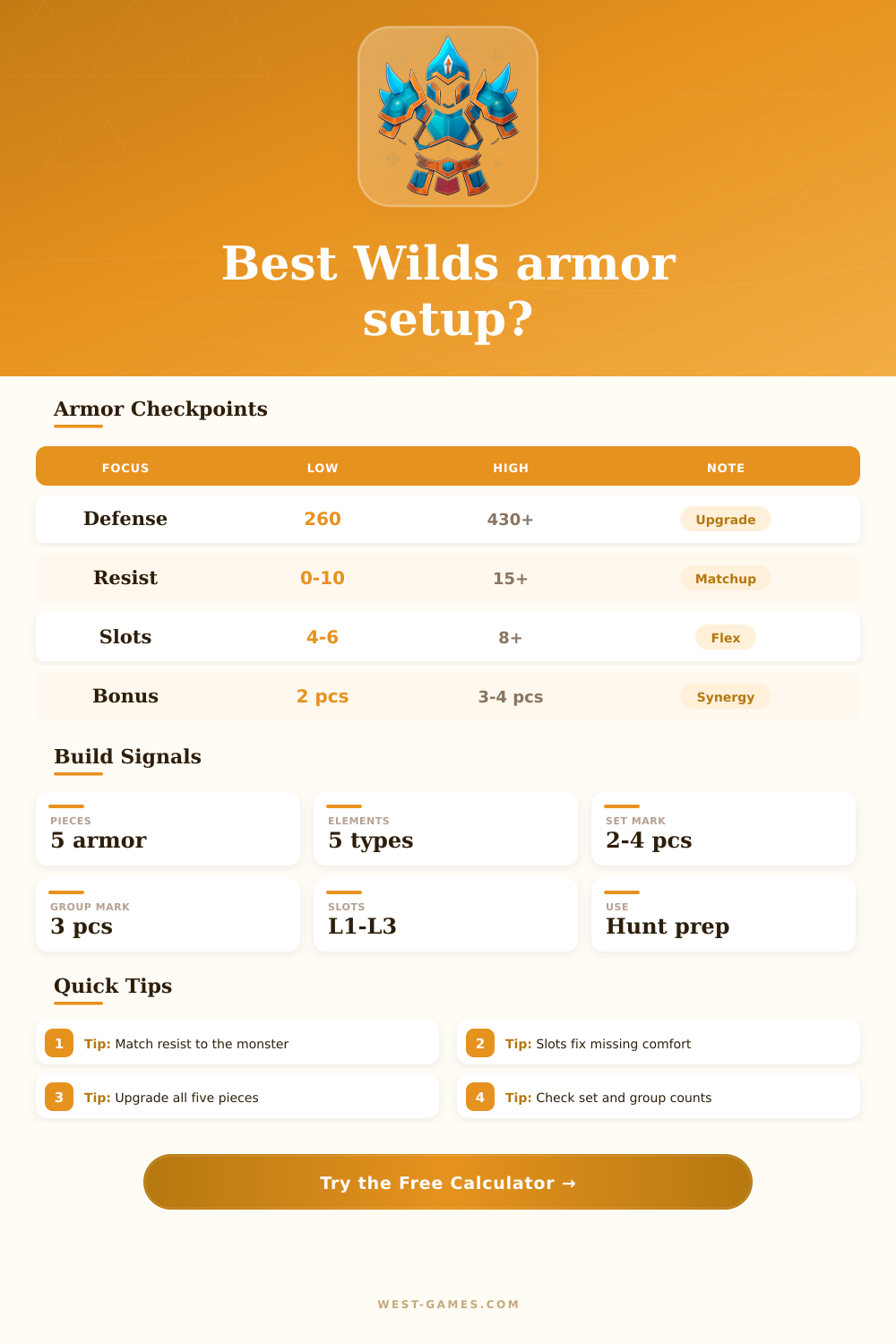
Compare five-piece defense, upgrade levels, elemental resistances, armor decoration slots, set/group synergy, and matchup mitigation before a hunt.
🎯Hunter Loadout Presets
⚙Hunt Profile
🛡Five Armor Piece Defense
⚡Elemental Resistances
💎Armor Slots, Set Bonuses, and Comparison
Armor Calculation Results
📊Live Loadout Snapshot
🧮Set Comparison Grid
Current Set
Calculate to compare.
Rival Set
Enter comparison values above.
Upgrade Path
Upgrade level changes effective defense.
Slot Path
Slots change comfort and matchup fixes.
📘Reference Tables
| Planning Band | Total Defense Signal | Upgrade Meaning | Best Use |
|---|---|---|---|
| Early low rank | Under 240 | Replace often | Learning monster patterns |
| Late low rank | 240 to 340 | Upgrade only favorites | Story and first mixed sets |
| High rank entry | 340 to 440 | Upgrade evenly | First serious decoration plans |
| High rank tuned | 440 to 560 | Keep all five current | Tempered, event, and farming sets |
| Endgame comparison | 560+ | Check cap and skills | Only if values match your save data |
| Incoming Profile | Resistance To Watch | Mitigation Assumption | Loadout Priority |
|---|---|---|---|
| Physical heavy | None primary | Defense drives most of score | Upgrade level, Divine Blessing, guard |
| Fire heavy | Fire | Positive fire resist reduces modeled chip | Fire resist, blight care, healing comfort |
| Thunder heavy | Thunder | Negative thunder resist raises risk score | Thunder resist, stun help, safe openings |
| Ice or water | Ice or water | Element buffs add to entered armor value | Stamina comfort, cleanser items, evade room |
| Dragon heavy | Dragon | Dragonblight planning can matter by weapon | Blight plan, raw fallback, reliable defense |
| Slot Mix | Calculator Weight | Armor Concept | Planning Note |
|---|---|---|---|
| Level 1 slots | 2 points each | Small comfort fixes | Useful for resistance, utility, and filler |
| Level 2 slots | 4 points each | Mid skill room | Often decides alpha vs beta tradeoffs |
| Level 3 slots | 7 points each | Premium armor decoration space | Protects flexible endgame loadouts |
| Native skills | 1.4 points each | Skills already on armor | Alpha pieces can score well with fewer slots |
| Comfort ranks | 2 points each | Survival and consistency | More valuable when learning a monster |
| Set / Group Check | Common Threshold | Calculator Treatment | Assumption Label |
|---|---|---|---|
| Same monster set bonus | Often 2 or 4 pieces | Rewards 2+ and 4+ piece counts | Check your in-game armor detail |
| Shared group skill | Often 3 pieces | Rewards 3+ shared group pieces | Group names vary by armor family |
| Alpha armor | More native skills | Adds native skill emphasis | Exact values must be entered |
| Beta armor | More slots | Adds slot flexibility emphasis | Exact slots must be entered |
| Mixed armor | Flexible thresholds | Balances slots, skills, and bonuses | Use if swapping single pieces |
💡Armor Calculation Tips
Armor decisions involves several different type of statistics. These type of statistics include raw defense, elemental resistance, decoration slot, and set bonus. These four category are all part of a five-piece armor set.
Many hunters may previously have focused on one type of statistic over the other three. However, hunters must now make a decision as to whether extra point of elemental resistance are more important than raw defense. Choosing elemental resistance will provide less damage from specific element but more damage from physical attack.
How to Choose Armor: Defense, Element Resistance, Slots, and Set Bonuses
Defense value are essential when knowing how often you will be getting hit by the monster that you are hunting. Even the best armor set will not provide the hunter with the best defense if the monster hit the hunter too often. The calculator will ask for the hunter’s weapon and the hit frequency for that specific weapon.
For instance, lance player will block more attacks than bow hunters. Thus, armor set with lower defense will work better for lance player. Bow hunter will have a different requirement for armor stat.
The armor’s defense will also increase with each armor upgrade. It is better to spread the armor upgrade rather than put them all into one armor piece. Elemental resistance are a category where many people make mathematical mistake.
Having a negative value in one of the elemental resistances will not ruin the armor set. However, it will allow the hunter to take more damage from the monster use that specific element. For example, if the damage profile is fire-heavy, the armor set will place more importance on fire resistance and blight care.
If a different damage profile is chose, the armor set will change the importance of the elemental resistances. Armor sets with more balanced elemental resistances will work better with blight care option. Hence, the blight care dropdown menu is present in the armor calculator.
Decoration slot and native skill are two skill that can be used to trade off one for the other. The alpha armor will provide built-in skill that will reduce the number of decoration a hunter has to use on their armor. The beta armor will provide more decoration slot for the hunter to add decoration to their armor later on.
The calculator will convert each type of armor into a single slot score for hunter to compare. Two piece of the same monster set will provide a bonus if the hunter has two of that piece of armor. Four piece of that monster armor will provide a different bonus that may change the way that the hunter goes into the monster hunt.
The reference table will provide information regarding the armor defense level that each hunter will use. Low rank armor piece will have defense value below a certain line because these armor set will be replaced when the hunter get stronger. High rank armor set that are tuned will have higher armor defense because these armor piece will be used in tempered monster fight and event quest.
There will also be table that show the damage profile that the monster may use and how armor will fare in those situation. Physical damage taken will reward raw defense and guard skill but elemental damage will focus on elemental resistance and blight management. These table will allow hunters to decide if their armor set is under-upgraded and if the armor is mismatched for the monster they are hunting.
Many people will make several common mistake when choosing armor. Some will choose one high defense armor for one monster and then leave the rest of their armor at the base level. This will lower the effectiveness of their armor.
Other player will focus on providing positive elemental resistance to one monster but will not account for the fact that mixed damage will be used more often than just elemental damage from one specific monster. Some player will also ignore decoration slot for their armor set which will prevent them from obtaining the comfort skill they require to fight certain monster. The comparison field will allow hunters to compare two different armor set.
The hunter can input the total defense, resistance, and slot score for another armor set for comparison to the hunter’s armor set. This will allow them to see whether their armor set is ahead of or behind their rival’s armor set. However, the armor set calculator will not allow the hunter to decide which armor set to wear.
Armor planning for each monster will allow each hunter to plan their armor set based on their playstyle for the monster they are hunting. The armor calculator will help each hunter decide whether their armor will match their playstyle for the monster they are hunting. Once they understand the significance of each number, they can decide if the armor set will allow them to last the entire monster hunt.