Warframe Armor Damage Reduction Calculator
Compare armor, health, shields, armor strip, Steel Path scaling, Adaptation, mod DR, faction damage, and effective health using armor / (armor + 300).
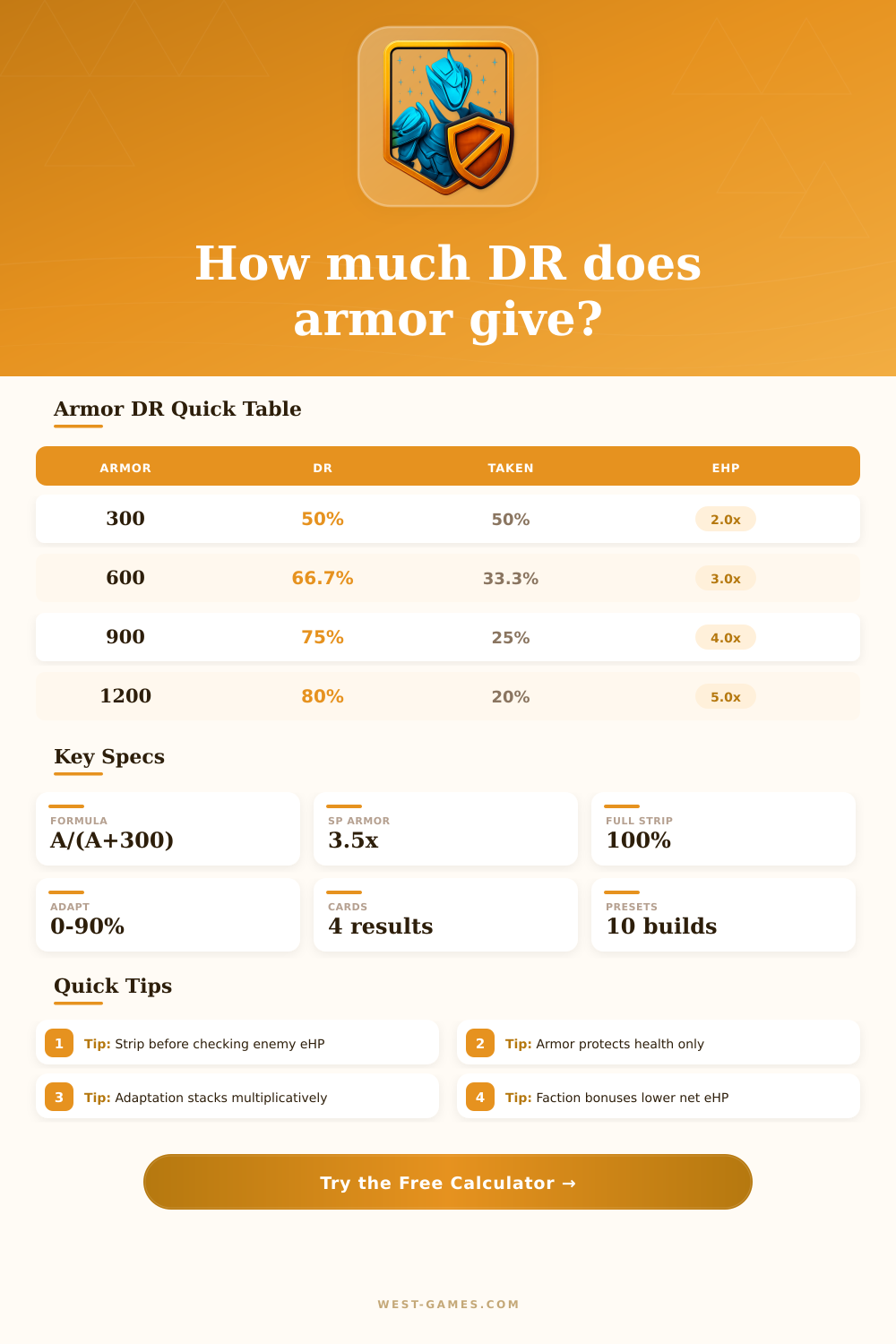
| Armor | DR Formula | Damage Taken | Health eHP Multiplier |
|---|---|---|---|
| 0 | 0 / (0 + 300) = 0% | 100% | 1.00x |
| 100 | 100 / 400 = 25% | 75% | 1.33x |
| 300 | 300 / 600 = 50% | 50% | 2.00x |
| 600 | 600 / 900 = 66.7% | 33.3% | 3.00x |
| 900 | 900 / 1200 = 75% | 25% | 4.00x |
| 1200 | 1200 / 1500 = 80% | 20% | 5.00x |
| 1800 | 1800 / 2100 = 85.7% | 14.3% | 7.00x |
| Armor Strip | Remaining Armor | 600 Armor Result | 900 Armor Result |
|---|---|---|---|
| 0% | 100% | 600 armor, 66.7% DR | 900 armor, 75% DR |
| 25% | 75% | 450 armor, 60% DR | 675 armor, 69.2% DR |
| 50% | 50% | 300 armor, 50% DR | 450 armor, 60% DR |
| 75% | 25% | 150 armor, 33.3% DR | 225 armor, 42.9% DR |
| 90% | 10% | 60 armor, 16.7% DR | 90 armor, 23.1% DR |
| 100% | 0% | 0 armor, 0% DR | 0 armor, 0% DR |
| Preset | Armor | Health / Shields | Why It Helps |
|---|---|---|---|
| Inaros Health Brick | 675 | 5200 / 0 | Shows pure health eHP with moderate armor. |
| Valkyr Prime Armor Stack | 1500 | 950 / 150 | Highlights how high armor multiplies smaller health pools. |
| Nidus Umbral Mutation | 900 | 1800 / 0 | Good sample for armor, health, and Adaptation stacking. |
| Hildryn Shield Focus | 315 | 450 / 4200 | Compares shield eHP against armored health eHP. |
| Steel Path Heavy Gunner | 500 | 22000 / 0 | Uses Steel Path armor multiplier for enemy durability. |
| Layer | Applies To | Input Field | Stacking Behavior |
|---|---|---|---|
| Armor | Health | Armor value and strip | Converted to DR with armor / (armor + 300). |
| Steel Path | Armor value | Steel Path / armor multiplier | Multiplies armor before strip in this calculator. |
| Adaptation | Health and shields | Adaptation or rolling DR | Multiplies remaining damage after armor. |
| Faction damage | Incoming hit | Faction damage modifier | Positive values increase damage taken and reduce eHP. |
| Shield DR | Shields | Shield damage reduction | Armor is skipped; shield layer is applied directly. |
Armor function as a multiplier for the health bar for a Warframe. Armor reduce the amount of damage that reach the health bar for the Warframe. High armor value will reduce the damage that reach the health bar.
Low armor values will allow more damage to reach the health bar for a Warframe. The value of armor is not linear. Small amount of armor can reduce the damage that reach the health bar by half.
How Armor Works in Warframe
Further armor values will provide smaller reduction in the damage that reach the health bar. Armor is very effective once the armor value reach a certain threshold. Stripping armor from an enemy will change the amount of damage that the enemy deals to you.
The formula for armor is simple, but can be difficult to judge. Current armor divided by the sum of the current armor and three hundred will determine the damage reduction percentage for that Warframe. The final damage reduction percentage will depend on the armor value for the frame after all multiplier and reduction to armor have been applied.
Enemies on the Steel Path has a boost to there armor value. This increased armor value make them more durable than normal enemies. With higher armor values, enemies on the Steel Path can be twice as durable but have the same health pools.
A calculator can be used to enter the armor and armor strip value for an enemy. This will show which is more effective between using a Corrosive Warframe or using an armor strip ability. Shield strength is a separate value to armor.
Shields dont use the armor system. Shields absorb damage before it reach the health bar for the Warframe. Some Warframes rely on shields while others, like Inaros, do not use shields.
Using a tool to analyze a character will separate the health and shield value for that Warframe. Many player find that tanky frame use more shields than expected once the shield and health values has been compared. Adaptation and mod-based damage reduction is separate from armor but does multiply the damage after armor has reduce the damage to the frame.
An example of this is if a Warframe has seventy-five percent armor reduction but forty-five percent Adaptation. The Adaptation will not simply add to the armor reduction. Adaptation will reduce the damage that armor had reduce for the Warframe.
This will cause the effective health for that Warframe to increase at a faster rate than is first expected. Damage bonus from faction and damage type vulnerability are separate from armor but will scale the damage after armor has reduce that damage to the Warframe. A common mistake is to treat armor strip as an afterthought in the combat between players and enemies.
If an enemy has its armor stripped, it will become a health pool target for players. Full armor strip is useful for players when they want to defeat an enemy quickly. Using a partial armor strip will leave the enemy with some armor.
It is up to the player to determine whether the armor strip is enough for the damage output that is desire. A calculator can be used to test armor strip values. It will also allow the player to see how much effective health is lost if a one hundred percent armor strip is use on the players Warframe.
This will make clear the value of having armor for a Warframe. Faction damage modifier and damage type resistance are additional layer to damage reduction. However, these are often ignored.
A positive number in the faction damage modifier will increase the damage of each hit that the enemy take. This will reduce the effective health of the player even if the armor value for the player do not change. Using the correct damage type against enemies with armor will lower the effective armor of those enemy before armor strip is applied.
Reference table can be used for a quick check of the armor values for a Warframe. These tables show the percentage reduction in damage at low armor values. They also show the increase in effective health as armor increase.
The tables also show the impact of armor strip on health with common armor values. These tables do not need to be memorized but provide insight into armor values and the armor curve. If a player know that three hundred armor will halve the damage to a Warframe and that nine hundred armor will reduce damage by seventy-five percent, the player can judge the effectiveness of different build for there Warframe without a calculator.
The calculator can be used to compare the effectiveness of two loadouts. One loadout may have higher health but more armor and Adaptation. By entering the values for each loadout into the armor calculator, the player can determine which loadout will allow the Warframe to survive longer against enemies with a similar level of damage output.
This is important for surviving combat between players and enemy. Armor do not protect shields. Armor does not provide any benefit to shield.
Shields do not benefit from armor multiplier. These two stat are separate and should be treated as such. Calculators separate these two stats and calculate the effective health for shields on its own track.
This will force the player to consider whether the build of their Warframe is a health or shield tank. More success can be had by treating armor as just one of several variable that impact the survivability of a Warframe in combat. Understanding how armor strip, Adaptation, faction modifier, and shields all interact will allow a player to make better decision regarding the mod that are placed on a Warframe.
If a player understands how these variable interact, the number will provide insight as to whether the Warframe will survive the next volley of damage from enemy.