💰 Tibia Loot Hunt Calculator
Plan a Tibia hunting session from creature mix, kills per hour, tiered loot chances, rare targets, prey and charm modifiers, party split, and supply waste.
| Loot tier | Adjusted chance | Expected items/hr | Value/hr | Planner note |
|---|
Adjusted chance applies loot prey, charm or event bonus, then removes your unlooted or unsold loss percentage.
| Preset | Creature mix | Kills/hr | Target item |
|---|---|---|---|
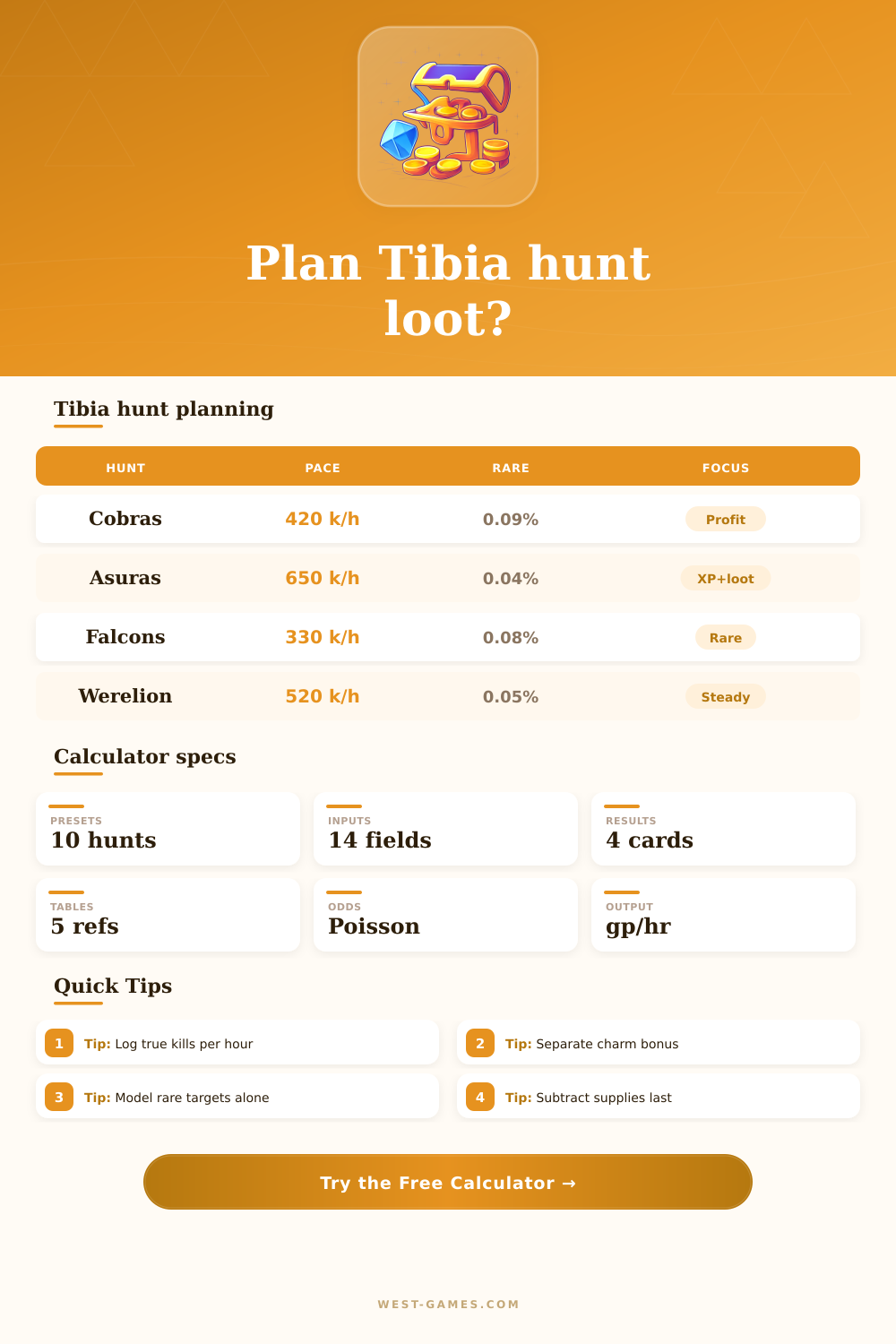
| Cobra Bastion | Assassin, Scout, Vizier | 420 | Cobra Rod |
| Werelion Loop | Werelion, Werelioness | 520 | Lion Wand |
| Asura Mirror | Midnight, Dawnfire, Hellspawn | 650 | Foxtail Amulet |
| Carnivor Rock | Spiky, Menacing, Lumbering | 470 | Carnivor Token |
| Falcon Bastion | Falcon Knight, Paladin | 330 | Falcon Greaves |
| Roshamuul West | Frazzlemaw, Guzzlemaw, Silencer | 760 | Cluster of Solace |
| Ferumbras Seal | Vexclaw, Grimeleech, Hellflayer | 610 | Pair of Nightmare Boots |
| Winter Court | Harbinger, Thanatursus | 390 | Crystal Shielding |
| Glooth Bandits | Bandit, Brigand | 700 | Glooth Capsule |
| Issavi Sphinx | Sphinx, Crypt Warden | 560 | Sphinx Feather |
| Input | What it changes | Use when | Risk |
|---|---|---|---|
| Loot prey | Drop expectation | Prey is on core creature | Mixed spawns dilute it |
| Charm / Gut | Creature product bonus | Bestiary charm adds loot value | May not affect all drops |
| Party share | Your gp after split | Duo, trio, service, or blocker split | Unequal splits need manual percent |
| Waste | Net profit only | Potions, runes, imbuements, ammo | Underlogging makes profit look high |
| Loot loss | All item value | Cap pressure or skipped corpses | Fast hunts hide small losses |
| Confidence | Full sessions | Kills needed | Use this for |
|---|
| Output | Formula idea | Why Tibia hunters care | Shown as |
|---|---|---|---|
| Expected loot/hr | Kills/hr x value/kill x modifier | Compares spawns before waste | gp/hr |
| Net profit/hr | Your share of gross - supplies/hr | Separates team loot from resource burn | gp/hr |
| Rare chance | 1 - (1 - p) raised to kills | Shows why rare hunts need volume | % per session |
| Target runs | Log confidence over no-drop chance | Plans how long a chase may take | sessions |
Until you view hunting as a ledger in Tibia, it will feel like a grind. You kill monsters for hours, but without tracking your actual input costs against your output value, you are just gambling with time. If you’re not keeping track of the value of your output compared to cost of your input, you’re just wasting time. And that’s all time is: a gamble.
You must understand the loot table. You need to know who drops rares, how often they drop, and how much it cost to stay alive. This is what separates profitable hunts from wasted effort. Big ticket items is why most people play. Sure, they’re rare drops, but that’s why you pay attention. Those rare weapons, those special accessories, don’t forget about the common stuff which helps pad your bank account.
How to Calculate Your Hunting Profit
It’s a dangerous trap. Rare rate hunts may seem appealing. Monsters hit hard! They cost loads of money in healing potions! But your net profit could dissapear in an instant. Consider all the common tier item that only make a few coins each, but quickly start adding up after hundreds of kills. That’s why the calculator above runs this math for you… It combines these tiers into one estimated hourly number so you can get a clear picture of what’s going on below surface.
High supply costs: Supplies are a large part of why hunting doesn’t pay out as much as it seems. Health potions, runes, arrows and imbuements cost money and many hunter fail to factor these into their totals. They’ll add up all of their gross loot then look up later and see that they’ve wasted more in supplies than what they’ve gained in gold. To determine your actual per hour wage, you have to deduct this expense from your total income. Otherwise, those numbers don’t mean anything. The tool allows you to input an estimated hourly cost for gear upkeep which gives you a realistic view of whether the hunt is worth the effort.
This is where the casual player ends and hardcore player begins. The other wrinkle is party dynamics. Loot sharing are an important variable when you’re out hunting with people. It’s possible that the speed boost from clearing creatures quickly in a five-person group will result in less gold for each person different than they’d get if they hunted solo. In this case, you need to compare the speed bonus with division of reward. If by hunting together you recieve fewer coppers per hour then you would just hunting alone, it may be better to hunt solo (even if it is slower) so you keep all the copper yourself. That’s how you’ll know when it makes sense to call up some friends vs. Going solo. The page has a handy reference table comparing your bottom line based off party size.
You should understand probability. It can take time to find rare items. That’s why I say understand probability and be patient. If an item drops once out of a hundred kills, don’t expect to get it on your hundredth kill. Luck plays a big role and variance exist. It can often seem unfair after short sessions. Manage expectations by thinking about expected value over many hours rather than individual outcomes. A good way to manage expectations is to set a confidence goal which shows how many times you may have to go through a session before getting the loot you want. It keeps you from being frustrated at not seeing it right away.
Never overlook the modifier bonus rewards such as charm points or prey tickets. They can dramatically increase your drop rate, but there are limits to them and they cost something too. Wasting time putting a prey ticket on an animal that doesn’t drop good stuff is a terribel idea. Only use these modifiers where base chance is worth it. Tuning your active bonuses helps you understand exactly what marginal value you’re getting out of these mechanics. This allows you to treat abstract parts of the game as real financial choices. It’s something that will change how you play.
You won’t just hop aimlessly from spawn to spawn, hoping for good luck during those hunts. Now you go in with a plan; not only knowing what your risks are but also what you can expect back (and how much it’ll cost). It streamlines everything and helps remove some of the stress from the game so that it becomes a calculated gamble instead of just pure luck. Next time you login, you should of considered the numbers involved before casting your initial spell.