🎮 League of Legends Elo Calculator
Estimate hidden MMR alignment, LP swing, match difficulty, and promotion pressure for ranked queues.
Estimated from tier, division, and LP. It represents where your displayed rank sits in this calculator.
Your override or the visible estimate. A higher value means the account may gain more LP than it loses.
Team MMR versus enemy MMR drives the match difficulty card and adjusts expected result pressure.
LP gain minus LP loss tells whether the climb is forgiving, neutral, or punishing across a session.
Winning streaks improve short-term confidence; losing streaks increase pressure even when MMR is healthy.
High LP, weak LP health, and recent losses raise the pressure score before a promotion or demotion swing.
| Tier | Floor | Mid | Ceiling |
|---|---|---|---|
| Iron | 400 | 550 | 700 |
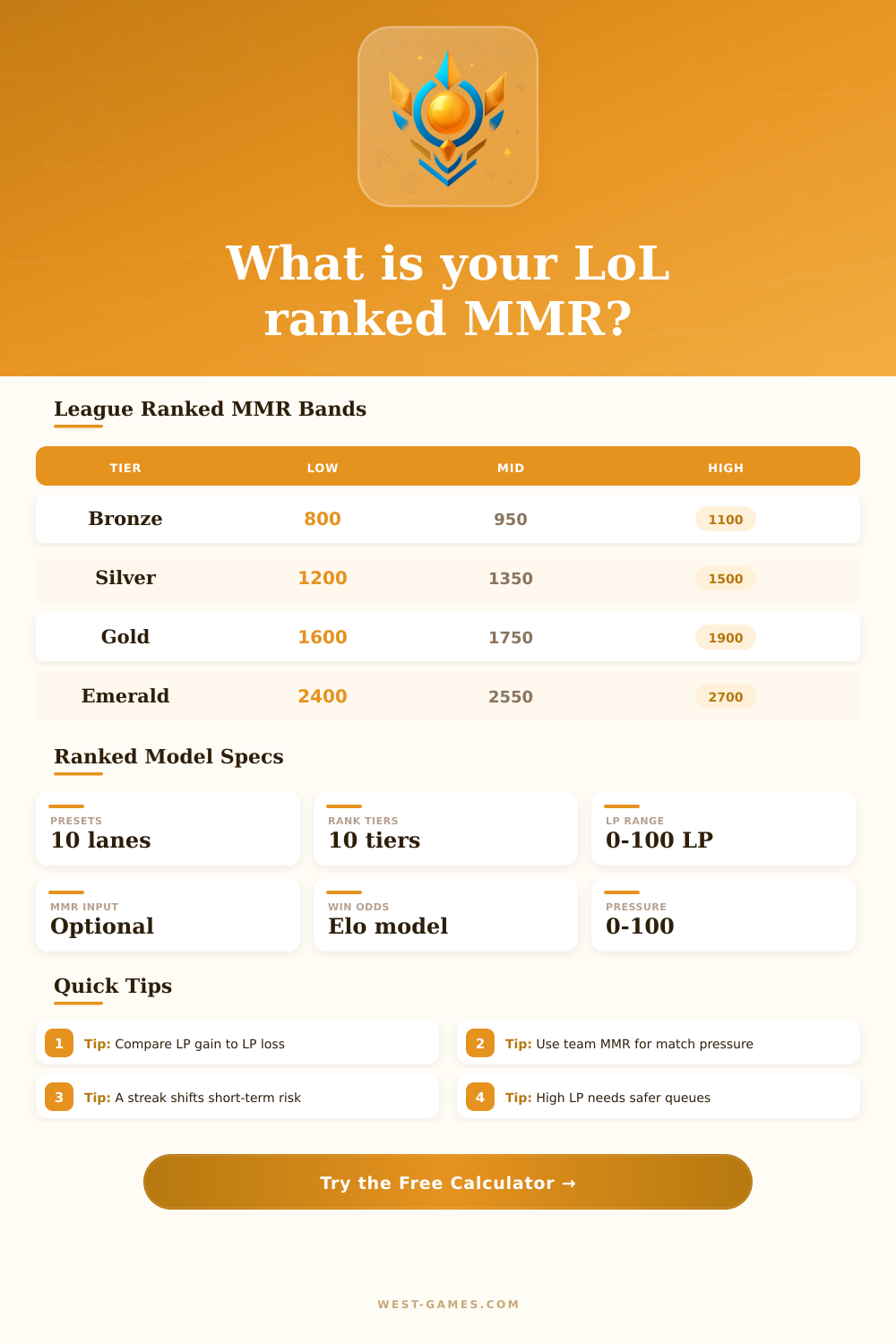
| Bronze | 800 | 950 | 1100 |
| Silver | 1200 | 1350 | 1500 |
| Gold | 1600 | 1750 | 1900 |
| Platinum | 2000 | 2150 | 2300 |
| Emerald | 2400 | 2550 | 2700 |
| Diamond | 2800 | 2950 | 3100 |
| Master+ | 3200 | 3600 | 4000+ |
Bands are practical calculator estimates, not official Riot values.
| LP Gap | Signal | Meaning |
|---|---|---|
| +6 or more | Hot | MMR likely above rank |
| +2 to +5 | Healthy | Climb has cushion |
| -1 to +1 | Even | Rank and MMR aligned |
| -2 to -5 | Heavy | Losses are costly |
| -6 or worse | Stressed | Needs consistency |
| Win Odds | Readout | Queue Feel |
|---|---|---|
| 58%+ | Favored | Your team has MMR edge |
| 52%-57% | Slight Edge | Playable advantage |
| 48%-51% | Even | Skill and draft matter |
| 43%-47% | Hard | Enemy team is ahead |
| Below 43% | Severe | Upset needed |
| Score | Status | Ranked Action |
|---|---|---|
| 0-24 | Low | Play normal volume |
| 25-49 | Building | Watch losses and tilt |
| 50-74 | High | Shorten the session |
| 75-100 | Critical | Queue only when sharp |
For many people, climbing feels hard. League of Legends‘ ranking system is unintuitive. It seems like you should move up or down based on wins and losses, but then suddenly you’ll get 3 wins and zero movement, followed by 2 losses and you’re down a division.
The way it actualy works is that there’s an unseen ranking called MMR that decides how much (or if) your LP increase or decrease with each match, while your visible rank only represents where you are relative to other people. Because of this disconnect between the internal ranking used to calculate LP and the public ranking displayed to you, people wants to find a clearer picture of how well they’re doing. A lot of people don’t realize just how important your actual MMR is compared to what they’re seeing on-screen. When you’re above what’s displayed, wins will earns you bigger LP while losses make a dent that’s not too bad. Conversely, if you’re below your displayed ranking, you’ll have your losses feel worse as it makes bigger dents (though wins still reward you with a bigger bump).
How to Use the LoL MMR Calculator
After plugging in your rank information, including your LP number, typical LP gain/loss, and tier/division, the calculator do the rest for you. You can even input a rough estimate of your hidden MMR and it’ll show you how your account compares to your shown rank. Similarly, match difficulty is calculated. If your team’s overall skill level are lower than the opposing team, then it’s going to be an uphill battle regardless of which champions is chosen. The tool calculates your chance of winning based off the MMR difference between teams. It converts that information into a difficulty rating so you know when to try and when to hold off until things improve.
Losing streaks will make these decisions more difficult while winning streaks might hide issues regarding your LP health. There are some other signals to keep an eye on as well: LP health. This is simply the gap between your average LP gain and average LP loss, which indicates whether the climb is currently punishing or forgiving (a positive gap typically indicates that your hidden rating supports the climb, while a negative one means you must clean up your act since the system are taking more than it’s giving). You can view this relationship directy in the calculator to see whether recent results have helped or hindered your long-term climb.
Some of these factors combine into promotion pressure. Losing streak, high LP, negative LP health…all of these push up the pressure score. And when it goes up, you should of typically take a short break or wait until you feel sharper. The tool does one thing for you: give you one number that doesn’t require you to carry all those things around in your head.
In the end, rankings systems is only valuable if they enable you to improve your decision making around how and when to play. While the calculator can help provide a better picture of where you’re at, it won’t substitute for judging how you are feeling mentally or how your recent games went. Take the numbers into account and go with what you truly feel like doing next time you hit queue up.