🛡 Iron Banner Calculator
Estimate Destiny 2 Iron Banner reputation from challenge completions, Iron Banner gear and emblem boosts, activity streaks, wins, losses, rank targets, engrams, resets, and match time.
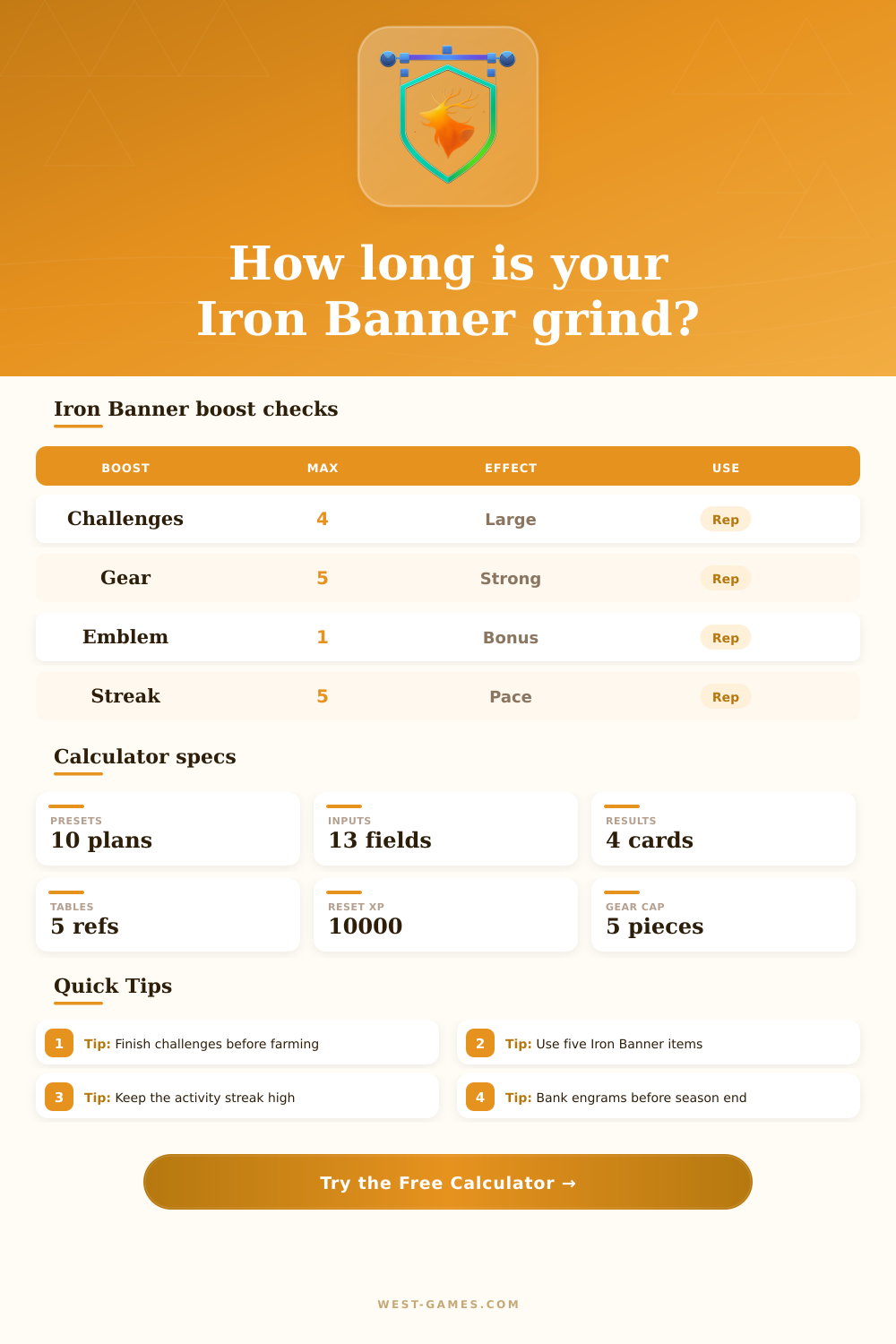
| Boost source | Calculator input | Default effect | Planning note |
|---|---|---|---|
| Weekly challenges | 0 to 4 | +1.0x each | Largest controllable boost once unlocked |
| Iron Banner gear | 0 to 5 | +0.4x each | Weapons, armor, and ornaments can count |
| Iron Banner emblem | Yes or no | +1.0x | Easy boost after you have an emblem |
| Activity streak | 0 to 5 | +5% each | Applied after the base boost model |
| Multiplier cap | Editable | 10.0x | Prevents extreme estimates when all boosts stack |
This is a transparent planning model. Use the displayed in-game multiplier as the final authority when Iron Banner is live.
| Target | Reputation goal | Why use it | Calculator option |
|---|---|---|---|
| Rank 7 | 4,000 rep | Mid-track reward check | Rank 7 reward check |
| Rank 10 | 6,000 rep | Deeper reward planning | Rank 10 reward check |
| Rank 13 | 8,000 rep | Near reset review | Rank 13 reward check |
| Rank 16 | 10,000 rep | Reset-ready milestone | Rank 16 reset ready |
| Double reset | 20,000 rep | Heavy event-week farm | Two full resets |
Destiny rank substeps can vary by reward track presentation. The calculator uses 10,000 reputation as the reset track anchor.
| Session | Wins | Losses | Use case |
|---|---|---|---|
| Quick challenges | 4 | 4 | Unlock and test boosts |
| Solid farm | 12 | 6 | Good win-rate reset push |
| Long solo queue | 10 | 14 | Completion-heavy progress |
| Stacked team | 22 | 4 | High streak and high win rate |
| Catch-up night | 18 | 18 | Large sample with even results |
The plan uses your exact wins and losses first, then estimates additional matches from your entered win rate if the target is not reached.
| Metric | Calculator method | Best input | Meaning |
|---|---|---|---|
| Rank-up engrams | One per 625 rep band | Current reputation | Expected reward claims |
| Held engrams | Added directly | Saladin inventory | Focus-ready total |
| Reset count | Floor total rep / 10,000 | Target plan | How many tracks cleared |
| Overflow rep | Total rep after resets | Session rep | Progress into next track |
| Season caution | Manual check | Event timing | Use engrams before risk windows |
Engram count is an estimate for planning focused rewards, not a live inventory pull.
| Metric | Formula | Inputs | Result |
|---|---|---|---|
| Base boost | 1 + challenges + gear x 0.4 + emblem | Challenges, gear, emblem | Core rep multiplier |
| Final multiplier | min(cap, base boost x streak factor) | Streak and cap | Displayed planning boost |
| Session reputation | wins x win rep + losses x loss rep | Wins and losses | Total session gain |
| Matches needed | remaining rep / average match rep | Target and win rate | Additional grind estimate |
| Time required | matches x minutes per match | Match pace | Hours and minutes |
All values are rounded for planning readability. Edit win and loss base reputation when a season's Iron Banner tuning changes.
For many, Iron Banner instills a certain kind of fear. Everyone is grinding through the playlist without thinking about tactics. Long queue times feels like a punishment to those who don’t progress quickly enough. The problem there is that rep isn’t gained solely on skill, it’s a math problem. You’re solving an equation that reboots once per week, so playing for efficient means (rather than winning) become most important.
Once you establish a set of baseline settings, the calculator calculates an estimate of how long it will take you. Knowing what these are helps you avoid wasting your hours. It also helps you translate vague boost ideas into tangible goals.
How to Play Iron Banner Better
The main mechanic is stacking multipliers before queueing up. Most players neglect to do this because they want to jump right in and play ASAP. This squanders the most valuable part of their week. You’ll want to hit as many boosts as possible during that initial match. It favors preparedness over pure play time.
Weekly challenges gives a huge boost once you complete them. The longer you wait into the week, the less effective they become. It’s modeled that way in the tool as well. It notes which challenges you’ve unlocked. It also gives you an idea of the distance between where you are and where you want to be.
Matches early on won’t net as much value if you don’t have all of your boosts engaged, preparation is important. Iron Banner gear is even more disciplined, you get better rewards if you equip it, but only after you’ve invested in five corresponding weapons or pieces of armor. Most of them will be under-powered for your typical run.
The problem is that while they might be underpowerd, dropping your meta gear can yield more reputation than winning an extra match through sheer skill. That’s where the math comes into play. The calculator shows what you stand to gain from keeping your meta build up and running versus dropping one weapon slot for increased reputation.
For example, the activity streak mechanic penalizes mode hopping, so taking breaks from strikes or raids melts down your bonus. It encourages you to grind on even if you’re exhausted. This is a poor choice because reference tables proves that doing one short session with maxed-out bonuses beats grinding through one long session with only half-stacks. Every game counts more than every game played.
Starting at rank sixteen you start to hit ten thousand rep for a reset track. That doesn’t seem like much when all you have to do is grind. But then you factor in loading screen and queue time. To match this, the planner uses your typical match duration as an estimate for hours spent. If you’re attempting to run several resets, you’ll see if it’s reasonable or if you need to adjust expectations. You’ll also learn just how many matches you can lose before you reach your target.
More than a test of your PvP skills, Iron Banner is a test of your ability to manage resources. The loot is worth it, but not without some careful system play in addition to how well you do in matches. If you can visualize the grind, the frustration turns into strategy: What do I need to do differently next week? It’s more valuable than any individual engram drop and removes the guesswork from the experience.
Actually, visualizing it could of helped.