🃏 Gloomhaven Stamina Calculator
Estimate action rounds, rests, stamina potion timing, lost-card pressure, and exhaustion round for Gloomhaven and Jaws-style mercenary hands.
| Class | Hand | Profile | Stamina note |
|---|---|---|---|
| Brute | 10 | Frontline | Standard 10-card curve |
| Tinkerer | 12 | Support | Best long-scenario buffer |
| Spellweaver | 8 | AOE burst | Reviving Ether changes timing |
| Scoundrel | 9 | Melee burst | Losses must be timed late |
| Cragheart | 11 | Control | Can afford selective burns |
| Mindthief | 10 | Control DPS | Protect augment tempo |
Hand size remains the selected scenario hand size even as a character levels and gains more available cards.
| Plan | Recover | Use when | Practical gain |
|---|---|---|---|
| No potion | 0 | Never | Baseline rest math |
| Minor current | 1 | 1 card short | Often one extra round |
| Major current | 2 | Empty or 1 card | Usually one extra round |
| Minor plus Major | 3 | Late cycles | Can bridge two rests |
| Original Minor | 2 | Before rest | Older-print stronger gain |
| Original pair | 5 | Late scenario | Very large endurance swing |
Potion cards must already be in discard. They cannot bring back cards in the lost pile.
| Scenario shape | Target | Loss budget | Rest advice |
|---|---|---|---|
| Small boss room | 8-10 | 2-4 burns | Spend power early |
| Three-room dungeon | 12-15 | 1-3 burns | Short rest for pace |
| Large map | 16-20 | 0-2 burns | Save potion for late |
| Objective race | 10-14 | 1-2 burns | Long rest only if safe |
| Summon-heavy crawl | 15-18 | 0-1 burns | Avoid early losses |
| Decision | Immediate effect | Hidden cost | Best use |
|---|---|---|---|
| Short rest | Lose one discard | Random lost card risk | Keep scenario tempo |
| Long rest | Choose lost card | Consumes a round | Heal, refresh, stabilize |
| Early loss action | More power now | Shortens every future cycle | Critical objective push |
| Damage prevention | Cancel damage | Permanent stamina drop | Avoid exhaustion or death |
| Late loss action | Finisher power | Small remaining cost | Last room or boss turn |
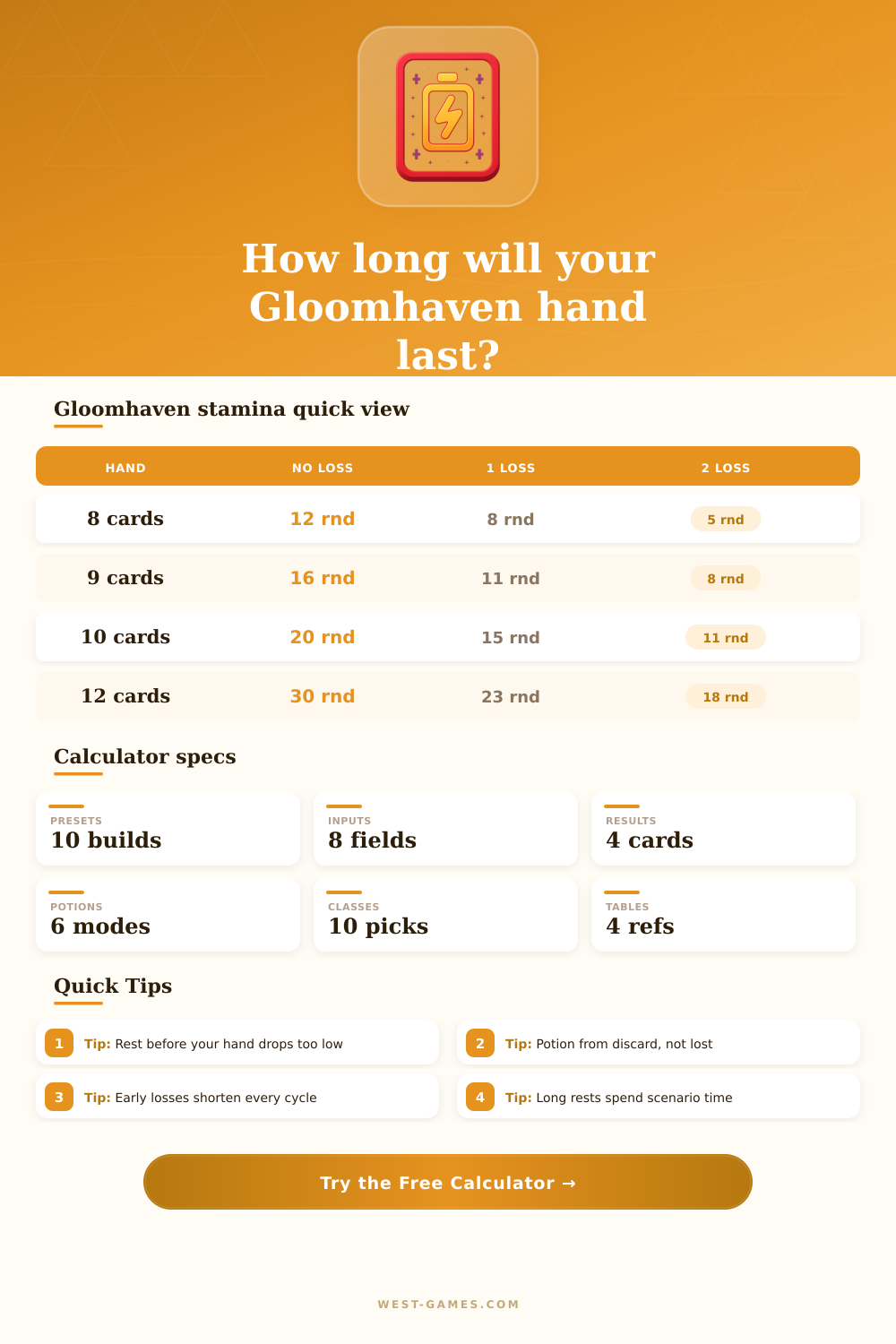
Stamina is an essential component of planning in Gloomhaven, and stamina is a resource that players must manages. The size of a player’s hand is one of the determinants of the stamina that a player possesses. The size of a player’s hand determine how many full turns that a player can take before a player must perform a rest.
If a player loses a card, it reduces the number of cards that is available to a player within the hand. Each lost card also reduces the number of turns that a player can take. Players must ensure that the cards in their hand last until the mission is completed; otherwise, they will experience a collapse of their stamina too early in the game.
How to Manage Stamina in Gloomhaven
The size of a player’s hand alone does not determine the stamina that they will possess during their game. Each time that a player decides to lose a card, the size of the player’s hand change. A class may start with a ten-card hand size.
However, each time that the player loses a card, their hand size decreases. Each lost card is lost for each of the player’s future turns. The card calculator allow a player to input the current state of their character, as well as the number of future losses that they may have in the game.
Based off these two values, the calculator can provide a mathematical calculation that tells a player how many more rounds they can participate in their game before they collapse from exhaustion. Cadence refers to the number of times that a player rests during the game. Players have the ability to take short rests or long rests.
Short rests is useful for maintaining the tempo of the scenario that they are playing. However, each time that a player takes a short rest, they will lose the top card of their discard pile. During long rests, players have the ability to select which card to lose from their hand.
Additionally, during a long rest, the player is able to heal themselves. However, long rests cost the player one scenario round. The timing of rests that a player takes can change in the instance in which exhaustion occur.
Additionally, the timing of takes rests can change the number of rounds in which a player can participate in the scenario. Stamina potions are items that can influence the stamina of the players. When a player consumes a stamina potion, the player’s character gains all of the cards that were discarded during the game.
Stamina potions does not allow players to regain cards from the lost pile of their deck. The value of a stamina potion is dependent upon the size of the discard pile. If players use a stamina potion while they have few cards in their discard pile, their stamina will not change significant.
However, if they use a stamina potion when they are one card short of completing a full turn with their hand, they will gain an extra round of play with their opponent. Using the calculator, a player can test out different potion plans. The calculator will provide information regarding whether or not each of these plans will lead to an increase in the number of rounds that a player is able to compete in their game.
The shape of the scenario in which the player is participating can influence how much loss pressure the scenario places upon the player. If the boss room for a scenario is short in length, players will have an incentive to lose cards during that room since it will end before the next rest. However, if the maps for the scenario are longer and include multiple rooms after the boss battle, the loss of a single card will have a punishing effect on the players stamina since each subsequent rest will feature a smaller hand size for the player.
The reference tables on this page illustrate the number of turns that are typically targeted in each type of scenario. These tables will help the player to understand how much stamina to “save” for the end of the game. Within the game, there are a variety of small decisions that have an impact upon the stamina of the player.
Decisions to lose a card in rounds three of a game will reduce the number of cards that are available to a player. Additionally, each lost card will reduce the number of turns that the player can take. The loss of a card in the final room may be considered low cost since the mission may be completed before the next rest in the game.
The calculator allows a player to model losses during the game, such as the loss of a card during an encounter with an enemy, so that the player can see the difference between losing a single card early in the game versus later in the game. The goal of a player is not to avoid losing cards altogether. Instead, the player desires to lose their cards only when the cost of that loss is the lowest.
In order to achieve this goal, the player must have an understanding of their hand size, the type of rests that they take, the timing of those rests, the use of stamina potions, and how many losses they may take in the future. If a player has an understanding of each of these factors, that player can play until the mission is completed instead of until they collapse from exhaustion.