🚂 Factorio Train Throughput Calculator
Calculate Factorio train payload, loading time, unloading time, round-trip cycle, trains per minute, items per second, fluid per second, and belt-equivalent capacity from verified wagon and stack data.
per train
station fill
round trip
station empty
after availability
| Cargo group | Stack size | One normal cargo wagon | Four cargo wagons | Throughput note |
|---|---|---|---|---|
| Iron ore, copper ore, coal, stone | 50 | 2,000 items | 8,000 items | Raw ores need twice as many wagons as plates for the same item count. |
| Iron plate, copper plate, steel plate, stone brick | 100 | 4,000 items | 16,000 items | Smelting at the mine often doubles train item capacity for iron and copper. |
| Iron gear wheel, transport belts, wall, landfill | 100 | 4,000 items | 16,000 items | Finished intermediates can be train-friendly if local demand is high. |
| Electronic circuit and advanced circuit | 200 | 8,000 items | 32,000 items | High stack size makes circuits dense cargo for mall or science feeds. |
| Processing unit | 100 | 4,000 items | 16,000 items | Blue circuits stack lower than green and red circuits in this model. |
| Science packs except space science | 200 | 8,000 items | 32,000 items | Train batches can feed labs smoothly when cycle time is stable. |
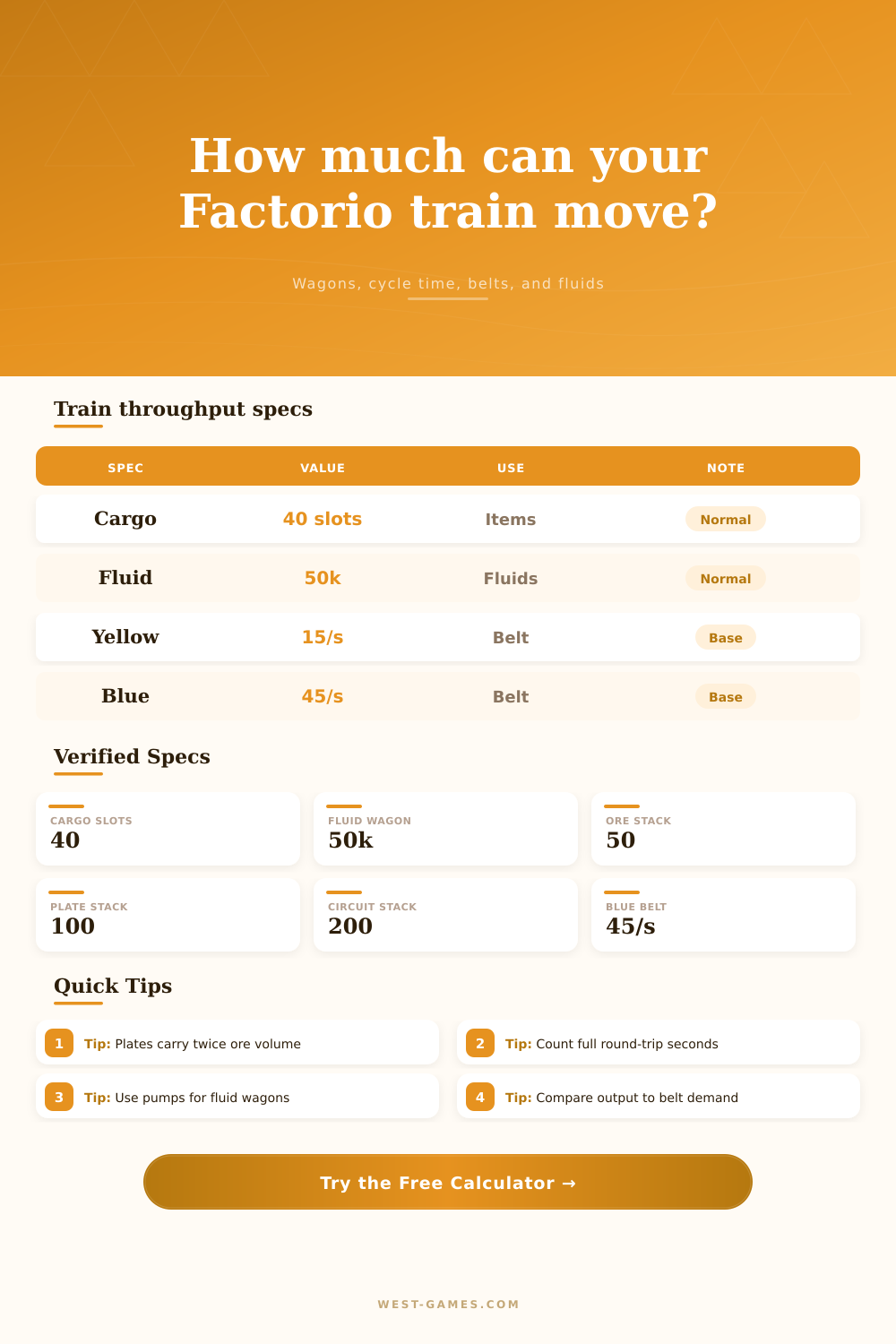
Capacity formula: cargo wagon payload = wagon slots x item stack size. The calculator defaults to 40 normal cargo wagon slots.
| Belt type | Stack height 1 | Stack height 2 | Stack height 3 | Stack height 4 | Use in calculator |
|---|---|---|---|---|---|
| Transport belt | 15 items/s | 30 items/s | 45 items/s | 60 items/s | Early and compact stations |
| Fast transport belt | 30 items/s | 60 items/s | 90 items/s | 120 items/s | Midgame station feeds |
| Express transport belt | 45 items/s | 90 items/s | 135 items/s | 180 items/s | Base-game high-throughput hubs |
| Turbo transport belt | 60 items/s | 120 items/s | 180 items/s | 240 items/s | Space Age high-capacity stations |
Selected belt equivalent = train throughput divided by selected belt base rate x selected stack height.
| Fluid wagon setup | Normal capacity | 1 pump | 2 pumps | 3 pumps | Planning note |
|---|---|---|---|---|---|
| One fluid wagon | 50,000 fluid | 42 s | 29 s | 14 s | Times are rounded full-wagon transfer estimates. |
| Two fluid wagons | 100,000 fluid | 42 s | 29 s | 14 s | Parallel pumps keep station time per wagon unchanged. |
| Four fluid wagons | 200,000 fluid | 42 s | 29 s | 14 s | Pipe supply and tank buffers must keep pumps fed. |
| Eight fluid wagons | 400,000 fluid | 42 s | 29 s | 14 s | Long stations need all wagons aligned on straight rails. |
The calculator applies station efficiency to these fluid transfer times so imperfect pipe or tank layouts can be modeled.
| Step | Formula | Cargo example | Fluid example | Bottleneck to check |
|---|---|---|---|---|
| Payload per train | Wagons x wagon payload | 4 x 4,000 plates | 2 x 50,000 fluid | Stack size or tank volume |
| Load time | Payload per wagon / station rate | 4,000 / two blue belts | Normal pump table | Chests, pumps, lane balance |
| Travel time | One-way travel x 2 | 45 s x 2 | 60 s x 2 | Intersections and stackers |
| Cycle time | Load + unload + travel + delays | Used for train arrivals | Used for tanker arrivals | Round-trip route length |
| Throughput | Payload x trains/min / 60 | Items per second | Fluid per second | Target draw versus delivered flow |
Trains per minute = active trains x 60 / cycle seconds x route availability percent.
At some point during each run of Factorio, the train network cease to appear as a logistics system and begins to appear as a traffic jam. Everything’s hooked up, the mines, the factories, the automated smelters. But the trains is … there. Waiting. For something. Maybe they’re waiting for another signal. Or maybe they’re waiting for chests or pumps. Or maybe it isn’t that the trains aren’t fast enough. Usually it’s because math of throughput has gone wrong. You’re moving fewer items every second from one place to another than your factory can consume, and mismatch grows worse with each tick. Time to stop guessing, and start calculating.
Once you know how much stuff comes through each stack, how many stacks you have, and how long they take to fill back up, the calculator (above) will do math for you. It will translate the crazy world of your rail network into one simple, truthful number: How many fluid units or items per second?
How to Calculate Your Train Speed
Most players think about train speed. They’ll upgrade their trains. They’ll find ways to make them go as fast as possible. They assume that if something goes faster then it produce more. Well, that’s what most folks get wrong. For a normal route, travel time only makes up a tiny fraction of the overall cycle. Usually, bottleneck isn’t even your train (it’s the station). If it takes you ten seconds to drive from point A to point B but it takes you another forty seconds to load/unload, making your train drive five seconds faster won’t really help your average throughput. Attack those load/unload times.
But should you haul those same plates instead of ore? Plates stack to a hundred; ore stacks to fifty. A single cargo wagon fits four thousand plates, but it only fits two thousand ore. Should you smelt in-place at the mine? Your payload capacity is cut in half; if you’re hauling raw ore from some remote mine back home. This is laid-out clearly in reference table on the page: wagon efficiency are dictated by stack size. And it matters. Yes, remote smelting is a nice little convenience piece of mid-game, but it’s also a capacity multiplier. Don’t need more trains? Just denser cargo.
There’s another type of friction: fluid trains. Wagons is a given size, as are pump speeds. There are three pumps per wagon (the max), which takes about fourteen seconds to fill a wagon’s fifty thousand fluid units. That means if you’re running four wagons then just those pumps alone will take fifty-six seconds to load your train. Then you need to factor in signal delays, unloading times, and travel time, all of which makes your cycle time balloon.
To account for these realities, you must consider the messiness of train spacing. You also have to consider pipe settling and chest balancing. You can do this by adjusting station efficiency, which is a percentage of how well system works. One-hundred percent is optimistic. Eighty-five percent is honest. It recognizes that your factory is a real place with friction.
Maybe the most practical output are belt equivalents. Sure, it’s abstract to know that you’re producing one hundred and eighty items per second. But it’s tangible to know that this is equivalent to four blue belts. This allows you to directy compare output of a train with demand from a factory. Are your inserters capable of dealing with three blue belts worth of inputs? Then don’t send them a train that produces four! The calculator will show you when you’ve gone over the mark.
When you build a huge loading station for a train that turns up once every three minutes, this is a common mistake. In other words, it’s all about balance. The timing must ensure next load is finished by the time the train pulls in. The loaders must work at maximum capacity and never have a queue of work waiting. It means thinking about the train less like a vehicle and more like a batch processor (each trip being one transaction).
The transaction length also equals its flow rate, you should of checked it sooner. At which point, everything make sense when you look at the network with this in mind. Those little red flashing things aren’t errors. They’re data points. They’re just the trains sitting there waiting for you to do the math.