🐺 Diablo 4 Druid Skill Tree Calculator
Plan Druid skill points, Spirit economy, boon package, Fortify coverage, shapeshift uptime, and key passive synergy in one build model.
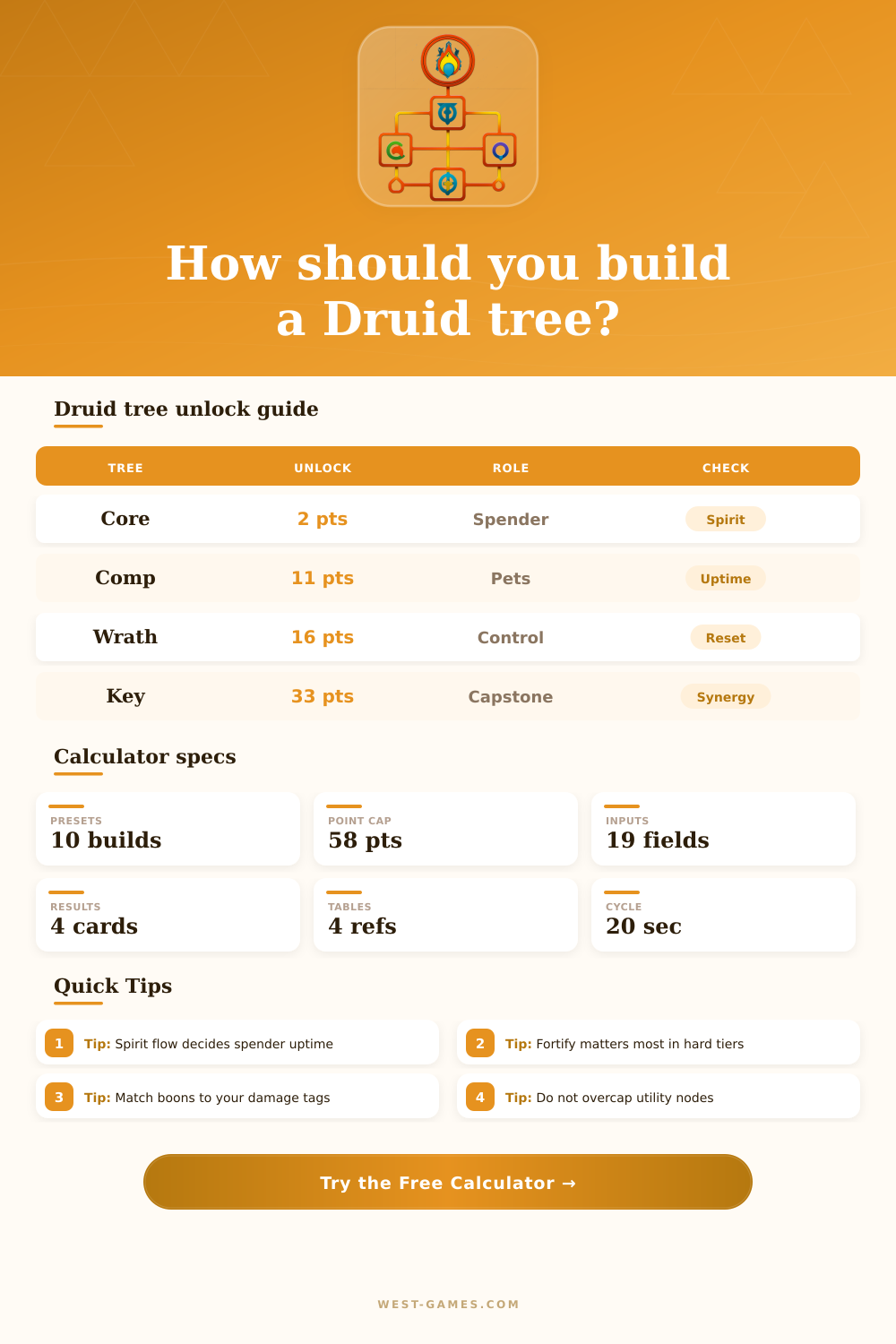
| Cluster | Points | Primary use | Calculator check |
|---|---|---|---|
| Basic | 0 | Spirit generation and opener | Basic casts per cycle |
| Core | 2 | Main spender or scaling attack | Ranks and upgrades |
| Defensive | 6 | Fortify, barrier, howl, armor | Fortify score |
| Companion | 11 | Pets, Poison Creeper, Ravens | Companion points |
| Wrath | 16 | Control, storm, poison, boulder | Control score |
| Ultimate | 23 | Cataclysm, Petrify, Grizzly Rage | Cooldown value |
| Key passive | 33 | Final build identity | Passive synergy |
The calculator treats these as planning gates while also checking whether your total spend exceeds the selected point budget.
| Skill | Cost | Tag | Model power |
|---|---|---|---|
| Pulverize | 35 | Bear Earth area | 1.30 |
| Tornado | 40 | Storm projectile | 1.22 |
| Lightning Storm | 15 | Storm channel | 1.08 |
| Landslide | 30 | Earth control | 1.18 |
| Shred | 35 | Wolf melee | 1.12 |
| Boulder | 40 | Wrath control | 1.15 |
| Claw or Storm Strike | 0 | Basic hybrid | 0.82 |
| Companion attacks | 0 | Pet pressure | 0.88 |
Model power is normalized for planning. Skill ranks, tags, boons, Overpower, lucky hit, and uptime values modify the score.
| Boon package | Main value | Damage mod | Resource value |
|---|---|---|---|
| Eagle crit plus Wolf resets | Crit and cooldown flow | 1.10x | Medium |
| Snake Overload storm | Storm lucky-hit bursts | 1.13x | Low |
| Deer Guarded defense | Elite damage reduction | 1.02x | Medium |
| Snake Obsidian Slam | Earth Overpower cadence | 1.12x | Low |
| Wolf Packleader companion | Companion reset loops | 1.08x | High |
| Balanced four-spirit mix | General tree stability | 1.06x | Medium |
The model uses boons as a package because Druid strength often comes from combining crit, resource, defense, and reset effects.
| Key passive | Best material | Formula effect | Watch-out |
|---|---|---|---|
| Ursine Strength | Werebear Fortify | Damage and defense | Needs healthy Fortify |
| Bestial Rampage | Form swapping | Damage and speed | Needs shift uptime |
| Earthen Might | Earth lucky hits | Crit and Spirit burst | Needs lucky hit setup |
| Nature's Fury | Storm plus Earth | Cooldown resets | Needs hybrid skills |
| Perfect Storm | Storm control | Damage and Spirit | Needs storm uptime |
| Lupine Ferocity | Werewolf crit | Damage spike | Needs fast hit cadence |
Compatibility score rises when the selected form, main skill tag, and uptime inputs point toward the same passive material.
| Build material | Best specs | Strong inputs | Formula role |
|---|---|---|---|
| Spirit-positive spender | Tornado, Pulverize, Landslide | Generators, cost reduction, extra Spirit | Raises uptime and readiness |
| Fortify armor shell | Werebear, Earth, Pit pushing | Defensive points and Fortify uptime | Raises survival score |
| Lucky-hit reset engine | Storm, Earthen Might, Packleader | Lucky hit and cooldown value | Raises reset and damage score |
| Companion pressure | Packleader, Poison Creeper, Wolves | Companion points and reset value | Raises control and pet damage |
| Overpower package | Pulverize and Obsidian Slam | Overpowers and Fortify uptime | Adds burst to cycle score |
| Hybrid nature chain | Nature's Fury storm-earth | Wrath points and cooldown value | Improves utility uptime |
Use this comparison grid to decide whether extra points should become resource, defense, lucky hit, companions, Overpower, or hybrid reset material.
The Druid skill tree in Diablo 4 is a tree where the different choice feed into each other, and one must understand these relationship in order to succeed with the Druid skill tree. Many players find difficulty in the higher tiers of the game due to treating the Druid skill tree as a list of skills that need to be purchase rather than as a system of interrelated component. In order to succeed with the Druid build, players must manage Spirit, Fortify, and cooldown flows in order to ensure their character both survives and deals damage with their party member.
Spirit is a resource for most Druid build, and one that must be managed in order for the build to function correct. Most skills that are purchased with Spirit have a cost in relation to how much Spirit is spent with each use of that skill. Additionally, most skills that are purchased with Spirit also return a fixed amount of Spirit with each hit that the player deals with their enemy.
How to Use the Druid Skill Tree
Should the amount of Spirit that is spent in relation to the amount of Spirit that is generate be negative, a player’s Spirit levels will drop. Should a players Spirit levels drop, their build will be unable to progress through its main rotation. It is likely that many players feel as if their build is slow due to insufficient generation of Spirit, but their Spirit generation are too low.
When building their Druid game character, players should ensure that their level of Spirit generated through basic attack, lucky hit procs, and Spirit from their gear is balanced in relation to the number of each of those action they will perform in-game. Once such a loop for Spirit is create and stable, players will feel as if their game characters are more responsive to their input. Fortify is a defensive resource that contributes to a player’s survivability in challenging game content.
Additionally, Fortify contribute to a player’s damage output in that Fortify provides Overpower window, and that Fortify contributes to the active state of certain key passive included within the Druid build. Werebear builds that do not include Fortify will experience drops in survivability if an elite enemy attack them. Additionally, Earth caster build that do not use Fortify will experience difficulty using their Earth caster ability, as they will not be able to retain control of their game character.
Thus, Fortify should be included as one of the component of one’s rotation for the Druid game class to feel tanky in relation to their enemy. The different choice of Boon package and key passive will create some form of synergy within the Druid build. The four spirit animal each have their own benefit.
Any selection of Boon package that does not correlate to the requirements of one’s key passive will lead to friction between those two component of the Druid build. For instance, some passive may reward frequently shifting form into the spirit animal, while others may reward lucky hit and Fortify. Any damage that include such a passive will not function correct if it does not generate the condition required for that key passive to trigger its final damage modifier.
Each point that is allocated to the skill tree incurs a tradeoff for other skill. For instance, allocating a point to Wrath or Companion ability means that a point is not allocated to defensive game skill. Thus, any Druid build that chooses to focus on the damage output of companion loses the ability to allocate a point to defensive node or passive.
Many Druid build benefit from leaving one cluster in a skill tree light so that other can reach the threshold required for their ability. Additionally, avoiding overinvestment into a single area of a Druid build prevents that build from developing a weakness. The calculator that is provided can take a player’s focus, form, main skill, boon package, and point spread to determine the mathematical outcome of their skill tree allocation for the Druid class.
This damage calculator will help a player to determine whether their Spirit loop will remain positive, as well as to determine whether their damage output is likely to be sufficient for their target level of difficulty. Additionally, the reference table that are provided detail the order in which many of the skill can be unlocked, as well as offer table to help player understand the tradeoff that are made between different skill. Some of the most common mistake include treating the Druid game class as one that provide damage to enemy.
For instance, many player will maximize the level of their main damage skill before allocating any skill point to defensive node. However, these player will find that they die before they can utilize their damage skill. Additionally, many player will ignore cooldown reduction for skill until they reach their key passive.
However, these same player will find that their ultimate and reset skill will not be available when needed. An effective Druid build is one that consider these various factor before increasing the damage output of the player and their party member. A Druid build that respects the described relationship between the various component of the Druid game class will function more effective.
Once the player establish the Spirit, Fortify, and cooldown loop within their game character’s rotation, that Druid build will feel complete, and each component of the game character will work in harmony with each other.