⚡ Factorio Solar Accumulator Ratio Calculator
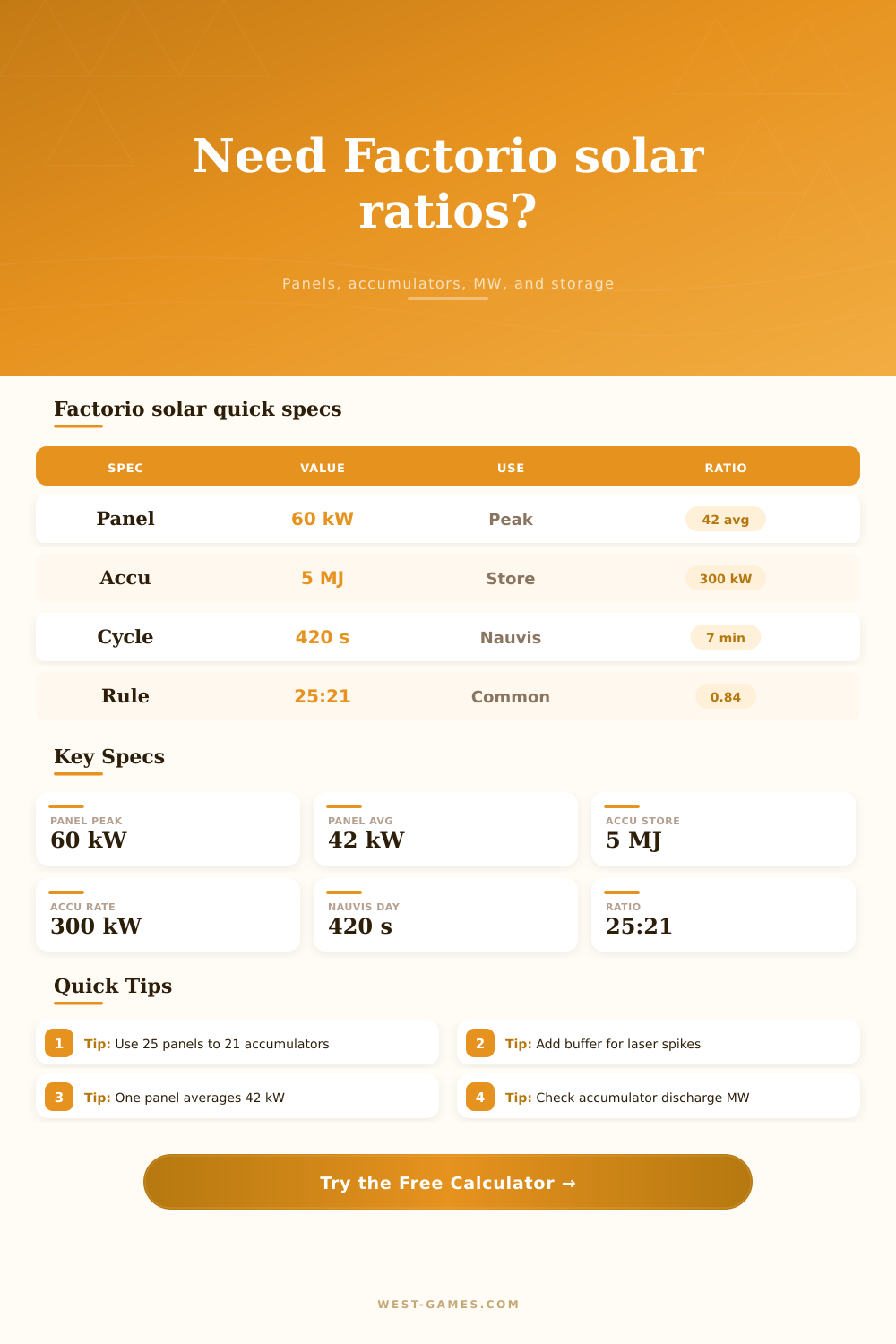
Size solar panels, accumulators, storage buffer, MW support, item stacks, and tile footprint using the Factorio wiki's 60 kW panels, 5 MJ accumulators, Nauvis cycle math, and 25:21 rule.
Analytic accumulators per normal solar panel on Nauvis.
Convenient blueprint ratio for about one megawatt class chunks.
Each solar panel occupies nine tiles before poles or paths.
Each accumulator occupies four tiles and stores 5 MJ at normal quality.
Full light, dawn and dusk ramp, and darkness share of a Nauvis cycle.
| Item or cycle value | Wiki value | Calculator use | Formula impact | Tile size | Planning note |
|---|---|---|---|---|---|
| Solar panel peak | 60 kW at full daylight | Peak output base | Average is 70% of peak | 3×3 | Normal quality equals 100% |
| Solar panel average | 42 kW on Nauvis | MW target to panel count | Panels = kW / average panel kW | 9 tiles | Includes dawn and dusk ramps |
| Accumulator capacity | 5 MJ normal quality | Night storage count | Accumulator count scales by capacity | 2×2 | Higher quality stores more energy |
| Accumulator rate | 300 kW normal quality | Discharge check | Rate MW = count x rate / 1000 | 4 tiles | Separate from energy capacity |
| Nauvis cycle | 420 seconds | Reference day/night math | 17.64 MJ per panel per cycle | Not placed | Equivalent to 7 minutes |
| Canonical shortcut | 25 panels to 21 accumulators | Common blueprint planning | 0.84 accumulators per panel | 265 tiles | Close to exact 0.84672 |
The calculator defaults to exact Nauvis math, then rounds up counts so the entered MW target is not undersized.
| Factory load | Exact panels | Rounded panels | Exact accumulators | Rounded accumulators | Stored energy |
|---|---|---|---|---|---|
| 1 MW starter grid | 23.81 | 24 | 20.16 | 21 | 105 MJ |
| 5 MW early mall | 119.05 | 120 | 100.80 | 101 | 505 MJ |
| 10 MW science block | 238.10 | 239 | 201.60 | 202 | 1,010 MJ |
| 25 MW main bus | 595.24 | 596 | 504.00 | 504 | 2,520 MJ |
| 50 MW laser buffer | 1,190.48 | 1,191 | 1,008.00 | 1,008 | 5,040 MJ |
| 100 MW block | 2,380.95 | 2,381 | 2,016.00 | 2,016 | 10,080 MJ |
These examples exclude optional buffers and use normal-quality panels and normal-quality accumulators on Nauvis.
| Location | Solar output | Average per normal panel | Normal accumulator ratio | Panels for 10 MW | Accumulators for 10 MW |
|---|---|---|---|---|---|
| Nauvis atmosphere | 100% | 42.00 kW | 0.846720 | 239 | 202 |
| Vulcanus atmosphere | 400% | 168.00 kW | 0.725760 | 60 | 44 |
| Gleba atmosphere | 50% | 21.00 kW | 0.604800 | 477 | 288 |
| Fulgora atmosphere | 20% | 8.40 kW | 0.072576 | 1,191 | 87 |
| Aquilo atmosphere | 1% | 0.42 kW | 0.024192 | 23,810 | 577 |
The planet ratios are normal solar panel to normal accumulator ratios from the wiki. Custom mode assumes the Nauvis day shape with a custom output multiplier.
| Planning factor | Normal | Uncommon | Rare | Epic | Legendary |
|---|---|---|---|---|---|
| Solar panel output multiplier | 1.0x | 1.3x | 1.6x | 1.9x | 2.5x |
| Panel peak on Nauvis | 60 kW | 78 kW | 96 kW | 114 kW | 150 kW |
| Accumulator energy | 5 MJ | 10 MJ | 15 MJ | 20 MJ | 30 MJ |
| Accumulator power rate | 300 kW | 390 kW | 480 kW | 570 kW | 750 kW |
| Useful buffer choice | 0% | 5% | 10% | 20% | 50%+ |
| Footprint before overhead | Panel 9 tiles | Same | Same | Same | Accumulator 4 tiles |
Higher-quality accumulators reduce count through energy capacity, while higher-quality panels reduce panel count through higher average output.
Every Factorio player eventualy hits the same wall regarding power planning. Maybe there is plenty of copper and iron ore to build factory with, but your electrical network are still shaky. Sure, you can use solar panels, which produce electricity when it’s daytime.
That’s the basic dilemma: How much do you invest into energy storage so you can keep running smelter throughout those endless Nauvis nights? And how much do you overdo it with accumulators that sits around collecting dust while everyone else work? The math is simple, but miscalculating your ratio result in brownouts, and a minute or two lost production time. Essentially it’s all about storage versus generation.
How to Plan Power in Factorio
At max sun, a typical solar panel generate 60 kilowatts; but that only happens for a short time. On average across the full cycle of day and night, those same panels generates just 42 kilowatts. That average is what you should of use as your sustainable load limit. For instance if your factory needs constant power of ten megawatts then don’t base your panel size on maximum sunlight. Think about nighttime.
The calculator takes amount of megawatts you want to draw from the grid and computes these variables for you. It then spits out a real world plan for how many accumulators and panels you need. It translates wiki info into something actionable: a concrete plan for how many panels and accumulators you actualy need to place.
There’s a general rule of thumb used by most players: twenty-one accumulators for every twenty-five solar panels. It’s easy to remember, it fits nicely into a blueprint, and that’s all fine for early game purposes. But this is a simplification; the real number comes out just a bit higher, about 0.84672 accumulators per panel. That sounds like a tiny difference; but if you’re building a megabase where being precise and efficient matter, that difference add up.
Calculating to the exact formula means you’re not leaving yourself any room for error. This might bite you during an extra-long night or a spike in laser turret firing. These equations also vary by component quality. Uncommon and rare versions of solar panels is more efficient, meaning they produce more power. But they also require more storage, which will affect the number and type of tile used in your power station.
A better panel means you need less total equipment, which changes the footprint of your power generation tile. Your accumulators, however, must contain same amount of energy, regardless of quality. This may lead you to believe that higher-quality panels equal fewer batteries. That’s not quite true. It doesn’t scale in a straight line. However, you can tweak for quality using the tool, which lets you know precisely what upgrading do to the final tally.
Often, this upgrade is worth the additional resources, since it shrinks physical space your power takes up. In a crowded base, space is as good as power. Another factor is discharge rate. An accumulator doesn’t just store energy, it releases it at a related rate. A big array of laser turrets all firing at once require a high discharge rate for such an instantaneous load.
Discharge rate and storage capacity is different boxes to check. It’s possible to store sufficient energy in the batteries to sustain the night and yet still be overwhelmed because power isn’t released fast enough to support defense. That’s what this parameter does on the calculator: warns against trying to use a set-up that won’t manage any particular level of nighttime power spike. Players often get hung up here because they only look at total megajoule capacity without paying attention to how that power flow.
That doesn’t even take planet mechanics into account. Depending where you are in the system, amount of solar you can expect will change a lot. On Vulcanus, you get 4x the solar input of Nauvis and nearly nothing at all on Aquilo. The basic 25:21 isn’t going to work if you’re colonizing elsewhere. Recalculate with your local atmosphere in mind. Fortunately, the tool accounts for it.
You see what would be necessary on a clear world vs. It is a foggy one. It’s still the same principle, just different inputs. Finally, Factorio power planning is all about mitigating risk. How much do I need? You need enough that you don’t run out, but not so much as to waste resources.
When in doubt, increase your buffer. The tool lets you specify buffers which provide some margin of error for those times when the going gets tough. Best case: too much capacity. Worst case: production stops because you forgot to buy battery. So begin with base ratio, tweak based off quality and planet, and then add some headroom. That’s how you stay lit up, no matter how dark the night becomes.