⏱ Diablo 4 Cooldown Reduction Calculator
Plan additive gear rolls, multiplicative cooldown effects, temporary buff uptime, target breakpoints, and real skill uptime for Diablo 4 builds.
| Package | Typical slots | Add CDR | Use case |
|---|---|---|---|
| Starter helm roll | Helm | 7.8% | Early breakpoint testing |
| Helm plus amulet | Helm, amulet | 17.6% | General utility skills |
| Helm, amulet, focus | Triple roll | 25.4% | Sorcerer and offhand builds |
| Near-max triple rolls | High affixes | 32.5% | Tight breakpoint setups |
| Ultimate-focused setup | CDR plus ultimate lines | 22.0% | Long cooldown windows |
Enter your exact item tooltip values when masterworking or tempering changes the final roll.
| Effect path | Modeled mult | Usual uptime | Best fit |
|---|---|---|---|
| Hectic-style cycling | 18% | 45% | Basic-heavy loops |
| Ice Blades pressure | 10% | 55% | Sorcerer conjuration |
| Flickerstep path | 20% | 35% | Ultimate resets |
| Decrepify pressure | 15% | 50% | Necromancer lucky hit |
| Exposure-style reset | 16% | 40% | Trap and burst loops |
The calculator converts proc-heavy effects into an uptime-weighted multiplier for practical comparison.
| Skill type | Common target | Why it matters | Watch out |
|---|---|---|---|
| Vulnerable control | 12-15 sec | Matches elite packs | Duration can be short |
| Emergency immunity | 14-18 sec | Safer boss recovery | Do not overrate uptime |
| Shout defense | 14-16 sec | High mitigation uptime | Needs duration checks |
| Ultimate window | 32-42 sec | More frequent burst | Proc uptime varies |
| Preset | Base | Target | CDR focus |
|---|---|---|---|
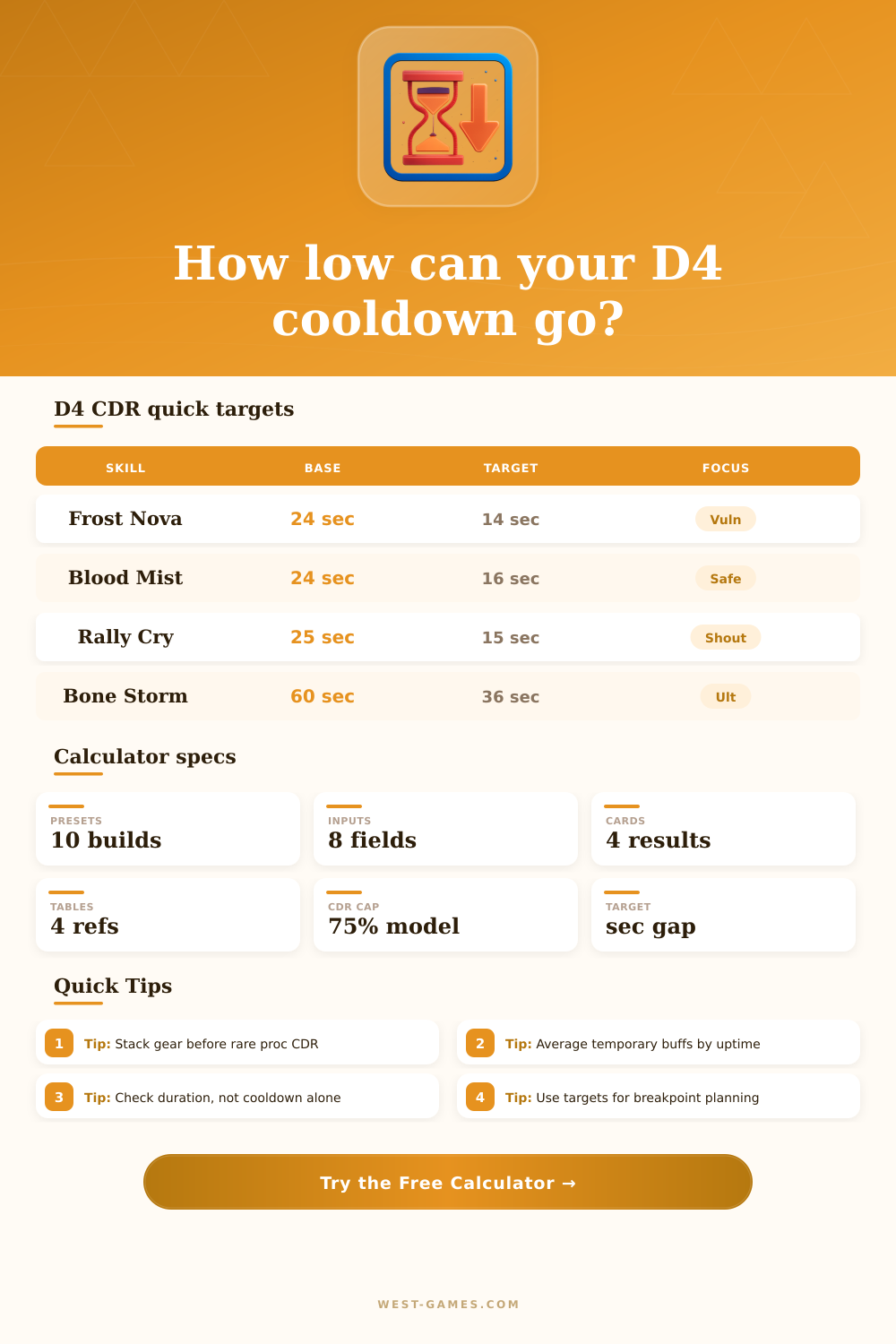
| Frost Nova Chain | 24 sec | 14 sec | Gear plus Ice Blades |
| Blood Mist Safety | 24 sec | 16 sec | Decrepify uptime |
| Rallying Cry Cycle | 25 sec | 15 sec | Shout uptime |
| Grizzly Rage Window | 50 sec | 34 sec | Ultimate refresh |
Cooldown reduction are one of the factor that determines your build choices in Diablo 4. Cooldown reduction determines the number of time that you can use a specific skill. You select a specific skill to use due to the effect that you want to use on demand.
The longer you have to wait between skill use, the less useful a specific skill will be for you. This is the reason that you must consider cooldown reduction for your skill. Cooldown reduction come in two forms: additive cooldown reduction and multiplicative cooldown reduction.
How Cooldown Reduction Works in Diablo 4
Additive cooldown reduction comes from gear item such as helms, amulets, and focus slot. Multiplicative cooldown reduction come from temporary game effect such as aspects and buffs. These two type of cooldown reduction work in different way and having a clear understanding of the difference between them prevents you from overestimating the effectiveness of your cooldown reduction abilities.
In addition to cooldown reduction, the duration of your skill is just as important. If your skill dont last long enough to provide their effect during the cooldown period, then they are not useful to you. Using a calculator, you can enter your cooldown and your active skill duration to find the gap between your current recast time and your target breakpoint.
This will tell you if you need more cooldown reduction or if you have enough cooldown reduction to satisfy the demand of your skill uses. Not all skill require the same amount of cooldown reduction. Some skill have different purpose to fulfill within the game.
Vulnerable application skill, for instance, need to be ready whenever you encounter a new pack of enemies. Immunity skill need cooldown reduction so that they are ready before dangerous mechanic in enemies occur. Defensive shout need to have enough uptime to always be active during gameplay; ultimates need enough cooldown reduction to allow them to land at the appropriate time.
Reference table exist to tell players what cooldown reduction each of these skill type require. Temporary cooldown reduction effect can be challenging to plan around due to the inconsistency of their uptime. A 20% temporary cooldown reduction that occur half the time is not the same as a 10% permanent cooldown reduction.
Factors such as density, movement speed, and lucky hit chance can all impact the effectiveness of temporary cooldown reduction effect. The tool will calculate the average effectiveness of these temporary cooldown reduction effect to allow you to compare setups with temporary cooldown reduction vs gear that provide steady cooldown reduction. Cooldown reduction can be applied to any character in the game.
However, each character place a different value on cooldown reductions. For instance, a Sorcerer might value cooldown reduction of Frost Nova over other skill; a Barbarian might value cooldown reduction of their defensive shout more. The calculator allow players to change these priority to reflect their desired character focus.
Cooldown reduction will give players a better understanding of their characters ability. Now, players will be able to clearly see if an additional affix roll will help narrow the gap between their current cooldown and their target cooldown. They will also understand if their buff need more uptime or if their skill already perform well as they are.
This knowledge will allow them to avoid unnecessary affix roll and ensure that they do not neglect other part of their build. The true goal of cooldown reduction is not to reach a point where your skill have a cooldown of 0. Instead, the goal is to ensure that you have enough cooldown reduction so that you have access to the effect that your skill offer when the game demand it.