Clash Royale Win Rate Calculator
Estimate your next ladder set using deck archetype, league, recent form, battle mode, matchup difficulty, level gap, streak, and target goal.
| Deck preset | Archetype | Base estimate | Best queue condition |
|---|---|---|---|
| Hog 2.6 Cycle | Fast Cycle | 51.5% | Even levels, practiced defense |
| Classic Log Bait | Bait / Pressure | 52.0% | Opponents low on small spells |
| X-Bow 3.0 | Siege Control | 50.5% | Patient players, clean spell value |
| Splashyard Control | Graveyard Control | 52.5% | Ground-heavy queues |
| LavaLoon | Air Beatdown | 51.0% | Weak anti-air fields |
| Golem Beatdown | Heavy Beatdown | 49.5% | Lower punish speed opponents |
| Royal Giant Fisherman | Royal Giant Control | 52.2% | Single-building defenses |
| Miner Poison Control | Control Chip | 51.8% | Overtime and spell-cycle games |
| P.E.K.K.A Bridge Spam | Bridge Spam | 50.8% | Elixir leads and counterpushes |
| Mega Knight Bait | Midladder Punish | 50.0% | Swarm-heavy ladder pockets |
| Setting | Modifier | Why it matters | Calculator use |
|---|---|---|---|
| Arena Ladder under 5000 | +2.0 pts | More uneven deck quality and mistakes | Good for learning streaks |
| Champion to Royal Champion | 0.0 pts | Baseline competitive ladder | Default estimate |
| Top Ladder / High UC | -4.0 pts | Opponents punish tiny elixir leaks | Lower chance if not one-tricking |
| Challenge Queue | -1.5 pts | Decks are tighter and players prepare | Use for Classic or Grand Challenge |
| Clan War Duel | -0.5 pts | Multiple decks reduce comfort picks | Good for duel planning |
| Friendly Practice | +1.0 pts | Lower pressure and known opponents | Best for warmup tracking |
| Current record | Target | Next 20 games | Needed pace |
|---|---|---|---|
| 10-10 | 55% | 12 wins | 60.0% |
| 13-7 | 60% | 11 wins | 55.0% |
| 15-10 | 65% | 15 wins | 75.0% |
| 30-20 | 60% | 12 wins | 60.0% |
| 36-24 | 65% | 16 wins | 80.0% |
| Input | Low value | High value | Win rate impact |
|---|---|---|---|
| Matchup difficulty | Very favorable | Hard counter | Largest swing in the model |
| Card level gap | You +2 | Opponent +2 | Changes spell and tower breakpoints |
| Recent wins/losses | Small sample | 50+ games | Stabilizes current form |
| Battle mode | Friendly | Challenge | Changes opponent preparation |
| Current streak | Loss streak | Win streak | Small tilt and confidence adjustment |
If you’re doing good but seeing your trophies go down, it can be frustrating. Remember that win rate isn’t a constant. It depend on card level and matchups against other deck. It also depends on random player.
To determine whether this is typical noise from a bad streak, or something more serious, take it up with the calculator above. Leave the math to us.
Understanding Your Win Rate
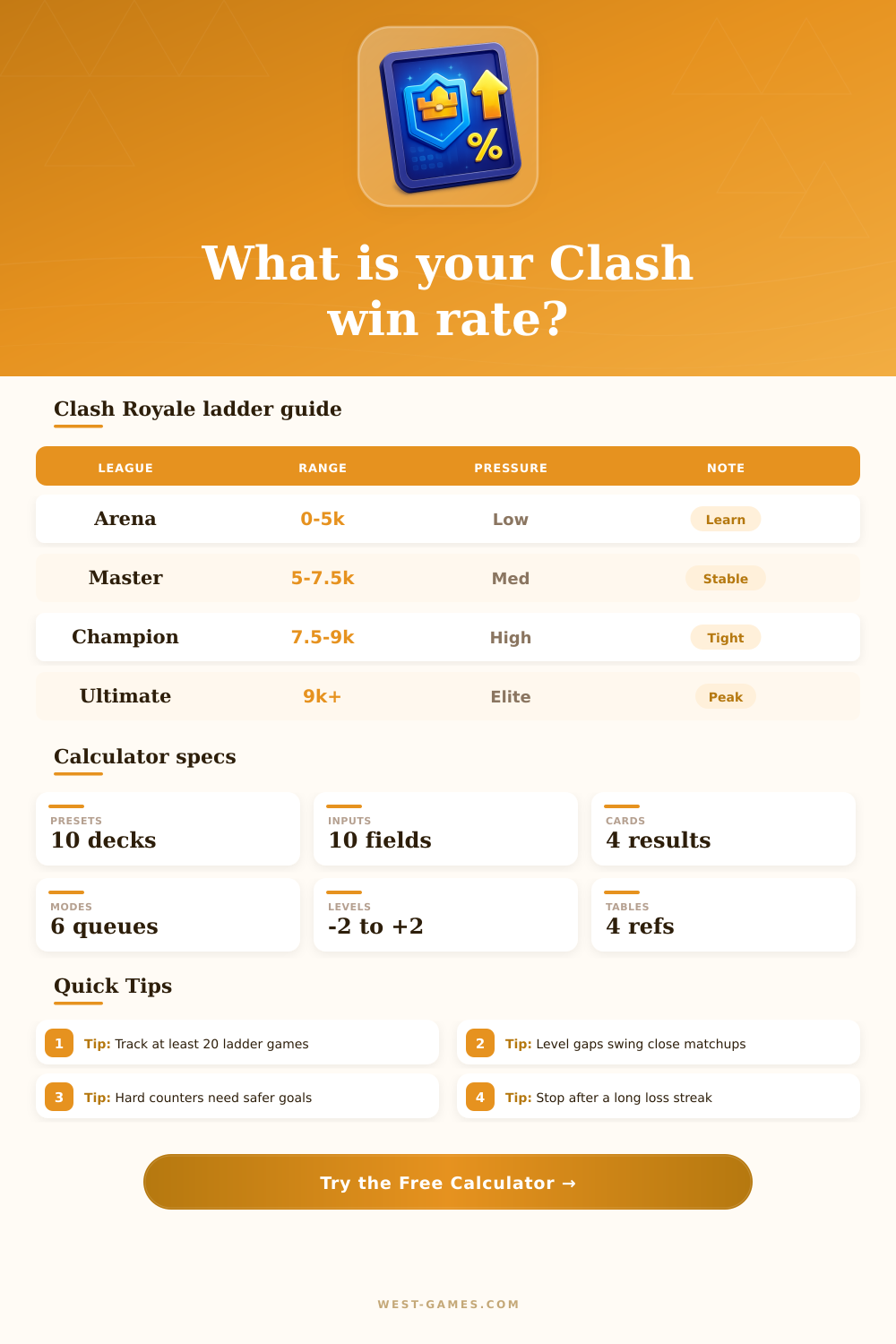
Players tend to focus mainly on their overall win percentage. They don’t consider conditions of a game. Winning 55% of your matches is one thing at three thousand trophies. It is something else entirely in Grand Champion. That’s average at three thousand trophies, it is elite play in Grand Champion. That is why it will ask what league and trophy range you’re playing at.
Small errors has large penalties in higher level ladders. Higher arena have opponents who know how to counter typical pushes. Even if you are playing well they diminish your base win chances. These leagues shift your expected results as shown in reference table on the page.
These predictions is heavily influenced by what deck you choose. Not all plays carry same volatility. Fast cycle decks depend on accurate timing of spells and damage to the towers. These are high variance play. Beatdown decks such as LavaLoon or Golem require long periods of safe setup, but one bad counter can swings the entire game into a loss before you even attack. One bad play, and you lose before you even get to attack. Bait decks perform best against an opponent without targeted counters. But they fall flat if your enemy doesn’t take the bait but pushes straight ahead. By choosing your deck makeup, you’re adjusting your base chance and that shows your strategys own risk.
Many people forget about card levels adding another layer of complexity. A two-level advantage over your enemy can break their defenses. Conversely, falling behind in card levels means your units die faster and your spells deals less damage, effectively shrinking your margin for error. Troops kill each other faster when you have lower card level. Spells do less damage. That reduces your margin of error.
The calculator lets you enter the average card level difference. It is important in modes such as Clan War Duels with restricted deck choice. Sometimes you can’t counter pick for particular advantages. A big stat deficit due to lower card levels isn’t fixed by strategy.
People underestimate how important win/loss streaks are. When you’re on a four-game win streak, it’s likely you’re making good decisions and not getting too frustrated. When you’re on a four-game losing streak, it probably means you’re mentally fatigued. It could also mean your deck just doesn’t play well in the metagame right now.
There’s an input for this factor in the tool. To prevent us from over-reacting to short term noise, the adjustment will be kept small. Figure out whether or not you need to change decks or if it’s just variance causing a streak. If the projected pace required to hit your target win rate is significantly higher than your estimated chance, then take a break. You can also try switching strategies. You can also try switching strategies.
It is about understanding probability and managing expectations. That’s what climbing the ladder is all about. Expect to lose games that you should of won. Win games that you shouldn’t have taken. It happens, it’s competitive play. Rather than try to justify each result, use data to help make your decision.
Consider a block of 20-30 games as opposed to just one match. Adjust based off matchup and levels. Remember that consistency beats intensity in the long run. Eventualy, the ladder tells you your actual skill level. Give it enough data to do its job.