🐢 TWoW Talent Calculator
Plan Turtle WoW class tree splits, Vanilla+ point budgets, leveling, raid, dungeon, PvP, hybrid scoring, capstone reach, and custom race/class assumptions.
| Class | Tree 1 | Tree 2 | Tree 3 | Common Turtle use |
|---|---|---|---|---|
| Warrior | Arms | Fury | Protection | Raid DPS, tanking, PvP weapon pressure |
| Paladin | Holy | Protection | Retribution | Healing, dungeon tanking, support DPS experiments |
| Hunter | Beast Mastery | Marksmanship | Survival | Leveling pets, raid ranged, trap and utility builds |
| Rogue | Assassination | Combat | Subtlety | Combat raid, dagger burst, stealth-control PvP |
| Priest | Discipline | Holy | Shadow | Power utility, raid healing, Shadow leveling |
| Shaman | Elemental | Enhancement | Restoration | Hybrid damage, totem support, healing |
| Mage | Arcane | Fire | Frost | Frost control, Fire raid output, Arcane support |
| Warlock | Affliction | Demonology | Destruction | Drain sustain, pet safety, Ruin burst |
| Druid | Balance | Feral Combat | Restoration | Feral tanking, healing, Balance hybrid routes |
Tree names follow the familiar Vanilla structure. Turtle WoW may alter individual talent effects, so the calculator focuses on route math and role fit.
| Preset | Class | Split | Best role | Why it works |
|---|---|---|---|---|
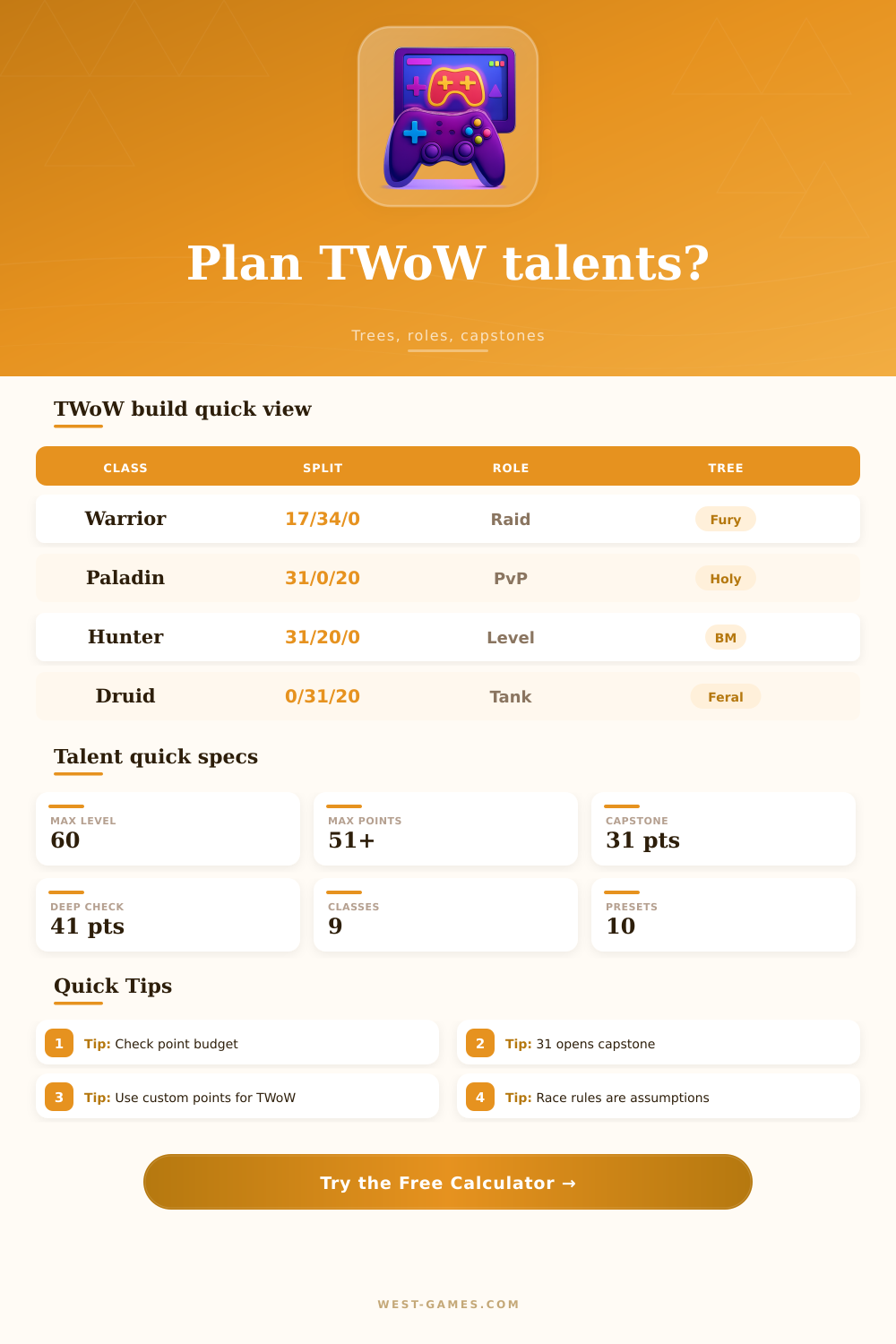
| Fury Raid | Warrior | 17/34/0 | Raid DPS | Deep Fury with enough Arms value for weapon pressure |
| Shock PvP | Paladin | 31/0/20 | PvP burst | Holy capstone route with Ret damage support |
| BM Leveling | Hunter | 31/20/0 | Leveling | Pet stability plus ranged throughput |
| Combat Raid | Rogue | 19/32/0 | Raid DPS | Combat main tree with Assassination efficiency |
| Shadow Level | Priest | 10/0/41 | Leveling | Shadow capstone route with Discipline support |
| Enhance PvP | Shaman | 0/31/20 | PvP hybrid | Enhancement pressure with Restoration utility |
| Frost Level | Mage | 18/0/33 | Leveling | Frost control while Arcane adds mana support |
| SM/Ruin | Warlock | 30/0/21 | Raid hybrid | Affliction sustain with Destruction crit payoff |
| Feral Tank | Druid | 0/31/20 | Tank | Feral core backed by Restoration survival |
| High Elf Support | Paladin | 20/31/0 | Dungeon tank | Protection control with Holy support tools |
| Mode | How combos are handled | Use when | Score effect |
|---|---|---|---|
| Turtle common | Allows known custom races and several public extra combinations | You are planning a normal Turtle WoW character | Unsupported combos show a warning only |
| Strict listed | Only accepts the calculator's listed Turtle assumptions | You want the race check to matter | Unsupported combos lower readiness |
| Classic fallback | Uses old Vanilla race/class combinations and excludes High Elf or Goblin | You compare a Classic-style build | Custom combos are penalized |
| Custom permissive | Allows every race/class pair | You play a custom realm or theorycraft freely | No race penalty |
The race selector includes Turtle WoW additions such as High Elf and Goblin. Treat the support mode as an assumption toggle, not an official rules database.
| Signal | Low | Solid | Strong | Planning note |
|---|---|---|---|---|
| Point budget | Over cap | 0-4 free | Exact spend | Exact spend is cleaner for final routing |
| Capstone reach | Under 21 | 31 reached | 41 reached | Deep builds give identity, hybrids give flexibility |
| Hybrid score | 0-30 | 31-65 | 66-100 | High is not always better for raid throughput |
| Role readiness | Under 55 | 55-79 | 80+ | Use this to compare routes, not to rank classes |
You grind out 60 levels across Azeroth, save your gold for respec scrolls, and agonize over how to spend each point. Even then, there is still big debate of whether to put points into utility trees or go deep into capstones. Turtle WoW adds another wrinkle by giving you extra talent points and custom races. Use this to help plan out your splits so you don’t waste your hard-earned currency making bad decisions.
It uses the Vanilla point skeleton, modified to take in account how Turtle bends the rules. Because there are so many hybrid class, race choice becomes far more important then it is in retail. There are also permissive custom rules vs. Strict Classic rules, and toggling between them make a difference when you play a Goblin, say, or a High Elf, on a server where such an option exists. Ignore the race assumptions at your peril; they may seem fine at first glance until you reach that wall of incompatible traits in game.
How to Plan Your Talents in Turtle WoW
Talent trees are typically viewed as silos. Players will put thirty-one points into their main one for capstone and randomly spread the rest out everywhere else. This is why so many hybrids fail: they need thoughtful support structures. One of the things the calculator looks at is whether or not your secondary tree help (or hinders) your primary role; a higher score means your character is more of a hybrid.
That’s not necessarily doing everything all at once. It’s having your off-tree points investing in ways that complement your main feature instead of watering down your primary role. More healing points for a tanking Druid make him more survivable by letting him heal himself instead of just straight damage points which dont matter when he’s trying to stand there.
It all changes when you consider content. Solo leveling has different requirements for burst and sustain compared to a DPS build for raids. The utility priority slider lets you increase or decrease how much you value healing support, control, or dispel talent options based off group composition. Playing with a casual group of people running dungeons without a healer? Increasing utility weight will help you visualize which talents is most important to keep everyone alive.
This shows you how those stats affect your chances of staying alive. There are preset buttons that give you shortcut for popular strategies. Load up a Beast Mastery Hunter leveling build or a Fury Warrior raid spec, and it will show you how those points are distributed across each of the three trees. Those presets are starting places, not rules. What’s valuable is adjusting from there.
Do you need more survivability in PvP? Shift some of your points out of raw damage into stances that protects you. The tool updates immediately with your role readiness and budget, letting you know where you sit before spending a point.
The other important factor for Capstone is its reach. Thirty-one points in a tree and you open up some seriously end-game skills which solidify what class you are playing. With one fewer point, you would of have to start over on the strategy you built, making it useless. You know, from the moment you start, you either have the reach to unlock those end game skills, or the calculator tells you that you are going to have to prune back elsewhere.
You see the cost of each point. The readiness score is also influenced by the level of gear. If you’re rocking quest greens in raid, then having a perfectly balanced talent build doesnt mean much. Your expected gear tier affects how the tool assesses your readiness. This provides a more accurate idea of how viable that build will actualy be. You won’t plan out a high-maintenance rotation for something you don’t yet have.
Finally, talent planning is a mix of realism and idealism. Sure, you’re striving for the highest possible numbers, but you must have some wiggle room for when things dont go as planned. While the calculator above will crunch the numbers for you, ensuring they follow the rules and are distributed correctly; it’s up to you to determine how much of which type of player you’d like to be at any given time.
Do you want pure damage output or are you looking for something that lasts longer? Knowing this makes the math pretty straightforward. It removes the guesswork and allows you to construct with intent. Leveling becomes an extension of creating your final character.