Brake Bias Calculator
Estimate front bias, front and rear braking force, dynamic weight transfer, axle tire grip, stopping distance, and lockup margin for sim racing setup work.
Formula Breakdown
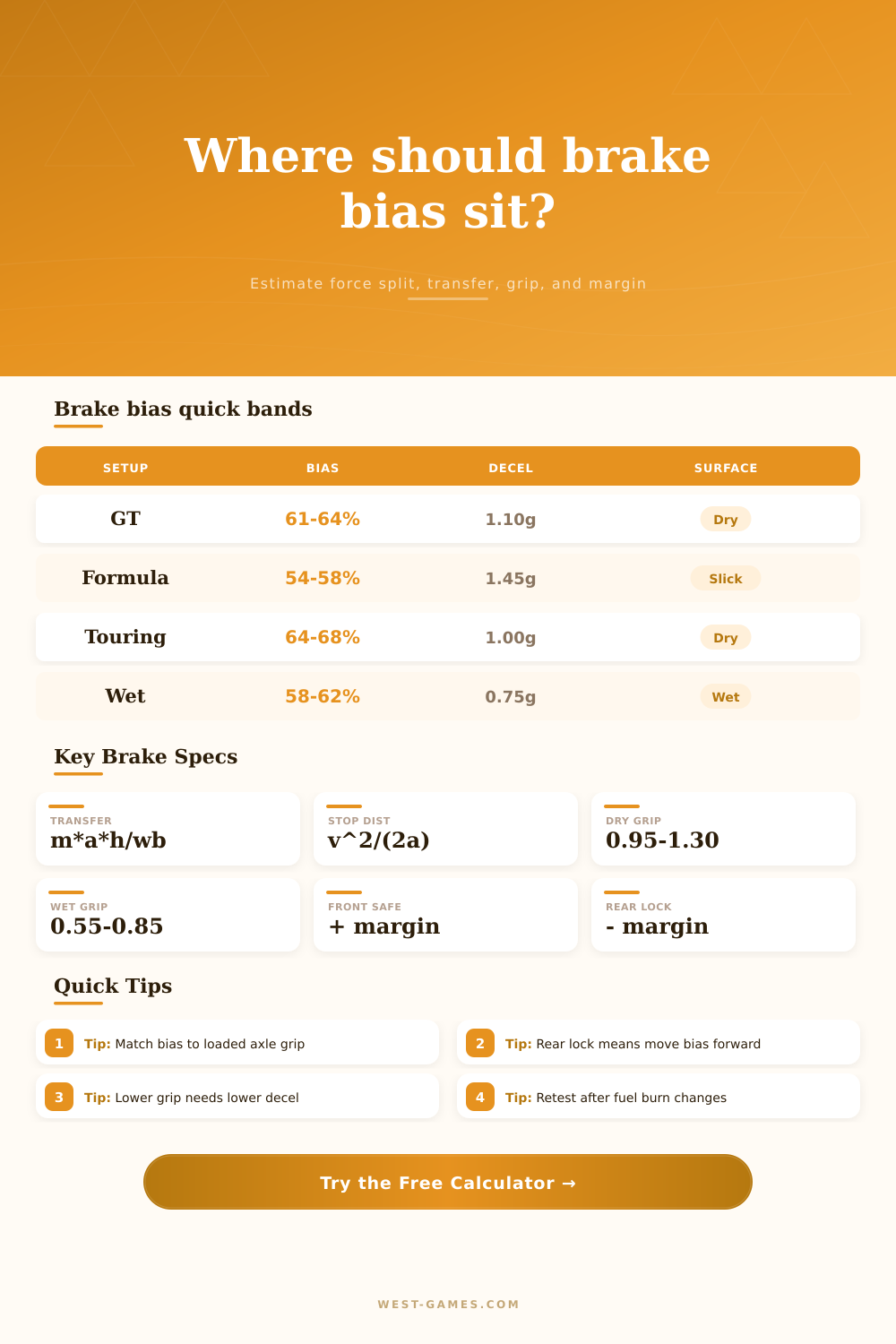
| Preset | Mass | Front Static | Wheelbase | CG Height | Decel | Grip | Bias |
|---|
Presets are generic sim setup cases, not tied to any vehicle maker or purchase advice.
| Item | Formula | Input | Output | Why It Matters |
|---|
| Surface | Typical Mu | Target Decel | Bias Tendency | Setup Note |
|---|
| Margin State | Front Margin | Rear Margin | Likely Feel | Bias Direction |
|---|
The pedal goes down and the car gets heavy. Front tires bite. Nose dives. Rear end wants to step out. This is the lap, if you’ve watched enough racing on TV. Where driver who carry speed through corner separate themselves from those who wind up in gravel trap spinning around.
The dance of this moment are controlled by an invisible hand called brake bias. It determines which axle will hold its line and which will slip away. Get it wrong and you’re either understeering like a shopping cart or oversteering like soap on ice. Get it right and you can brake later and go into corner harder.
What is Brake Bias and Why It Matters
The calculator above handles the math for you when you plug in your grip levels and weight distribution. It saves you the guesswork on conversions and coefficients.
Brake bias is often thought of by most sim racers as a static value. You select a number (perhaps 60% front) and stick with it throughout duration of your session. That’s an error. The car changes. The tires degrade. The fuel depletes. Every second you’re in the driver seat, the car’s balance constantly change.
As you enter a corner and begin diving in, weight shifts forward. This moves load toward the front, which creates more grip on front axle but less at the rear. In order to match this change in load transfer, you need to adjust your braking force accordingly. Perhaps sticking with same bias when tires is fresh and cold works out okay. However, as race continues, that exact same bias can become too rear-biased. Without sufficient vertical load to hold the braking torque, the rear tire will lock up.
How do we understand that? Weight transfer is the key. As center of gravity increases (heavy cars), the weight transfers further forward. That should of imply more front brake bias… right? Wrong. It’s more nuanced. Yes, the front tires gains more grip. But they must work harder to overcome all the inertia; they’re trying to stop a heavy vehicle. Formula cars are lightweight, sitting low on their wheels. They don’t transfer as much weight. Because the rear tires remains loaded, they can run more rear bias.
How does all this translate? The page has a table that shows you how various class of vehicles will run. A Formula car might be able to get away with running fifty-five percent front bias where a GT car need sixty-two percent. Why isn’t it arbitrary? Well, those figures represent physics of each individual chassis.
And then there’s the surface. The higher the coefficient of friction on the surface, the better the grip. The lower, the more slippery. When it’s wet out there, your braking force is reduced all around. Your ability to squeeze is reduced. And if you’re set for dry, your rear end will get twitchy. Time to slide that bias forward and stabilize rig.
Some guys don’t understand that sliding bias forward doesn’t make their rear end “lighter”. This makes the rear brakes less effective, preventing them from locking up when total braking force is low. It is small stuff. But it is important stuff. Do you spin out or have a smooth exit?
But there’s one more wrinkle: fuel management. Your car is heavy when the tank is full. Where does all that gas go? Most often it goes into the center-rear or rear of vehicle. Fuel burns up over time. The car lightens. The static weight balance shifts. The dynamic load transfer shifts. What felt right initialy no longer feels right by last lap. You need to account for that change. You might be able to begin race with a slight rearward bias and then move that bias forward as the race progresses. Alternatively, you could establish a compromise that fits average fuel load.
The calculator gives you an idea about how much margin you’ve got. It displays your grip reserve on both axles. If the rear has a negative margin, you’re putting too much pressure on those tires. Adjust the bias forward. If the front has a negative margin, you’re putting too much pressure on the front end. Adjust it backward.
Data is what makes practice efficient, but practice still makes perfect. When the tires lock up, you know it. The simulator will tell you when they locked. Look at the lockup margin and get an idea of just how close you were. Chasing the very edge is not a good thing. Leave yourself some room for error. The extra buffer allows you to trail brake effectively and never lose control. It provides the confidence needed to take more speed into the turn-in point.
Brake bias isn’t about stopping in a straight line. It’s about balancing the car as you transition from straight-line speed to cornering speed. It’s a fluid process. So treat it as such. Adjust your settings with changing conditions. Monitor the telemetry. Get a feel for the car.
And don’t forget, the best set-up is the one that keeps the car moving. That is the ultimate goal. Stopping isn’t about speed. Not stopping when you don’t want to stop is.