🔫 Borderlands 4 Harlowe Skill Tree Calculator
Plan tree points, cooldown cadence, and survivability fit before you lock your route.
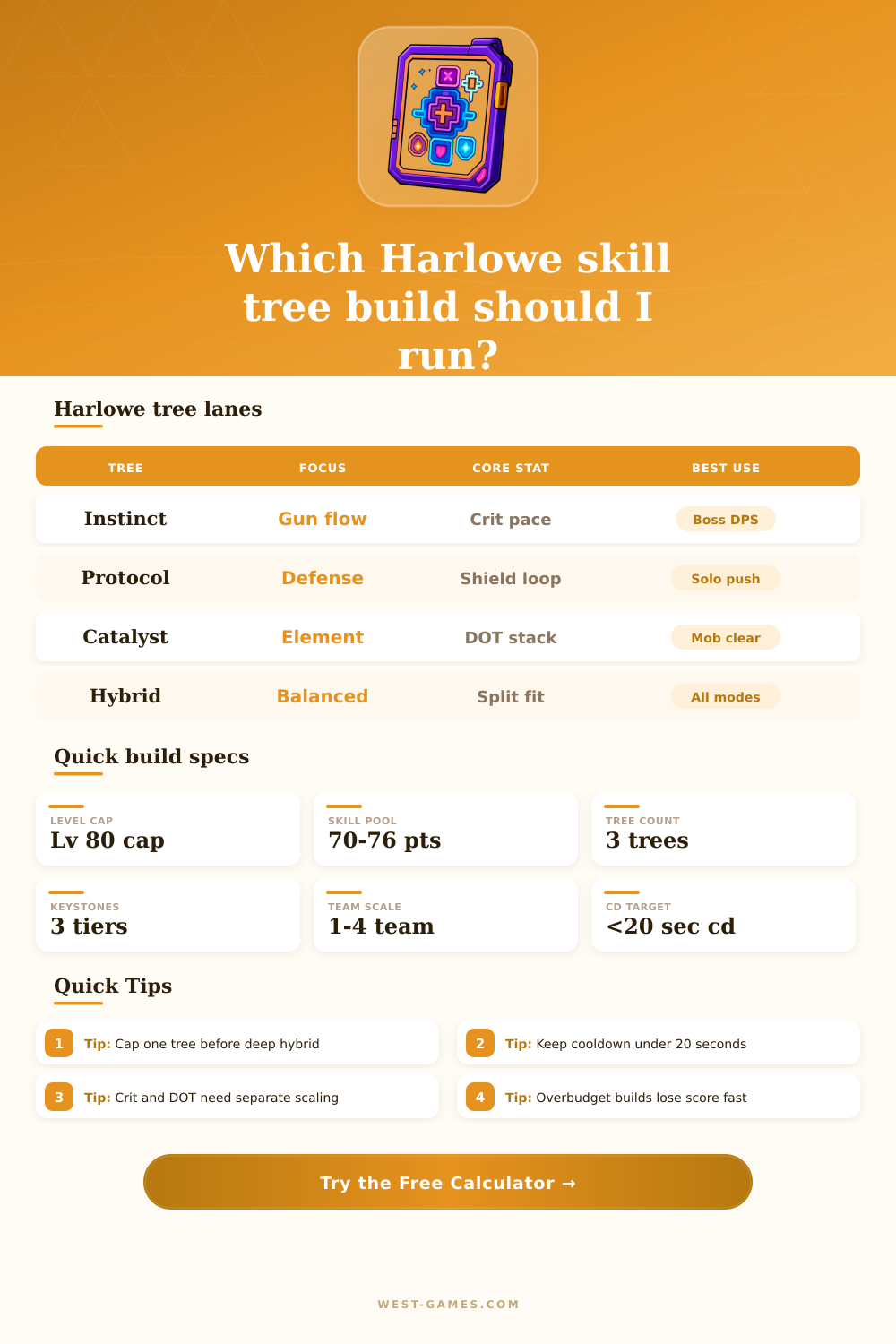
| Tree | Focus | Power | Use |
|---|---|---|---|
| Instinct | Gun flow | Crit chain | Boss |
| Protocol | Defense | Shield loop | Solo |
| Catalyst | Element | DOT stack | Mobs |
| Hybrid | Balanced | Split fit | All |
| Points | Gate | Jump | Note |
|---|---|---|---|
| 8 | Core | Base loop | Early |
| 16 | Strong | Stable | Mid |
| 25 | Deep | Major | End |
| 33+ | Peak | High | Focus |
| Archetype | Instinct | Protocol | Catalyst |
|---|---|---|---|
| Crit Aggro | 48% | 28% | 24% |
| Status Runner | 26% | 22% | 52% |
| Shield Sentinel | 22% | 54% | 24% |
| Skill Weaver | 34% | 26% | 40% |
| Balanced Hybrid | 35% | 33% | 32% |
Harlowe skill tree require planning because the skill trees for Harlowe rely on the player’s rhythm to generate the desired effect rather than the raw power of the abilities. There are three primary skill trees available to player for Harlowe, and these are Instinct, Protocol, and Catalyst. The Instinct skill tree focus on critical hits and is helpful for players looking to increase there damage against boss enemies.
The Protocol skill tree provide players with the ability to increase there survival during solo play. Finally, the Catalyst skill tree increases the players elemental damage over time, which is beneficial for those looking to deal group of enemies. If players dont plan their skills correctly, they will most likely find themselfs too weak for the game or not doing enough damage.
How to choose your Harlowe skill tree
Players can select their skill tree to match their playstyle. If players want to do high damage to boss enemies, they should select the Instinct skill tree to allow for critical hit to chain. However, they may have trouble with groups of enemies with no shield and may do too much damage to their shields.
Players who would like to survive longer in their playthrough should select the Protocol skill tree to help them loop their shields for defense. If players want to clear many enemies at once, they should select the Catalyst skill tree to allow them to stack their damage over time with each enemy. Although its possible to create a hybrid of these skill trees, players should first complete one of them before selecting the next.
Skill tree milestone gates are at 16 points and 25 points, which provide players with increases in there power. Players can select their weapon to match their skill trees. Players should ensure their skill tree selection match their weapon choice.
For example, players that use a submachine gun that critically hit players should use the Instinct skill tree to increase the critical hits. For players that use elemental weapons that deal damage over time, the Catalyst skill tree will work best for these player. Players that take on a support role for their team should use the Protocol skill tree to sustain their shields for their teams.
Boss enemies are geared toward critical hits, whereas mob wave are geared toward damage over time. Cooldowns will dictate how often a player can use their abilities. If a player uses high uptime skill, this will work better with their skill trees.
If they do not invest in cooldowns, they will have periods of downtime in their gameplay. The critical hit rate and the number of status effect opportunities will depend on the skill trees the player chooses. In addition to dealing damage, players must be able to survive their gameplay.
A player that cannot survive the enemies will fail even with the best damage. Lastly, the size of the team will impact the players requirement for there Harlowe skill build. There are skill tree presets available to players that allow them to avoid guesswork.
Skill tree presets show the player one of the proven skill tree distribution. For example, the Crit Cascade skill tree is geared toward boss encounters, whereas the Shield Anchor skill tree is for endurance-based encounters. These skill trees will show players how to distribute their points in their skill trees according to their playstyle.
The tree shares will show if their skill tree distribution is skewed toward one skill tree over the others. The depth score will allow players to see if they have focused on one skill tree before taking the next skill tree to level. Budget warnings will let them know if they are overcommitting to a specific skill tree and the outputs will give them a grade for there entire build.
An S-tier is the best, while a B-grade is still playable. Many players will make mistake with their skill trees by not considering the type of enemy they are fighting. Bosses will ignore damage over time and will ignore critical hit skill in some cases.
Players should create their skill tree build during the leveling process so that they can properly create a skill tree that balances there damage, survival, cooldowns, and points distribution. They should work towards the keystone node for the endgame content as they level up. These nodes take two points per tier but provide players with significant power.
In addition to the game, there are real world gears that can assist in there game such as class mods that reduce cooldowns and anointments that increase the critical hit rate for players. Common mistakes that players will make are not considering cooldowns when investing there skill trees. Players that want to deal high damage with their abilities but do not focus on cooldowns will have period of downtime.
Players that do not focus on survival will have to focus on there movement around enemies if they want to survive. Lastly, using a hybrid between skill trees before they are completed will result in players losing skill tree level as their skills will not build as fast as if they focused on only one skill tree. Players can use the calculator to weight their weapon and skill tree choice.
The calculator will weigh skill trees that provide the best outcome for players in high-end game runs.