Balatro Score Calculator
Estimate a Balatro hand score from poker hand base Chips and Mult, planet levels, played cards, editions, seals, held Steel cards, Joker additives, X Mult, hands remaining, and the blind target.
| Score? | Rank | Enhancement | Edition | Seal | Extra retriggers | Card label |
|---|---|---|---|---|---|---|
Card rows model the usual left-to-right card scoring layer. Red Seal adds one retrigger when seal handling is enabled. Extra retriggers allow estimates for Mime, Hack, Sock and Buskin, Blueprint copies, or other repeat effects.
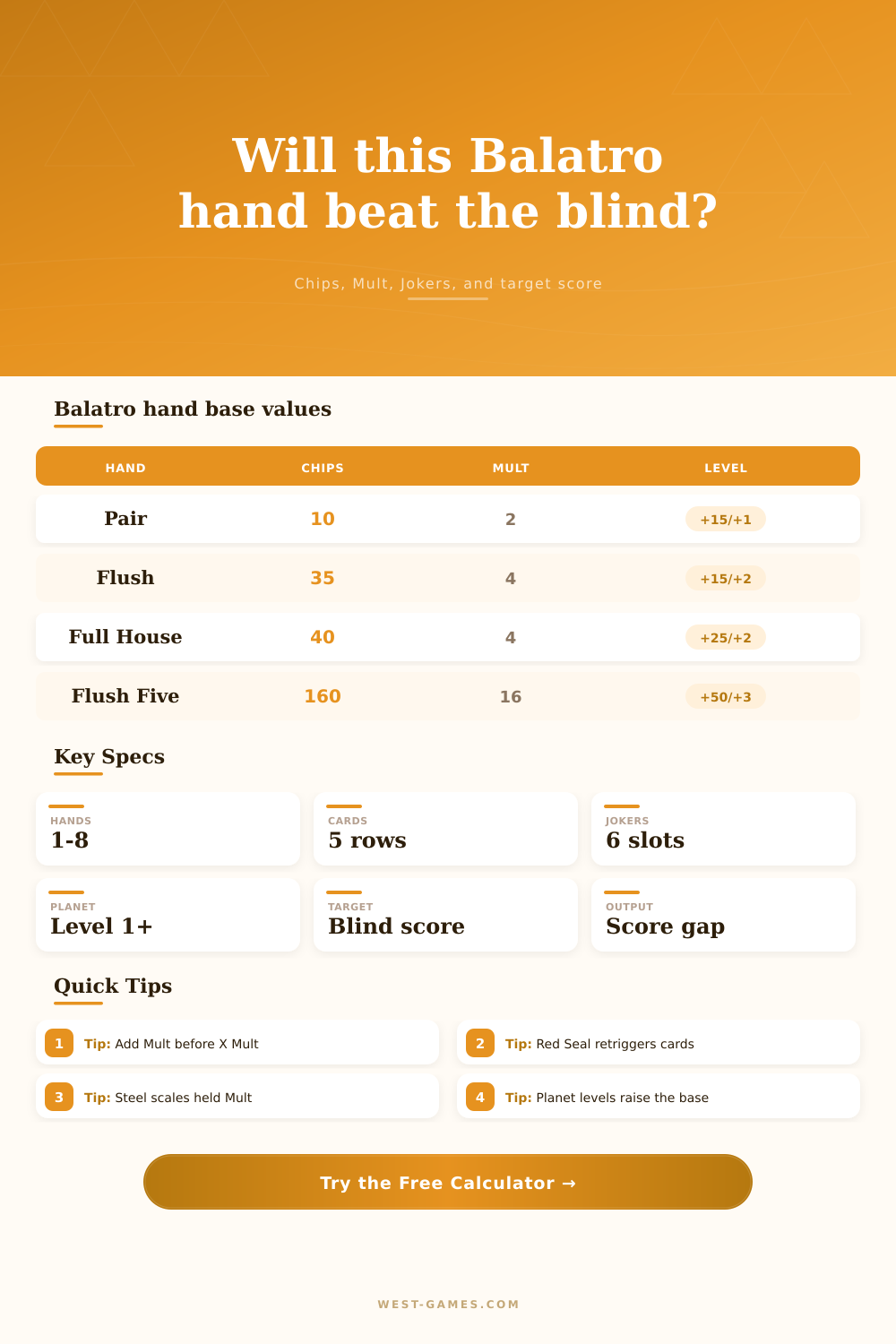
| Hand | Level 1 Chips | Level 1 Mult | Planet level gain |
|---|---|---|---|
| High Card | 5 | 1 | +10 Chips, +1 Mult |
| Pair | 10 | 2 | +15 Chips, +1 Mult |
| Two Pair | 20 | 2 | +20 Chips, +1 Mult |
| Three of a Kind | 30 | 3 | +20 Chips, +2 Mult |
| Straight | 30 | 4 | +30 Chips, +3 Mult |
| Flush | 35 | 4 | +15 Chips, +2 Mult |
| Full House | 40 | 4 | +25 Chips, +2 Mult |
| Four of a Kind | 60 | 7 | +30 Chips, +3 Mult |
| Straight Flush | 100 | 8 | +40 Chips, +4 Mult |
| Five of a Kind | 120 | 12 | +35 Chips, +3 Mult |
| Flush House | 140 | 14 | +40 Chips, +4 Mult |
| Flush Five | 160 | 16 | +50 Chips, +3 Mult |
| Modifier | Chip effect | Mult effect | Scoring note |
|---|---|---|---|
| Rank card | 2-10, face 10, Ace 11 | None | Only scored cards add rank Chips. |
| Bonus card | +30 Chips | None | Added when the card scores. |
| Mult card | Rank Chips | +4 Mult | Adds before X Mult effects. |
| Glass card | Rank Chips | X2 Mult | Applied for each scoring trigger. |
| Steel card | None if held | X1.5 Mult | Use held Steel inputs for cards left in hand. |
| Stone card | +50 Chips | None | Has no rank or suit. |
| Lucky card | Rank Chips | Modeled as 0, expected +4, or hit +20 | Lucky money is utility, not score. |
| Red Seal | Repeats card scoring | Repeats card scoring | One extra trigger when seal handling is on. |
| Effect type | Input field | Value modeled | Order used |
|---|---|---|---|
| Foil playing card | Card edition | +50 Chips | With that card trigger. |
| Holographic card | Card edition | +10 Mult | With that card trigger. |
| Polychrome card | Card edition | X1.5 Mult | With that card trigger. |
| Foil Joker | Foil Joker editions | +50 Chips each | After card scoring. |
| Holographic Joker | Holographic Joker editions | +10 Mult each | Before X Mult Jokers. |
| Polychrome Joker | Polychrome Joker editions | X1.5 Mult each | With multiplicative Jokers. |
| Additive Joker | Total additive Joker Mult | +Mult | Before the X Mult chain. |
| X Mult Joker | X Mult Joker slots | Multiplicative | After additive Mult in listed order. |
Four hands remain. A number acts as a blind. A number dares you to try.
The deck is thin. Jokers that adds flat numbers and exponentially multiply. The board shows a flush, yet to make that flush requires burning your best cards. That’s when arithmetic replaces intuition.
Understanding the Math Behind Your Score
That’s when Balatro punishes those who fail to grasp that score isn’t one stat. Score is the result of two different engines firing in succession. Add the chips. Multiply the sum at game’s end. Increase the former while ignoring the latter and you won’t come close. Stack the latter without a base and all you’re doing is multiplying nothing.
The calculator above handles the heavy lifting, but it do not play the game for you. Input your level on each planet plus which specific hand type you’re dealt. Then watch it show you math behind the decision before committing to a play.
“New players make the fatal mistake of assuming every source of score is equal. That’s just not true. Flat bonus to Chips is good, but it’s limited. Flat bonus to Mult is risky… It thins out your multipliers. Understanding the order of operations is where the magic happens. You want to create as big a pool of additive Mult from card modifiers + jokers as possible. After that you slap down multiplicative jokers over the sum.
Why do you care about the position of your jokers? Because the further back a multiplier sits in the chain the more powerful it becomes. The later your multiplier is better. You can set certain slots to have an X amount of Multiplier. From there you can move around your deck and/or switch jokers and see how it changes your overall score. Ideas become real numbers.
Then there’s the layer of Card modifiers. For example, foil cards adds 50 Chips. That doesn’t sound too bad…until you remember that it isn’t scaled by your multiplier. Holographic cards add +10 Mult. It is still better but it is still additive. Then there are Glass and Steel cards. Those really start kicking ass, particularly if you have Red Seals.
When a card re-triggers a Red Seal, it counts as two hits on that card. If that card happens to be a Glass Joker, it doubles your Mult…twice. And if it’s a Steel card that’s in your hand, it activates a passive multiplier. The trick is that all these interactions does not follow a straight line. Doubling your input isn’t doubling your output. It squares it.
On the right of the page they break out what the base value is for each kind of hand. This is critical when deciding how to spend your planets’ upgrade points. Leveling up a Straight Flush gives different returns than leveling up a Pair. Know which hand you’re leaning into for the next five rounds.
The boss blindly demands that you change how you think about planning. Early in the game, you’ll get by with crude synergy and a little bit of luck. Late in the game, you’ll be precise. Not only do you have to calculate the score of this hand, but you also has to calculate the projected score of every subsequent hand. With three hands left, and ten thousand points needed, that means each hand has to hit an average of three thousand three hundred and thirty-three points.
Enter your current score into the calculator, along with the number of hands remaining. Will your current plan get you through the blind? If the gap remains positive, you’ll instantly know if your current line of play won’t cut it. You’ll instantly know if your current line of play won’t cut it.
Perhaps you should discard that weak joker to create space for a better multiplier. Or perhaps you should settle for a lower hand type so you can save that key card for the next round. That’s because there are equations in every single round of this game, and the math doesn’t lie. Your gut might.
But when you treat each round as an equation with a solution, you take anxiety out of the decision making process. You no longer wonder “will this gamble pay off?”. You begin to know how much it costs. The calculator isn’t playing the game for you. It’s simply offering a lens. It is a way to see the cost of your choices more clearly.
So yes, when you get your deck and sit down to play, you’ll still draw cards chaotically. Sometimes you’ll have an unfortunat distribution. But you’ll know the difference between a hopeful guess and a calculated risk when it comes to the value of your choices. Because then, you’ll know the difference: the difference between a calculated risk and a hopeful guess. Knowing the difference is all of the edge you’ll ever need in Balatro.