🛰 Space Engineers Resource Calculator
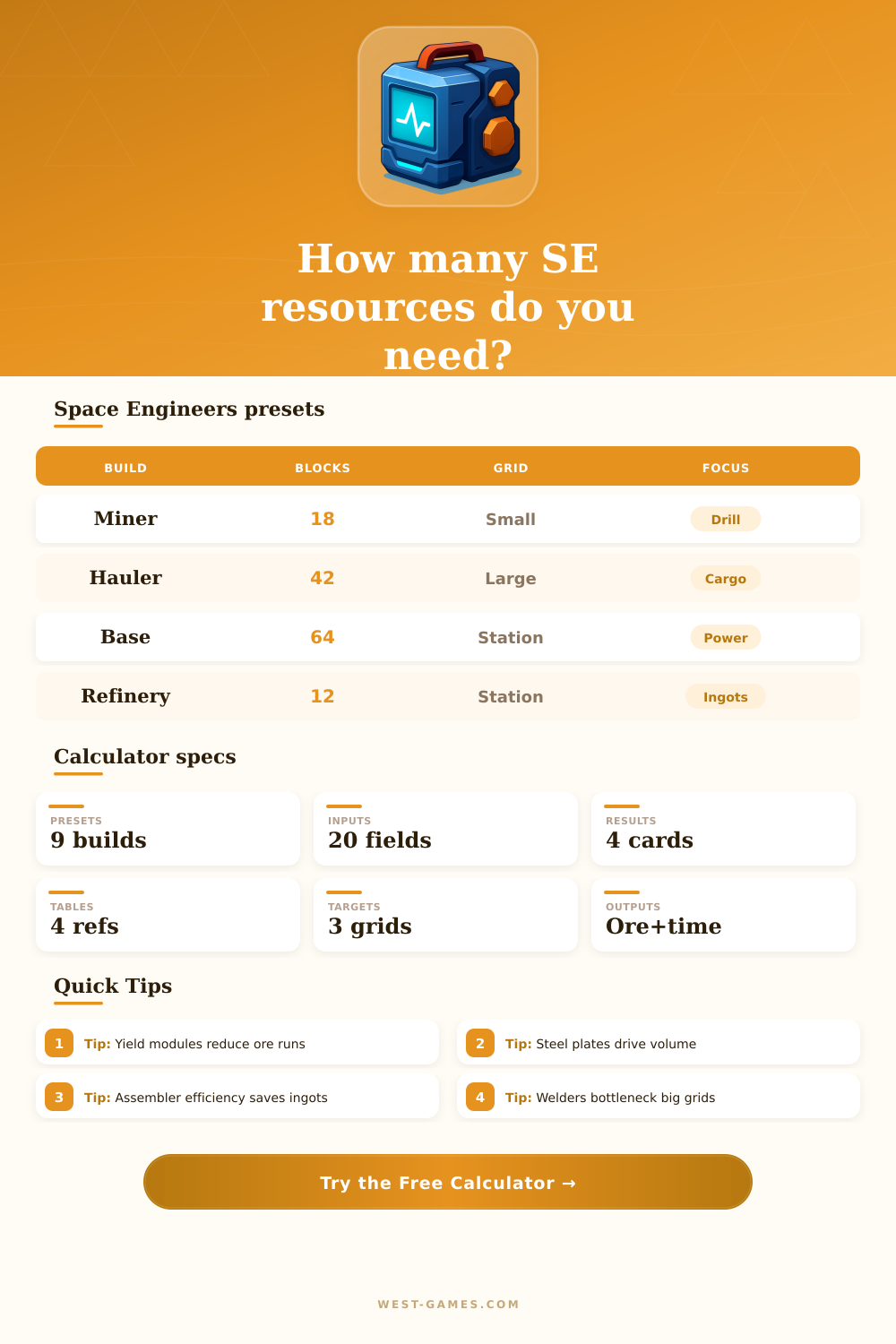
Plan Space Engineers block blueprints, component counts, ingot requirements, refinery yield, assembler efficiency, inventory volume, welding time, ship or station targets, and ore-to-ingot conversion.
| Component | Main ingots | Volume | Planning note |
|---|---|---|---|
| Steel plate | 7 iron | 3 L | Armor and frames |
| Interior plate | 5 iron | 5 L | Light blocks and fittings |
| Construction comp. | 2 iron | 2 L | Common functional part |
| Motor | Iron, nickel, cobalt | 8 L | Thruster and rotor pressure |
| Computer | Iron and silicon | 1 L | Control and electronics |
| Metal grid | Iron, nickel, cobalt | 15 L | Heavy and industrial blocks |
Component recipes are practical planning values for vanilla-style blueprint estimates. Mods and server settings can change exact values.
| Preset | Target | Heavy component | Best use |
|---|---|---|---|
| Small grid miner | Ship | Motors | Early ore runs |
| Large hauler | Ship | Steel plates | Cargo logistics |
| Starter base | Station | Construction comps | Survival expansion |
| Defense wall | Station | Computers | Ammo and control |
| Refinery room | Station | Metal grids | Industrial processing |
Use presets to shape a plan quickly, then edit the component counts from your actual projector or terminal list.
| Setup | Yield | Speed | When to use |
|---|---|---|---|
| Survival kit | 0.55x | 0.20x | Emergency stone processing |
| Basic refinery | 0.70x | 0.45x | Early base refining |
| Standard refinery | 1.00x | 1.00x | Default vanilla line |
| 2 yield modules | 1.22x | 0.80x | Ore-saving setup |
| 4 yield modules | 1.44x | 0.65x | Maximum yield planning |
Yield modules reduce ore required but may slow the line. Increase base refining rate if your refinery array runs in parallel.
| Ingot group | Planet ore | Asteroid ore | Common bottleneck |
|---|---|---|---|
| Iron | 0.70 kg/kg | 0.78 kg/kg | Steel plates |
| Nickel | 0.38 kg/kg | 0.46 kg/kg | Motors and grids |
| Cobalt | 0.28 kg/kg | 0.34 kg/kg | Motors and grids |
| Silicon | 0.55 kg/kg | 0.62 kg/kg | Computers and displays |
| Silver | 0.10 kg/kg | 0.13 kg/kg | Displays and electronics |
The calculator applies ore profile rates plus the selected refinery yield multiplier to estimate raw ore demand.
| Pressure | Cargo trips | What it means | Best adjustment |
|---|---|---|---|
| Light | 1 to 2 | Carry volume is fine | Focus on welding order |
| Moderate | 3 to 5 | Hauling starts to matter | Add temporary cargo |
| Heavy | 6 to 9 | Logistics can bottleneck | Use a welding ship |
| Severe | 10+ | Trips dominate the project | Stage components nearby |
Component volume is calculated after owned stock is credited, so prebuilt parts and nearby cargo can sharply reduce hauling time.
I mean, there’s this moment in every game like building this giant drill ship and realizing that you’re three hundred steel plates short of actually having built it. Right? And you look around and find all these cargo container, and think: where did my ore go? Space makes no sense. Your intuitive feel for mass doesn’t work in space. Getting materials isn’t so much an issue. It’s figuring out what to do with them, even before grabbing a wrench.
If only there were some way to clear the list without just… mining? That’s inefficient, that’s boring. What you need is to plan not only your material collection but also how you make the materials themselves. You should view resource management not as a scavenger hunt but as a supply chain problem. Just plug it all into the calculator above and it will do the math for you. It will spit out a concrete schedule for what to weld when, what needs to be refined, and what goes together.
Plan Your Building Project Better
But knowing why one input matters more than another helps you play the game better. The inputs that typically becomes a bottleneck are steel plate (they take up a lot of space in your inventory and require pure iron). But if you don’t consider their size and weight, you could wind up with plenty of materials to work with, only to not have anywhere to fit them as you weld. That’s where most people go wrong. They’ll tally up the mass, but overlook cubic capacity.
Productivity depends greatly on refinery efficiency. Each module yield more ingots from each unit of ore… Meaning you mine less frequently from asteroid belts or the surface of planets. On the other hand, those modules generally decreases the refinery’s speed. With this tool, you can toggle through different sets of modules and see what effect they’ll have on your overall time investment. Time is money, as they say, so if you’re short on time but rich in materials, speed is key. Patience is a virtue, though, so if you’ve got plenty of time but not many material, yield reigns supreme.
And then there’s inventory multipliers. When building in survival mode with no perks, your own inventory space is small; it doesn’t come close to what’s necessary to construct something like a big grid ship. To account for that, the calculator lets you enter reasonable amounts of cargo and how long it takes to move it from your storage boxes to wherever you’re working. That’s where some of the hauling time goes, if you need to fly back and forth ten times just to ferry a load of steel plates, that will add up much quicker then actually welding things together. Recognizing that logistical drag helps avoid the frustration of taking on a project that you feel is impossible to complete due to sheer movement limitations.
People also underestimate how fast it’s possible to weld. They think it must be hard because you’re hunting for rare items such as computers or even rarer metal grids. While those are hard to find, there’s also a huge queue of basic stuff that isn’t very interesting but would take forever to do by hand. Depending on what kind of setup you have, whether you’re projecting an array onto walls or just carrying around a hand welder or a ship welder… The tool tells you roughly how many hours will be spent welding. That gives you enough information to know if you want to play this today. Do I need to go to bed so the game can chew through everything while I’m asleep?” It makes abstract progress feel concrete.
You never know what you’re building if you don’t know what you’re building. Until three in the morning when you need fifty cobalt ingots but all you’ve got is iron. You waste hours wandering randomly around looking for ore that feeds something you need. If you plan ahead using the tool’s ingredient recipes, you can manage how much of each type of ore you want to consume. That means you’re only targeting asteroids or planets for the ones you care about. It’s less grinding and more engineering project: you aren’t running around after rocks anymore, you’re managing a factory. The reference tables that come with the tool provide a quick view of which ores go into each component. That way you can focus your mining runs directly on what you need.
Sometime along the way each Space Engineers player reaches a milestone of no longer being able to count by hand and must resort to systematic planning. This is the difference between a casual tinkerer and someone who builds stations as their passion. You won’t end up with an empty cargo like so many new players do if you can account for time, yield, and volume all at once. Next time you’ve got a big blueprint staring you in the face, keep in mind: it’s nothing more than some numbers on a screen begging to be organized. A little bit of planning goes a long way towards keeping your sanity and your ships flying.