🎮 Amon Skill Tree Calculator
Plan branch depth, mastery sync, and mode fit before you lock your next Amon build path.
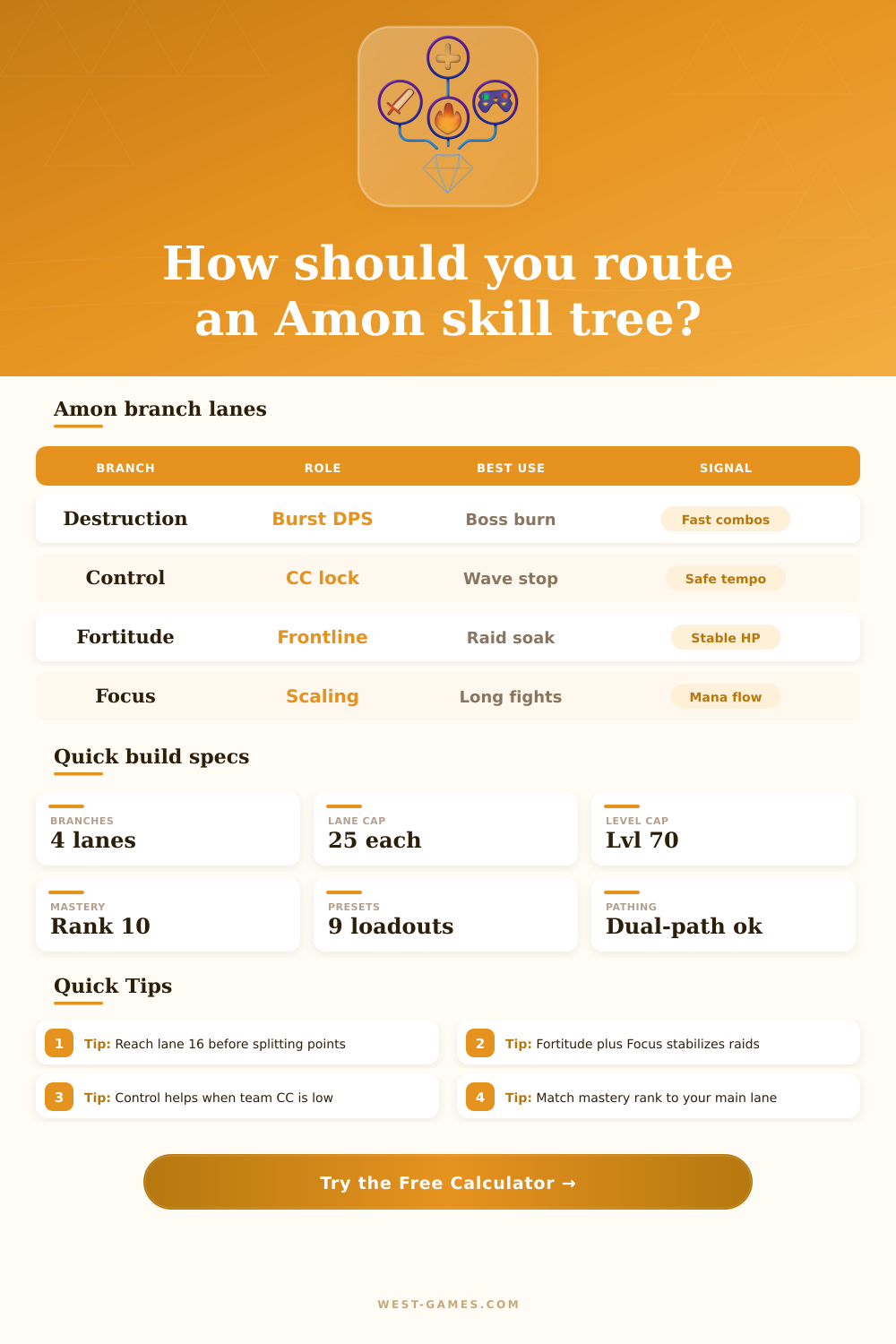
| Branch | Core role | Best use | Tradeoff |
|---|---|---|---|
| Destruction | Burst DPS | Boss windows | Needs setup |
| Control | CC and setup | Arena waves | Lower raw DPS |
| Fortitude | Mitigation | Raid soak | Slower clears |
| Focus | Scaling | Long fights | Late payoff |
Use this map to keep one clear lane identity instead of spreading points too thin.
| Lane points | Tier | Unlock type | Build signal |
|---|---|---|---|
| 4 | Base | Core nodes | Entry route |
| 8 | Mid | Modifier nodes | Identity starts |
| 12 | Deep | Signature nodes | Main lane |
| 20 | Elite | Capstone chain | Endgame route |
If no lane reaches 12, the build often feels unfinished in high-pressure content.
| Mode | Lead lanes | Point bias | Practical note |
|---|---|---|---|
| Duel | Destruction + Focus | Front burst | Win short windows quickly |
| Arena | Control + Destruction | Wave clear | Lock groups then burst |
| Raid | Fortitude + Focus | Sustain depth | Keep uptime through mechanics |
| Gauntlet | Control + Fortitude | Stable tempo | Prioritize survivable pace |
| Hybrid | Balanced spread | Mixed lanes | Safer for unknown fights |
Choose mode first, then tune the lane split to avoid rebuilding every time content changes.
| Mastery rank | Best lane depth | Resonance range | Planner signal |
|---|---|---|---|
| 0 to 3 | 8 to 12 | 35 to 50 | Early growth |
| 4 to 6 | 12 to 16 | 50 to 65 | Stable route |
| 7 to 8 | 16 to 20 | 65 to 80 | Late-game core |
| 9 to 10 | 20 to 25 | 80 to 95 | Capstone focus |
Mastery and resonance are strongest when they match the depth of your primary lane.
Amon’s skill tree define how Amon play in the game. Amon’s skill tree contain four branches: Destruction, Control, Fortitude, and Focus. Each of these branch offers Amon different benefits.
Amon must decide how to allocate skill point to each of these branches. Putting point into each branch equally will dilute the effectiveness of Amon’s ability; Amon should focus on one branch rather than attempting to develop all of them. The Destruction branch allow Amon to deal explosive damage with high damage output.
How to Build Amon’s Skill Tree
This is useful after knocking an opponent down with a stun or after Amon successfully dodge an opponent’s attack. The Control branch allow Amon to manage the waves of enemy that approach Amon. This provides security for Amon but require Amon to sacrifice some of the damage output that Amon otherwise could of done.
The Fortitude branch provide Amon with more survival skill. Amon can endure longer fight with Fortitude because it mitigate the damage that Amon take. Finally, the Focus branch allow Amon to execute the Destruction skill over longer periods of play.
Amon has more resource with Focus so that Amon does not run out of mana. Many player place point into each of the four branch equally at the start of the game. This prevent Amon from going deep into any one branch.
Amon should invest in one of the branches to reach the midpoint before then investing in another branch. Amon reach the midpoint of one of the skill trees to unlock signature node for Amon. Once Amon unlocks these signature node, Amon will have more effective rotation for combat.
Amon can then invest into another branch that work with the primary branch that Amon chose. For instance, Destruction and Focus work well together because Focus can refill the mana tank after using one of the Destruction skill that consume a lot of mana. If Amon does not follow this strategy and place equal point into each of the branches, Amon will only be able to use the base ability for Amon.
Amon will not be dominant in combat. The type of game content that Amon play with will determine which of the four branch is the most important. For instance, in duel, the most important branch for Amon will be Destruction because Amon will need to deal burst damage fastly to win the duel.
For arena wave, the most important branch will be Control because Amon will have to control the enemy in the arena. For raid content, Fortitude and Focus is the most important because Amon will have to endure the raid content. Finally, for gauntlets, Amon should focus on being a stable Amon rather than one that deal the most damage.
The mastery rank and resonance system will enhance the effectiveness of each of the Amon branch. Amon should ensure that mastery rank match the deepest point of investment into one of the skill branch. Amon should not put a high mastery rank into a branch with few game point invested into it.
Resonance will enhance the uptime of Amon’s sigil. Survivability target will ensure that Fortitude skill point are translated into Amon surviving the combat encounter. There are preset for Amon’s skill tree.
Preset are snapshots of Amon’s skill trees that have already been tested, such as the Shadow Duelist or the Void Bruiser preset. Amon should load the preset that match the archetype of Amon that Amon want to play and then tweak the preset to match Amon’s level and game point budget. Amon can use the fit score to see how close to the optimal skill tree Amon’s is.
The fit score will show the hierarchy of each of the branch and whether or not Amon has overspent Amon’s budget. The fit score will also count deep investment into each branch, meaning how many point Amon has invested into a branch with 12 or more point. There are some mistake to avoid when playing with Amon.
For instance, do not ignore the unlock tier because Amon will not have access to some of the sigil node that will allow Amon to maximize their effectiveness. Do not overcommit into burst damage because Amon will not have the resource required for the middle of combat. Amon should avoid mastery rank mismatch because they will also blur the effectiveness of Amon.
Amon should test Amon’s skill tree in non-critical game to see where Amon’s build fail and take unnecessary hit in combat. Based off these note, Amon can iterate on Amon’s skill tree to ensure that Amon is optimize for the type of game content that Amon will play.