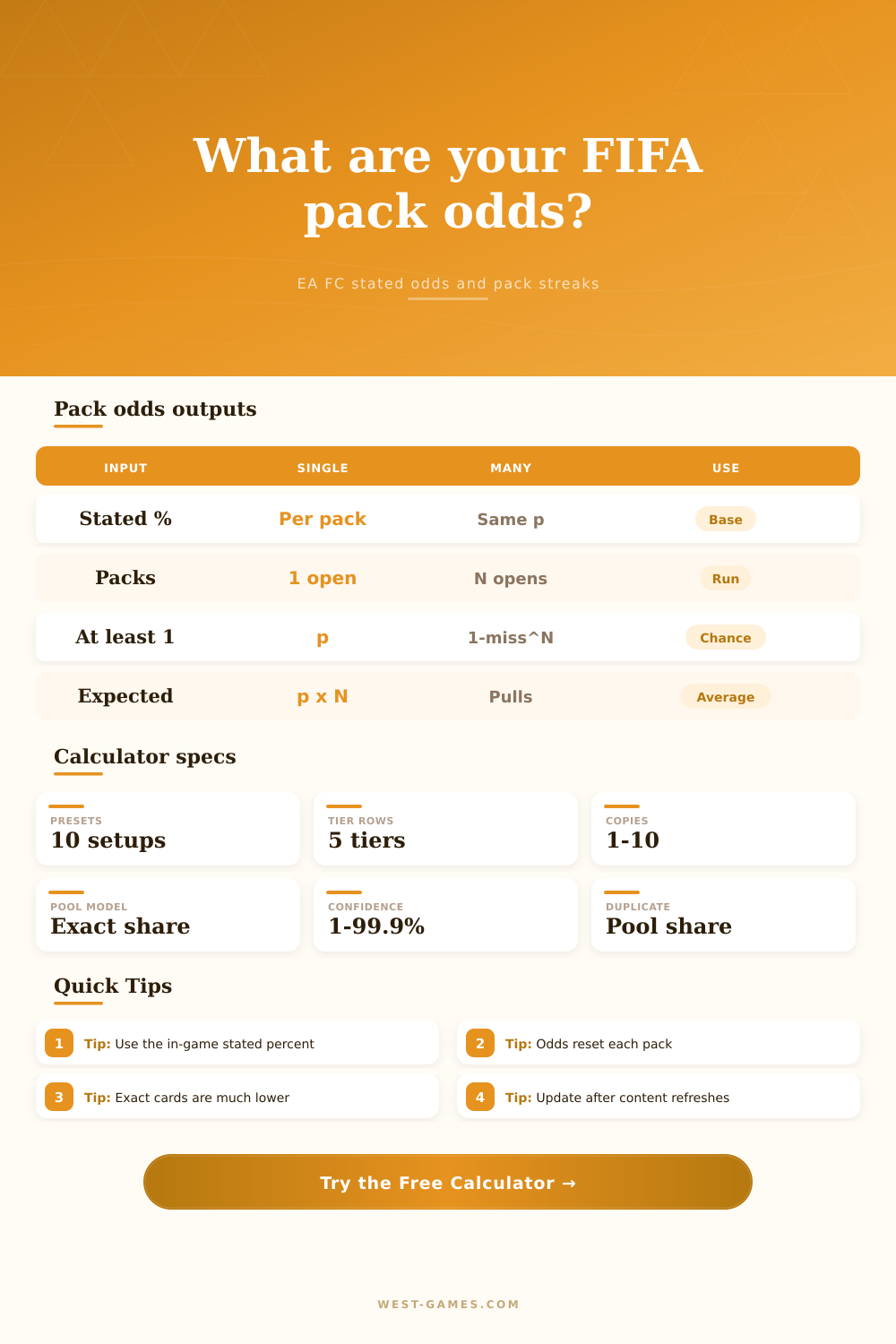
⚽ EA FC / FIFA Pack Odds Calculator
Turn the pack screen's stated probability into at-least-one odds, expected pulls, rating tier chances, exact-player estimates, duplicate risk, and confidence targets.
| EA pack screen item | Calculator meaning | Formula impact | Practical note |
|---|---|---|---|
| Minimum probability | At least one item in that listed category | Use p as one-pack chance | Not the exact-player chance |
| Pack-by-pack basis | Each opening is independent | Use 1 - (1 - p)^N | A prior miss does not boost next pack |
| Simulation method | EA runs many simulated openings | Displayed p is rounded/stated | Use the current in-game value |
| Live content updates | Odds can change with item pools | Refresh inputs after updates | Check timestamp on the screen |
This calculator is a probability planner using the stated pack-screen values, not a live pull predictor.
| Output | Formula | Input needed | Use case |
|---|---|---|---|
| At least one | 1 - (1 - p)^N | Stated %, packs | Session odds |
| Expected hit packs | N x p | Stated %, packs | Average hits |
| Expected pulls | N x p x items | Items per hit | Qualifying items |
| Exact target | p x target share | Pool estimate | Specific player |
| Confidence packs | log miss / log miss | Target chance | Planning target |
| Tier | Stated one-pack chance | At least one in run | Expected hit packs | Note |
|---|---|---|---|---|
| 84+ | 18.0% | 100.0% | 9.00 | Common high tier |
Nested rating ranges overlap: an 89+ player also counts as 88+, 87+, and lower qualifying ranges if shown that way in-game.
| Metric | Per pack | Run chance | Expected count | Interpretation |
|---|---|---|---|---|
| Specific target | 0.225% | 10.7% | 0.11 | Approximate exact-card model |
Exact-player odds are estimated by dividing the stated category chance by your estimated pool share. Real item weights can differ inside a category.
| Scenario | Main input | Best result to watch | Why it matters |
|---|---|---|---|
| Rating tier hunt | Use 84+, 85+, 87+ stated odds | Tier odds table | Shows how quickly common tiers become likely |
| Promo chase | Use campaign category odds | Specific target odds | Exact players are far below category odds |
| Duplicate-heavy club | Raise owned pool share | Duplicate risk | High ownership turns hits into repeats |
| Multiple acceptable players | Raise target items | Target run chance | Broad target groups improve odds |
| Confidence planning | Set confidence target | Packs needed | Shows how steep rare targets can be |
| One-pack chance | 10 packs | 50 packs | 100 packs |
|---|---|---|---|
| 50% | 99.9% | 100% | 100% |
| 20% | 89.3% | 100% | 100% |
| 5% | 40.1% | 92.3% | 99.4% |
| 1% | 9.6% | 39.5% | 63.4% |
| 0.1% | 1.0% | 4.9% | 9.5% |
These examples assume independent pack events with the same probability each time.
The Pack Screen, Hope (or Dread). See that? Eighty-four plus has an 18% chance. Open fifty packs. Get your hit. Right? Wrong. That’s another one of those traps.
The calculator compute the numbers. It translates the abstract probability to real-time odds for a given session so you can decide in advance how much you’re risking per coin.
How to Use the Pack Calculator
The takeaway: One should of understand the difference between a single event and a cumulative run. “The probability we show is on a pack by pack basis,” says EA Sports. And while they say each pack is independent… Meaning a pack doesn’t know if you missed out last time, there’s something about math of compound probabilities that explains why your gut tells you otherwise.
If your chance is one-in-six per pack, then after fifty openings, the chances increases to nearly certain that you’ll pull at least one of them. But how do you get there? That part are bumpy. Maybe you’ll pull two right off the bat out of those first ten and then nothing for the next twenty. The reality of variance vs. The tool reveals what you expect.
The inputs in calculator are designed to reflect your actual squad situation. Players forget to enter what they already possess as well as number of players available in their pool. Don’t make this error. If there’s a certain promo card you’re after, then the calculated category chance is not going to accurately predict whether or not you’ll get that pull. Instead, you should guess at size of the promo pool (how many players) and also number you already own. By entering current cards you possess and target pool size, you can calculate your duplicate risk.
That matter, because if you get a high-rated player but it is someone you already have three times, it is not worth anything. Your joy will be lessened by the following trip to the transfer market to sell that duplicate for pennies.
Let’s talk about expectation management by rating tiers. It’s all broken down in reference tables on the page. This makes it plain as day that an eighty-nine-plus includes an eighty-eight, eighty-seven, and below. There’s overlap between probabilities. That’s what you’re seeing when you look at a tier table: nested sets of possibilities. The calculator break them apart.
You’ll notice that there’s a good chance you hit an eighty-four-plus. However, there’s a clear statistical difference between hitting an eighty-four-plus and hitting an eighty-nine-plus in the same go, with much less probability of latter. That helps guide your decision making about grinding for volume or saving coins for guaranteed special teams.
For veterans: Risk of duplicates matter too. You’ve got a solid team? Great. That means you already own some highly rated cards and so you’ll have a large % ownership of those cards relative to your overall collection. So if the category hit, you will probably end up with a duplicate. Enter the # of items owned in that category as an adjustment to effective value of your pulls (this is how it’s done on the calculator).
Not only does it matter if you get a card at all but what card do you get? Opening blindly becomes building strategically. Maybe now you know that the category has a good hit rate. However, you’re only going to have a 10% chance of pulling the one card you’re interested in after opening fifty packs.
It’s also helpful for confidence targeting. Need to be sure you’ll get at least one player with Y rating? The calculator will work backwards to let you know how many packs is realistically needed for a 90%+ chance of hitting that mark. This takes the guesswork out of your budget. You no longer hope to hit X; instead, you aim to meet a statistical threshold. This also keeps you from getting tilted into spending more than you should of on a streak.
That’s what the pack screen is for, to inspire you, not to show you everything. It’s a real number but an open-to-interpretation number. Use it wisely. Consider how deep the squads already playing might be and take the declared likelihood as a minimum rather than a maximum. This will help you make better calls. The math isn’t forgiving, but it is predictable with proper perspective. Luck can happen, sure, but when it does, you’ll recognize that you were never in control so you won’t blame the system. And always keep in mind that each event stands alone. What happened yesterday has no bearing on tomorrow (or today). Planning will only affect your bank balance.