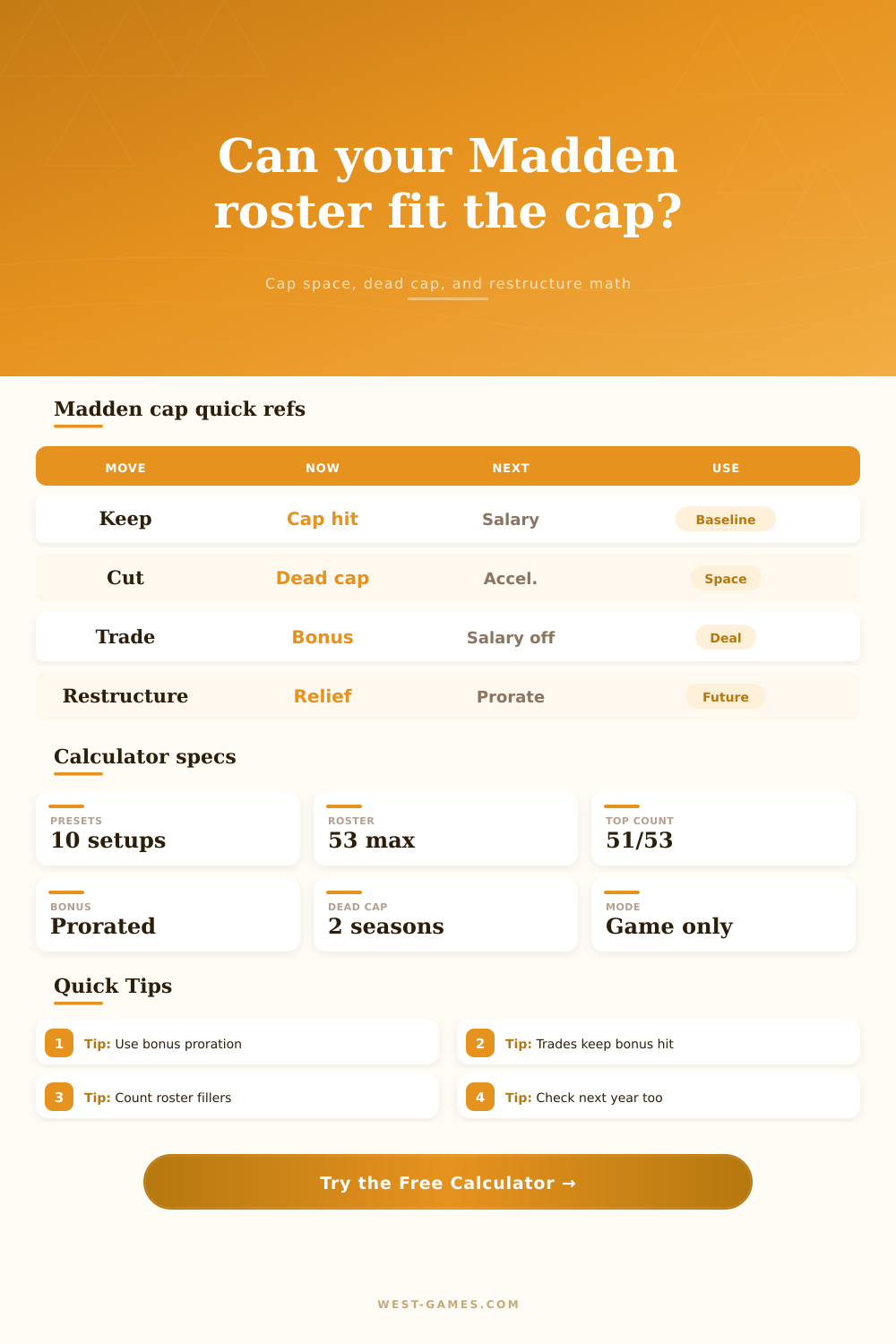
🏈 Madden Salary Cap Calculator
Estimate Madden franchise cap space, current cap hit, bonus proration, dead cap, cut or trade savings, roster filler needs, and restructure impact across the current and next season.
| Move | Current-year salary | Current-year bonus | Future bonus | Typical Madden reading |
|---|---|---|---|---|
| Keep player | Counts on current cap | Counts as proration | Stays in future years | Baseline cap hit equals salary plus current bonus proration. |
| Cut player | Removed from current cap | Becomes current dead cap | Accelerates by selected timing model | Cap savings are salary removed minus dead cap and filler. |
| Trade player | New team carries salary | Old team keeps bonus penalty | Old team keeps bonus acceleration | Trading helps most when salary is high and remaining bonus is low. |
| Restructure | Converted portion leaves salary | New proration added | New proration added later | Creates current room while raising later cap hits and dead cap risk. |
Madden screens can round values. Use the in-game salary, bonus, cap hit, savings, and penalty lines as the final tiebreaker when a result is close.
| Formula | How it is calculated | Why it matters | Common mistake |
|---|---|---|---|
| Annual bonus proration | Total signing bonus divided by original contract years | This is the bonus portion of each season's cap hit. | Using total bonus as one-year cap hit. |
| Remaining bonus | Annual bonus times years remaining, unless override is entered | This is the bonus still attached to the team. | Ignoring years already played. |
| Current dead cap | Current proration plus selected guarantee penalty | This can offset some or all current-year salary savings. | Assuming every cut frees the full cap hit. |
| Next-year dead cap | Future remaining bonus plus next-year guarantee penalty | Bad bonus deals can make next season worse. | Looking only at this year's cap space. |
| Roster view | Count | Filler treatment | Best use | Calculator setting |
|---|---|---|---|---|
| Offseason top count | 51 | Only top contracts usually matter in many franchise views | Free agency and draft planning | Top 51 offseason view |
| Regular roster | 53 | Every active roster slot needs a contract | Week 1 and regular-season checks | 53-man regular roster |
| Depth buffer | 55 | Add two low-salary slots for callups or injuries | Conservative roster planning | 53 plus two elevations |
| Preseason roster | 90 | Many low contracts can add up | Camp cuts and early rebuilds | Preseason 90-man roster |
| Signal | Current season | Next season | Likely reading | Next math check |
|---|---|---|---|---|
| Clean savings | Positive space gain | Low future dead cap | Salary-heavy deal is easy to move. | Check roster replacement quality. |
| Dead cap trap | Little or negative space | Large penalty spike | Bonus-heavy deal is hard to escape. | Wait a season or restructure carefully. |
| Restructure relief | Large current room | Future cap rises | Useful for a one-year squeeze in-game. | Sim the next season before locking it. |
| Roster squeeze | Savings shrink after filler | Depth still needed | Cutting many players can hide replacement cap. | Use target roster count and filler salary. |
Imagine this: It’s Madden franchise mode, it’s pre-free agency, your team is over the cap. The game forces you to carry dead weight. The number on the screen shows negative space and you panic. Most manager screw themselves because they don’t understand salary cap. This tool explains the forces at play. This tool take a confusing spreadsheet and makes it a plan. What do you have to give up? Where does the room come from?
Bonus vs. Salary. A bonus is money that you promise to pay a player as part of his contract, for his entire contract. Whether he plays or not doesn’t matter; you owe it. That’s why bonus money is split up by the calculator into annual chunks (which are called prorations). If I sign a four-year, ten million dollar bonus deal, then the bonus portion show up on my cap at two and a half million bucks a year. If I cut that guy, then that money accelerates. It turns immediately into dead cap. You’ve got ten million dollars in bonus money now sitting on your books. You figure: “I cleared twenty million dollars.” Nope. You cleared just the salary. The rest of it sit there, dead against you.
How Salary Cap Works
It’s the same with trades. A lot of managers believe they’ve cleaned the slate by trading away a player. They haven’t. Bonus penalties stays with the team that traded him away. Future salaries belong to new team, while the old team still owes unprorated bonus. It is hard to trade away a heavy-bonus contract. The other team would of had to be desperate for talent to even consider a deal. Table 2 show that trade makes a big difference when player has high salary and small outstanding bonus. When the bonus is high, cutting is better then negotiating a deal that doesn’t exist.
There’s one big option here: restructuring a contract. You turn present-day salary into bonus money. That distributes the hit across the rest of the deal. That creates an instant cap space for this season. But it’s a loan against the future. It moves the issue from this year in to next year. The calculator captures this effect in its estimates for next year. You can’t restructure so hard that you ensure the roster will be tricky to work with next season. Look past today’s relief and look toward final years on the contract.
But there are hidden costs in roster count. Cut a vet; save ten million dollars. But you still need to maintain fifty-three player. How do you fill them? You will have to fill those spots with minimum-salaried rookies or undrafted free agents. Those guys cost you about nine hundred thousand each. Cut three vets, save thirty million on paper. Spend two and a half million filling in the holes. The tool asks for your target roster count. It reminds you: Space depends on both removal and replacement. The little contracts adds up. Can’t be ignored.
You don’t want maximum cap space; you want enough to get it done. You need enough for your core guys. Enough for injury flexibility. You need enough so you have a road map heading in to next year. It’s math, but its cold. Strategy, though, is human. Who do you sacrifice? And who are you willing to pay a price for?
When you realize that bonus is rigid and salary is flexible, panic eases. You no longer see a sea of red dollars. You see a puzzle and know how to put the pieces together. Knowing the cap help you keep the championship window open.