Clash Royale Cycle Time Calculator
Estimate deck elixir average, cards to your next key card, cycle cost, and how many seconds it takes to return in single, double, triple, or legacy champion cycle timing.
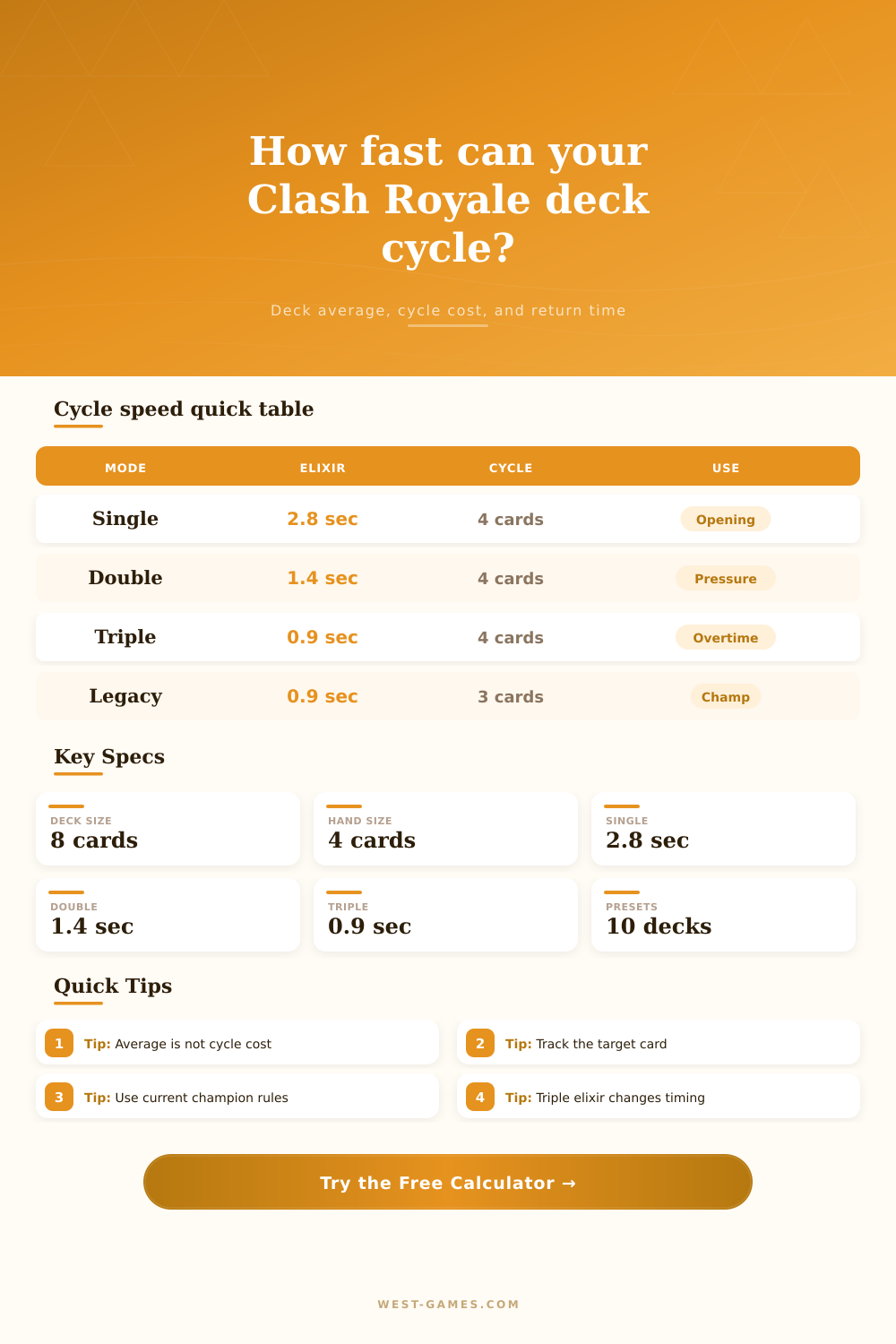
| Match phase | Approx speed | 10 elixir from zero | Cycle timing use |
|---|---|---|---|
| Single elixir | 1 elixir every 2.8 seconds | 28 seconds | Opening cycle, cautious defense, first rotation tracking |
| Double elixir | 1 elixir every 1.4 seconds | 14 seconds | Pressure cycles, repeated win condition attempts, spell defense |
| Triple elixir | About 1 elixir every 0.9 seconds | About 9 seconds | Overtime and special modes where expensive loops return quickly |
| Custom mode | User-entered seconds per elixir | 10 x custom speed | Friendly battle rules, event modes, or manual video timing |
| Preset | Cards | Average | Cheapest 4-card cycle |
|---|---|---|---|
| Hog 2.6 | Hog Rider, Musketeer, Cannon, Fireball, Ice Golem, Ice Spirit, Skeletons, The Log | 2.6 | 6 elixir |
| Hog EQ | Hog Rider, Earthquake, Firecracker, Knight, Tesla, Skeletons, Ice Spirit, The Log | 2.6 | 7 elixir |
| X-Bow 3.0 | X-Bow, Tesla, Archers, Knight, Skeletons, Ice Spirit, Fireball, The Log | 3.0 | 7 elixir |
| Log Bait | Goblin Barrel, Princess, Knight, Inferno Tower, Rocket, Goblin Gang, Ice Spirit, The Log | 3.3 | 9 elixir |
| Legacy AQ 3-Card | Archer Queen, Royal Hogs, Earthquake, Cannon, Firecracker, Skeletons, Ice Spirit, The Log | 2.9 | 7 elixir current, 4 elixir legacy |
| Rule | Cards required | How this calculator handles it | Practical note |
|---|---|---|---|
| Current normal card | 4 cards after target | Uses four cheapest legal cards or the next four listed slots | Applies to normal ladder and current champion card rotation |
| Current champion card | 4 cards after target | Same as normal when current mode is selected | Current champions return to rotation like other cards |
| Legacy champion 3-card | 3 cards after target | Uses three cheapest legal cards or the next three listed slots | For old replays, legacy discussion, or special private rules |
| Already cycled cards | Required cards minus progress | Subtracts your entered cards already cycled since the target | Set this after counting cards played after the target left your hand |
Then your Hog Rider hits the bridge. Then you freeze. Your elixir bar are empty. Your cards is useless, and yet you don’t want to spend them now. And there’s no way to get more then one elixir trickling in. So there it sits. The enemy tower take zero damage as you twiddle your thumbs.
Most Clash Royale games ends up becoming a waiting game. It’s rarely about having the best cards. Instead, it’s about when you can expect those card back in play. The thing is, that’s a bit of math we has to figure out… except this page will do it for us. But knowing what those numbers signify for your upcoming decision? That’s the skill.
Why Cycle Time Matters
The most misunderstood stat in the game are deck average. People see a 2.6 average deck and think they is cycling instantly. What they forget is that average is simply a mean. If you have three one-cost support cards and one two-cost card, your win condition cost four. You’re going to cycle back in six elixir.
This is a very different story than cycling back after spending twelve elixir on heavy troops. Six versus twelve elixir are the difference between constant pressure and a defensive timeout. Track the shortest path to your key card’s cost; not average of all the cards in your deck.
This also has to do with ruleset for cycling. In the past, each champion had unique three-card rotation rules, which changed strategy building. With the new rework, all champions cycles like other regular cards. That means they need four played cards to come back into play no matter what their class are. You can use the tool to toggle between three and four card cycle modes for replay analysis. You can also use it for custom leagues that runs with legacy rules. However, for standard ladder play, you’ll want to stay locked down at the four-card rule. Small thing, sure, but if you’re trying to time things correcty, it does make a difference.
The pace of the game shift according to how quickly you generate elixir. In single elixir, you get one point every 2.8 seconds. It is a slow grind. Half that time and its double elixir. Double your elixir production again. You are now spewing out spells and cycling through cheap troops so fast it feels like playing with superpowers. Adjust the calculator accordingly.
What’s the big deal here? Maybe you can handle a ten-second cycle if you’re in single elixir. But that same ten seconds feel like an eternity when you’re in double elixir. Suddenly you’re falling behind while you wait. If you know your double-elixir cycle time, you will know when to retreat to defend and when to keep attacking.
Here’s where it gets interesting: hand management. When you use your targeted card, the tool will ask you what other cards you’ve previously used in your hand. That information matter. Do you have three cheap cards now that you’ve played your Hog Rider? Do you only need one more to get that cycle back?
The calculator will deduct that advancement from the overall cost. It’ll also consider how much elixir you currently hold. Got seven sitting around? Cycle costs six? Then the wait is almost zero. It becomes a matter of whether you can quickly find a spot. It is not a question of generating resource.
And that’s the trick pro players know that others don’t. They’re not staring at the elixir bar. They’re looking at their card slots. Ignoring the cheapest path gets you into trouble. Even if you need to go through your deck quickly, players play cards from habit because they’re more expensive. That slows them down, leaving them open for attacks. It also hurt their rotation.
The calculator will show you the cheapest legal card first: the best case scenario. In a real match you may not actualy have that card in hand. Knowing what the theoretical minimum is, however, can help you plan. If you have a hand full of heavy troops, you know you’re behind on the optimal cycle. Better to go defensive and wait than force an attack you wouldn’t of be able to sustain.
And all this comes down to cycle time. When you see it says that my Hog Rider will come back in 16 seconds with one elixir, now I can start planning out my defense knowing that at any point during that cycle I’ll have a free Hog Rider coming back. So now not only do I know how much elixir it take, but I also know when I am at risk and when my next attack is coming back. It tells me the seconds.
All you got to do is learn the board. Remove as much guessing as possible from the equation. Stop sitting there in the dark trying to figure everything out. Know when to send your next push because you know exactly when your elixir is coming in. That’s what turns a slow deck into a rhythmical engine of pressure.