Sim Racing Gear Ratio Calculator
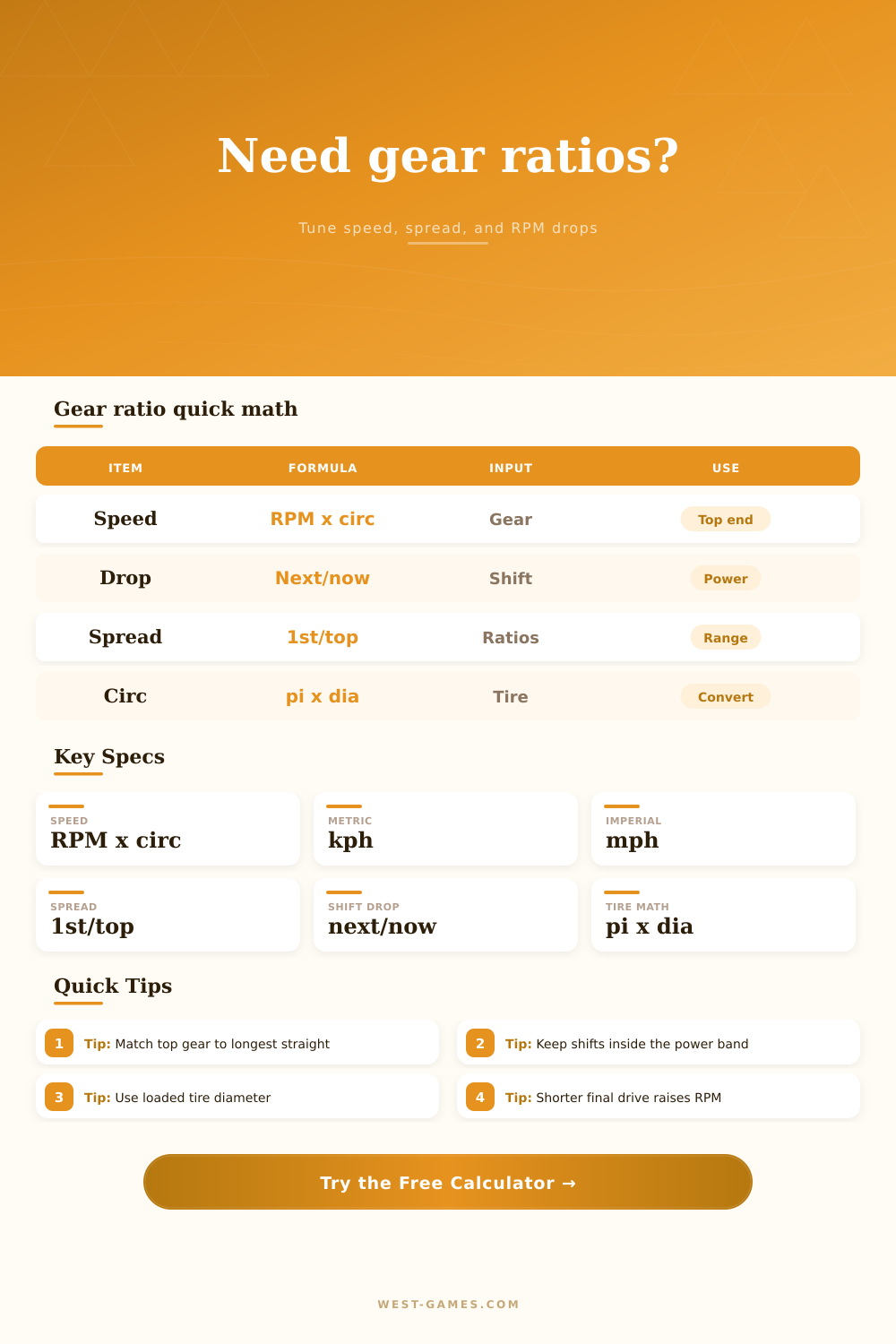
Calculate speed by gear from RPM, tire circumference, gear ratio, and final drive, then compare shift drops, gear spread, target speed RPM, and top gear reach.
Calculation Breakdown
| Gear | Ratio | Overall Ratio | Shift Speed | Redline Speed | Per 1000 RPM |
|---|
| Shift | Current Ratio | Next Ratio | RPM After Shift | Drop | Power Band Check |
|---|
| Preset | Final Drive | Top Gear | Shift RPM | Tire Dia | Typical Use |
|---|
| Metric | Formula | Inputs | Conversion | Result Meaning |
|---|
The next thing you notice on a sim as you crest a hill and find yourself with no juice left prior to the braking zone is, “Oh sh,.” The engine scream. The wheels is spinning. You aren’t moving forward. Your simulation has a glitch! Or maybe it doesn’t. Maybe it’s because your gearing are incorrect.
A lot of times, understanding your gearing is the difference between easy lap times and fighting with the transmission every second. It’s really simple math, but it make all the difference when it comes to your driving rhythm. Let’s get rid of all this math stuff because there’s a calculator for that. All you have to do is put in your final drive ratio, your tire size, and your unique set of gears. Then, it spit out precisely how high into the powerband you’ll be after each shift.
How to Fix Your Gearing
Top speed is largely an aerodynamic thing. Torque multiplication is what matters when you’re accelerating from a slow corner. The final drive ratio are the main control. Every single gear gets scaled up or down accordingly. Shorten it and you’ll find yourself accelerating better everywhere, although you’ll also lose a few miles per hour at top speed. Lengthen it and while you may hit the limiter coming through the main straight, you’ll feel more sluggish in the technical stuff.
The other variable that throws folks for a loop is the tire size. I know you think it is all about pressure and compound changes. However, it also affects the effective rolling radius. A little bigger tire behave more like a higher gear. The tool accounts for the loaded diameter (what actualy happens out on the virtual track). This way the predicted speeds won’t be off and you won’t end up over revving due to the fact that car is traveling faster than indicated.
Notice how much it drops on the upshift? That’s what keeps you on track. When you shift and let the RPMs go lower then the top of the power band, you dig yourself a hole. In this case, you lost traction while accelerating. Do that often enough, and you’ll dig a rut deep enough you can’t escape.
Use the reference table to see if you’re in the sweet spot (the meat of the power curve) or slipping off the cliff into the muck. You don’t want to drop too far (you’ll lose drive), but you also don’t want to drop too little either. It is a delicate balance. It is a delicate balance. Some vehicles has a broad power band, where tall gears won’t kill their thrust. Other engine have sharp peaks, requiring closer ratios to ensure the needle stays in the green.
The settings are a good start, but take them with a grain of salt. An endurance race will be different than tire and fuel management than a GT sprint. In some slower, high-grip corners, it may be necessary to give up a few tenths in the higher gears to save the rear tires. One size does not fit all. Your ideal gearing is what fits your driving style and the unique challenges of any given track.
Tuning your car is an iterative process. Run some laps, look at the telemetry, identify what you’re losing time on. Are you bogging down on exit? Your gears are too tall. Are you hitting the rev limiter early into the final straight? Your gears is too short. Test those hypotheses with the tool before committing to a change in setup. That’s how you should of saved yourself time in the simulator. But it also helps you understand that mechanical feedback loop.
But at its core, that’s what sim racing is all about, the limits. You have limits on your engine, limits on your brake ducts, and limits on your tires. And gears is how you make those limits move forward. When you dial them in properly, the car comes to life. The power arrives when required. The gear changes seem effortless. You stop fighting the machine and begin flowing with it. Every moment spent tuning the numbers pays off in a feeling of smooth acceleration.