💨 Oxygen Not Included Oxygen Supply Calculator
Calculate colony oxygen demand, producer count, resource burn, buffer refill, gas pump limits, gas pipe limits, uptime losses, and surplus or shortfall from verified Oxygen Not Included constants.
About 180 kg per cycle before headroom.
One ideal Electrolyzer covers breathing but leaves little stall margin.
One pump cannot move a full Electrolyzer oxygen output alone.
Enough for one Electrolyzer oxygen stream if packet flow stays clean.
Stored oxygen target scales directly with live demand.
| Duplicant type | Oxygen draw | Per cycle | 8 dupe equivalent | Use in calculator |
|---|---|---|---|---|
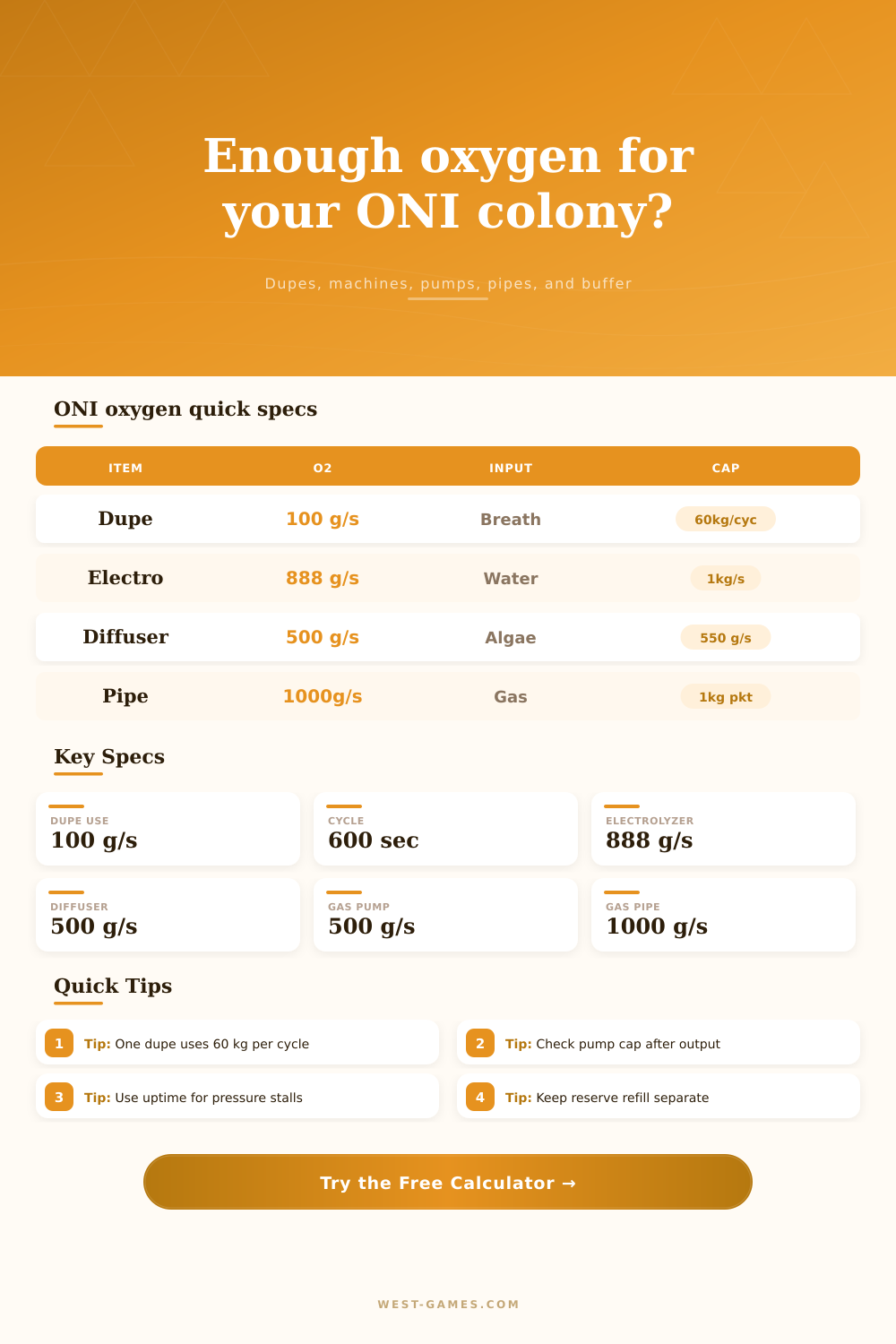
| Regular Duplicant | 100 g/s | 60 kg/cycle | 800 g/s | Baseline breathing demand |
| Mouth Breather | 200 g/s | 120 kg/cycle | 1,600 g/s | Double oxygen consumption |
| Diver's Lungs | 75 g/s | 45 kg/cycle | 600 g/s | Reduced oxygen consumption |
| Deeper Diver's Lungs | 50 g/s | 30 kg/cycle | 400 g/s | Deeply reduced oxygen draw |
| Manual extra load | User-entered | g/s x 600 | Variable | Suit docks, leaks, or measured losses |
Cycle mass uses Oxygen Not Included's 600 second cycle: kg per cycle = g/s x 600 / 1000.
| Source | Oxygen output | Main input | Byproduct | Power | Planning note |
|---|---|---|---|---|---|
| Electrolyzer | 888 g/s | 1000 g/s water | 112 g/s hydrogen | 120 W | Supports 8.88 regular dupes at 100% uptime before buffers |
| Oxygen Diffuser | 500 g/s | 550 g/s algae | None | 120 W | Old algae deoxidizer planning name, overpressure sensitive |
| Rust Deoxidizer | 570 g/s | 750 g/s rust + 250 g/s salt | 30 g/s chlorine and 400 g/s iron ore | 60 W | DLC oxygen option with chlorine handling |
| Algae Terrarium | 40 g/s | 30 g/s algae + 300 g/s water | Polluted water | 0 W | Low output per building, useful only when that rate is intentional |
| Custom source | User-entered | User-entered | None modeled | User-entered equivalent | Use for modded machines or mixed vents |
The calculator applies uptime to source output and resource input so automation and overpressure reduce both delivered oxygen and consumed feedstock.
| Distribution part | Rate used | Formula | Example | Why it matters |
|---|---|---|---|---|
| Gas Pump | 500 g/s each | Pumps x 500 | 2 pumps = 1000 g/s | A single pump bottlenecks one Electrolyzer oxygen side |
| Gas Pipe | 1000 g/s each | Pipes x 1000 x routing efficiency | 1 pipe at 95% = 950 g/s | Packet gaps and routing can reduce sustained delivery |
| Producer uptime | 1% to 100% | Gross output x uptime | 888 g/s x 90% = 799.2 g/s | Models pressure stalls without hiding the base rate |
| Delivered oxygen | Minimum cap | min(source, pump, pipe) | 844 g/s source, 1000 g/s pump, 950 g/s pipe = 844 g/s | Shows whether production or transport is limiting |
| Needed pipes | 1000 g/s line | ceil(design demand / effective pipe rate) | 1600 g/s needs 2 clean lines | Prevents hidden delivery shortfalls |
Disable distribution caps if you only want source sizing, but leave them on when checking a built oxygen room or duct network.
| Step | Formula | Inputs used | Output shown | Common check |
|---|---|---|---|---|
| Live demand | Trait counts x oxygen rates + extra load | Dupe fields and manual load | g/s and kg/cycle | Regular dupe = 100 g/s |
| Design demand | Live demand x headroom + buffer refill | Headroom, buffer cycles, refill cycles | Target g/s | Use reserve without pretending it refills instantly |
| Buffer mass | Live demand x 600 x buffer cycles / 1000 | Demand and cycles | Stored kg oxygen | One regular dupe needs 60 kg per cycle |
| Producer output | Source rate x source count x uptime | Source type, count, uptime | Effective source g/s | Pressure stalls reduce output |
| Resource burn | Source input x count x uptime x 600 / 1000 | Source type, count, uptime | kg per cycle | Electrolyzer water is 600 kg/cycle at 100% |
| Surplus check | Delivered oxygen - design demand | Production and transport caps | Positive or negative g/s | Positive covers the entered plan |
Webhook row marker: index 1087, gid 1450490472. Values are editable so measured colony behavior can override ideal-machine assumptions.
At the beginning of each Oxygen Not Included run, you start with three fresh face… And they’re already eating up oxygen. Think about your plan before you put down a single electrolyzer.
Long before you even realize it, the game has taught you something: Air isn’t a free thing; it’s a resource. And it burns through your reserve as soon as you arrive. Keeping tabs on how much air flows around your base is more than simply installing machines. It’s understanding your pipe system’s bottlenecks and learning to balance what’s produced versus consumed.
How to Plan Your Air in Oxygen Not Included
This lesson are learned the hard way by most players. They construct lots of electrolyzers. Then, their dupe population suffocates because a pipe packet gets stuck or a pump get clogged.
If you plug in the number of machines you have and your colony’s size, that calculator will crunch numbers for you. You don’t need to guess anymore. Instead, you’ll have to think about it as a system with limits different than just a group of buildings. That mindset can be the difference between life and death for your colony.
These numbers aren’t super complicated but they’re pretty rigid. By default a normal duplicant consume a hundred grams of oxygen per second. Multiply that by six hundred seconds in their cycle and that’s sixty kilograms of oxygen use per duplicant. Double that if you’ve got a Mouth Breather. The system factors them out individually. Put in how many duplicants per trait you have and it recalculate accordingly. It’s a little thing but when you need to squeeze all the juice from a lemon in a pinch, it counts.
The process is also inflexible. For instance, an electrolyzer will produce 888 grams per second. That seems ample. But it produces hydrogen, too which requires storing or venting. Compared with an oxygen diffuser (which relies on algae rather than water), how do they stack up? That depends on your waste handling and water table. A diffuser becomes appealing if you’re running short of water. Now, though, you has to arrange constant algae supplies. Either way, the tool displays their individual resource burn. You see the tradeoff between water scarcity and biomass management.
And then there’s the distribution layer… This is where most people go wrong. “I’m making a kilogram of O2 per second” is cool… but if I’ve only got one gas pump, I’m limited to half a kilo going down that hose. Your production output gets compared to your pump/pipe capacity. Does your transport network limit you? The calculator will tell you: is the air being produced getting out of the room? If not, you’re screwed.
Consider pressure stalls and packet flow. The tool models those problems with its uptime inputs. It’s all about uptime. Your in-game colonies aren’t going to operate at 100% efficiency. Filters will fail, pumps will get clogged, and pressure will build up in your vents. Define a reasonable uptime percentage for your model and it will assume that you’ll experience downtime. How much extra production do you need to account for this?
It also will help you determine the capacity of your reserve tanks. You don’t want to depend on them but you don’t want to be without any either. The calculator accounts for the refill load as well. When the buffer has been consumed, the system needs to replace it. It should of know if your production can handle replacing the buffer. It also will help you determine the capacity of your reserve tanks. Don’t want to depend on them, but don’t want to be without any either. The calculator accounts for the refill load as well. When the buffer has been consumed, the system needs to replace it. It should know if your production can handle replacing the buffer.
The constants that get fed into those equations can be found by reading through the reference tables on the page. These numbers are checked against in-game mechanisms, so you can believe ‘em. However, you should use these numbers to plan ahead instead of reacting during a crisis.
How many kilos of water does each cycle of electrolysis use? Plan out your water consumption based off that information. How much pipe do I need? Plan out your duct work with bigger pipes and more pumps based on that info.
In Oxygen Not Included, building a colony is a matter of flow. Your base has streams of air, water, heat, and waste flowing around it. If you block one stream, everything backs up. And the most immediate danger is oxygen. Without it, your people die. But it’s also the simplest thing to handle when you think of it as a logistical issue. Produce enough for your needs, size your transport, and account for mistakes. As long as you clear the lines, the air keeps coming in.