Speedrun Split Calculator
Estimate PB pace, gold pressure, time save, reset risk, and final time from your current split data.
Live Pace Result
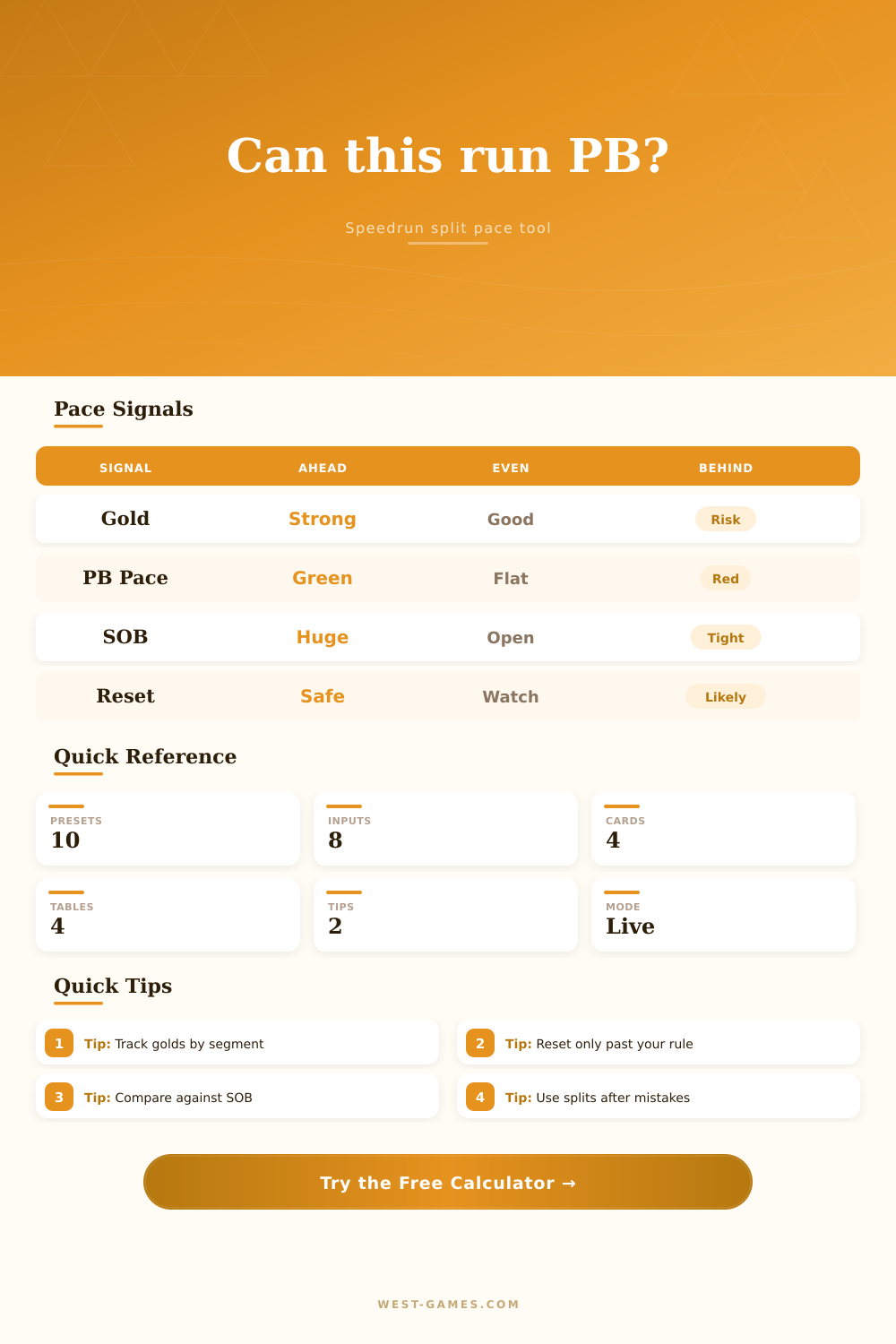
| Pace State | Delta vs PB | Runner Action | Calculator Meaning |
|---|---|---|---|
| Gold pace | 15s+ ahead | Protect clean movement | Run is ahead with room for one small mistake. |
| PB pace | 0s to 15s ahead | Stay on route | Final estimate can PB if remaining splits are average. |
| Even pace | 0s to 10s behind | Look for planned saves | Run needs cleaner late-game execution. |
| Danger pace | 10s+ behind | Compare to reset rule | Run may still be useful if practice value is high. |
| Segment Type | Common Length | Gold Sensitivity | Useful Reset Rule |
|---|---|---|---|
| Movement split | 20s to 2m | High | Reset only after repeated execution errors. |
| Boss split | 45s to 5m | Medium | Continue if the fight pattern was unlucky. |
| Menu split | 10s to 1m | Very high | Reset if the mistake breaks route resources. |
| RNG split | Variable | Low | Use a wider threshold than normal splits. |
| Run Category | Best Metric | Threshold Habit | Why It Matters |
|---|---|---|---|
| Any% | PB delta | Tighter early | Short routes reward quick reset decisions. |
| Glitchless | Final estimate | Wider late | Longer splits often recover through execution. |
| 100% | SOB gap | Very wide | Many objectives create more comeback paths. |
| Individual level | Gold delta | Strict | Short attempts need immediate quality feedback. |
| Input | Used For | Good Range | Common Mistake |
|---|---|---|---|
| PB total | Final estimate | Full run | Entering only remaining time. |
| PB split | Live delta | Current point | Using segment time instead of cumulative time. |
| Gold split | Segment delta | Best segment | Using best cumulative split accidentally. |
| Sum of best | Potential save | Full run | Leaving old route splits mixed in. |
PB Pace
Compares your current cumulative split with the same point in your personal best.
Gold Pace
Compares this segment against your fastest known segment, not the full run.
SOB Ceiling
Shows how much theoretical save remains between your PB and sum of best.
Reset Rule
Marks whether the run has crossed the behind-PB threshold you chose.
The split timer on screen turns red. You realize you f’d up the jump sequence. Your momentum is lost, now what? You feel like throwing down the controller, reloading the save file, but those urges is not going to improve your game in the long term. Now it’s time for a cold calculation, can I still do this run at this point?
A split calculator are more than just a spreadsheet; it becomes a co-pilot. It takes raw time differences and converts them into actions. It removes emotion from “I’m so frustrated” and changes it to “is it mathematically possible.
How To Use Data To Improve Your Game
When it comes to running, most people obsess over their personal best. They treat it like the sole metric they care about. It’s not. Your personal best is one data point in time, typicaly a lucky one at that. Your personal best delta will tell you how you stack up to history (the number the calculator spits out), while your sum of bests delta will tell you how good you’ve executed so far today (the number your calculator should of spit out).
Gold, however, will tell you how well you’re executing right now. If you’re on gold pace, you’re running perfect. But still, that feels good and doesn’t mean a quick overall time if other section were slower. On the flip side, you can feel like all is lost in terms of total time, only to learn that this last section was indeed faster then your historic average for that particular section.
The reset threshold is likely most debated setting in a speedrunner’s settings. Some players are discarding potentially good runs by resetting too soon, just because they fell off by two seconds of some arbitrary line. Then others hang onto hopeless runs because they feel they have already invested too much and end up wasting hours trying for something that never stood a chance of competing. Having a fixed rule helps to take the emotion out of it.
If you decide beforehand that a run that falls 15 seconds behind your personal best at the halfway point is a practice attempt rather than a PB push, then you can make that call with no hesitation. The pace state reference table on the page help you tell the difference between a broken run structure and a recoverable error by categorizing pace states into clear actions.
The type of game you’re playing, too, matters. A precise platformer like Celeste have low tolerance for variance, meaning early mistakes cascade quickly. Because late-game optimization can compensates for previous clumsiness, there’s more wiggle-room on a route-intensive title such as Metroid or Resident Evil. To account for that, the tool allows you to tweak how many splits you have remaining, plus your risk style. With eight segments to go, five seconds don’t matter much. With only two seconds remaining in the last room, five seconds mean death, because context is everything.
Then there’s sum of bests, which we also tend to ignore until we shouldn’t. Your sum of bests is your theoretical ceiling; if each segment could be ran as fast as humanly possible, what would that look like? How much time are you realisticly capable of saving right now, based off where your skill level is? If you’ve got a thirty-minute personal best and your sum of bests comes out to be twenty-eight, you know there’s a two-minute gap between the two because you’re being inconsistent, not trying anything new. And that knowledge shifts the way you train. You stop searching for new glitches and simply begin training yourself to repeat your best segment.
That’s the beauty of these numbers. It isn’t the end goal, it’s the process along the way that makes them worth keeping track of. If you are behind, you can increase your aggression level mid-attempt. If you are ahead, play safe. If you’re behind, take calculated risks. Data gives you the information. Judgment is left up to you.
And that’s half the battle of speedrunning; learning not just what buttons to press, but when to apply that knowledge. You must know when to let a run go and when to double down and race towards the end. Great players does this better than good players, and it makes all the difference between anger and improvement one split at a time.