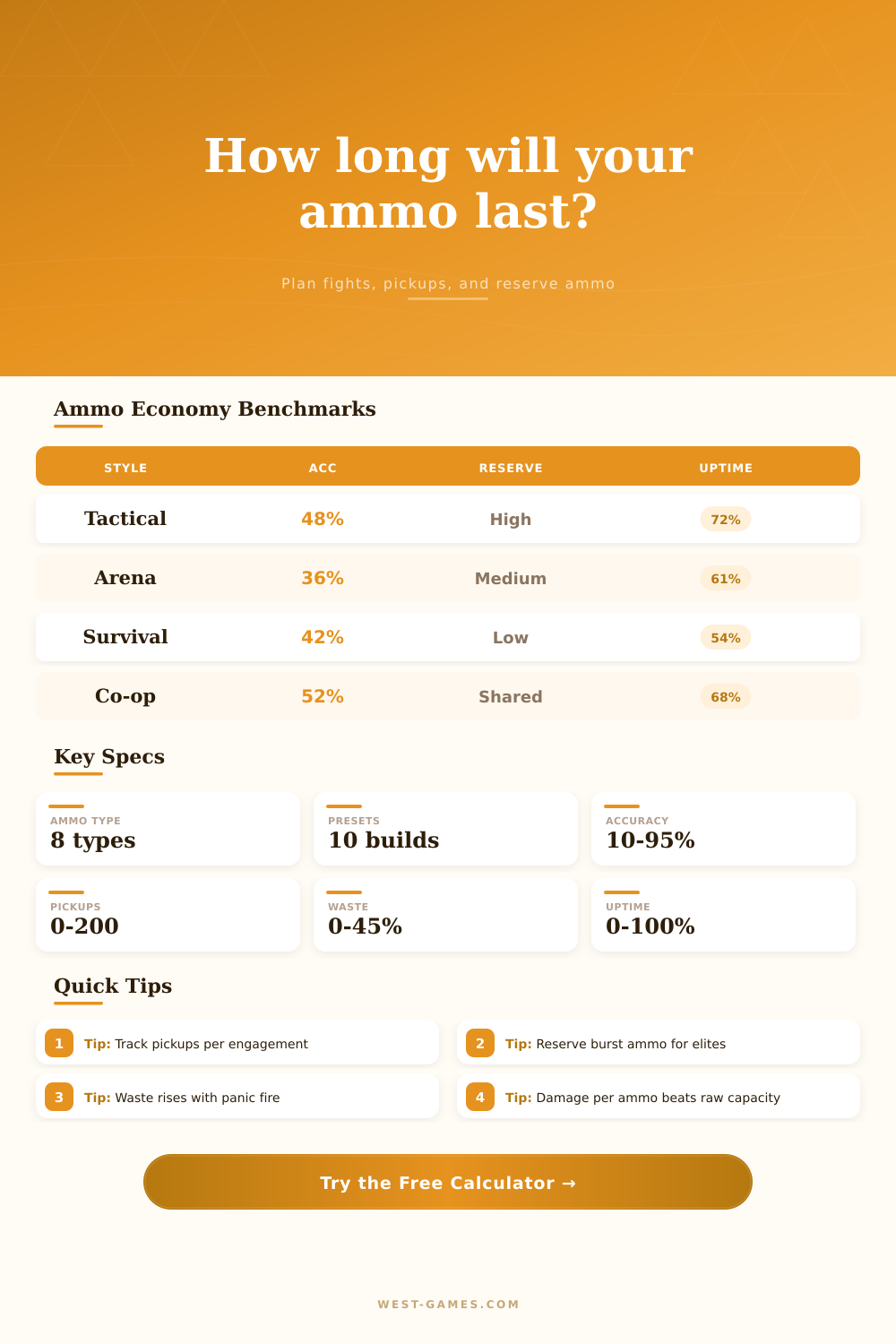
Ammo Economy Calculator
Estimate how many engagements a loadout can sustain after reserve ammo, accuracy, pickups, damage per ammo, waste, and combat uptime are applied.
Calculation Breakdown
| Ammo / Weapon Type | Baseline Damage | Typical Magazine | Fire Rate | Economy Note |
|---|---|---|---|---|
| Semi-auto pistol | 28 per round | 12 rounds | 180 ammo/min | High reserve control, weak burst damage |
| High-rate SMG | 21 per round | 35 rounds | 720 ammo/min | Strong close pressure, high waste risk |
| Assault rifle | 32 per round | 30 rounds | 540 ammo/min | Balanced pickup value and uptime |
| Marksman rifle | 74 per round | 12 rounds | 160 ammo/min | Excellent damage per ammo if accurate |
| Pump shotgun | 96 per shell | 8 shells | 90 ammo/min | Best close overkill control with pacing |
| Support LMG | 27 per round | 80 rounds | 620 ammo/min | High uptime, heavy reserve drain |
| Sniper rifle | 140 per round | 5 rounds | 45 ammo/min | Elite burst value, punishes missed shots |
| Heavy launcher | 520 per shot | 1 shot | 18 ammo/min | Boss phase tool, pickup dependent |
| Combat Style | Accuracy Pressure | Pickup Pattern | Waste Pattern | Planning Priority |
|---|---|---|---|---|
| Tactical shooter | Medium to high | Low but predictable | Low if firing in bursts | Reserve magazines for contact chains |
| Arena shooter | Low to medium | Frequent map control | High during tracking fights | Convert pickups into uptime |
| Survival action | Medium | Sparse and uneven | Medium from panic shots | Keep a hard emergency reserve |
| Looter shooter | Medium | Frequent drops | High against shielded enemies | Damage per ammo matters most |
| Battle royale | Medium to high | Loot spikes after fights | Medium from long range spray | Survive two fights before looting |
| Co-op horde | Medium | Shared and wave based | High during crowd control | Budget ammo by role |
| Roguelite rooms | Medium | Room reward based | Medium from hazards | Carry surplus into elite rooms |
| Console action | Medium | Scripted supply points | Medium from aim assist overfire | Plan around checkpoint stretches |
| Scenario | Reserve Ammo | Accuracy | Pickups | Expected Result |
|---|---|---|---|---|
| Tactical Rifle Patrol | 180 rounds | 48% | 3 x 20 | Good for 7 to 9 small fights |
| Arena SMG Duelist | 210 rounds | 34% | 8 x 25 | Lives on pickup timing |
| Survival Shotgun Run | 46 shells | 58% | 2 x 6 | Strong if overkill stays low |
| Marksman Elite Picks | 72 rounds | 62% | 2 x 10 | High value against tougher targets |
| Heavy Boss Phase | 9 shots | 76% | 1 x 2 | Short window, high burst output |
| Co-op Support LMG | 420 rounds | 39% | 6 x 45 | High uptime with controlled bursts |
| Factor | Calculator Use | High Value Means | Low Value Means | Best Adjustment |
|---|---|---|---|---|
| Reserve ammo | Starting ammo plus pickups | More fights before dry | Need safer pacing | Hold a minimum reserve |
| Accuracy | Converts ammo into hits | Better damage per round | More missed ammo waste | Reduce fire rate or range |
| Damage per ammo | Multiplies each landed hit | Fewer rounds per target | More reload pressure | Use burst windows carefully |
| Waste | Adds misses, overkill, and panic fire | Reserve collapses faster | Cleaner fight conversion | Stop firing after lethal damage |
| Pickups | Extends total ammo pool | More uptime between fights | Route must be conservative | Plan pickups before elites |
| Fire rate | Estimates active shooting time | Short, intense uptime | Longer controlled pressure | Match burst size to target health |
So when you drop into a mission, you have three mags in your hip pouch and you feel confident-ish that it will suffice. You take down first dude with minimal fuss, clean up the room, and continue. Now as you’re stepping into that next hallway, your reload button is practically humming beneath your finger, thinking: did I really just waste all my ammo on one patrol dog and two grunts? And that’s the core concern of every good shooter who cares about ammunition limitations.
It is not that your gun does lots of damage, but that all those bullets makes it from your clip to someone’s health bar without getting spent in a moment of panic shooting, overkill, or missing your mark. With this in mind, I’ve created a calculator (above) to approximate the number of engagements your loadout will be able to withstand after applying waste, accuracy, pickup, and reserve ammo.
How to Save Your Bullets
People tend to rely on magazine size and think they have an idea. Guess what? This is where most people are incorrect. A thirty round magazine seems like a lot…until you realize that during a wild fire fight, only forty percent of them is hitting anything. Throw some real world variables into the mix; missing shots, shooting over an enemy when he’s already gone, and the numbers falls apart fast.
To understand ammo economy, you have to consider both firepower and discipline. Essentially, you’re placing a tax on each trigger pull by entering your expected accuracy. A hit rate of only thirty-five percent mean you spend almost triple the ammo to do the same damage as someone who is disciplined and can hold an eighty percent hit ratio. It is easy to see your accuracy drop like that during heat of arena shooters.
The calculator will convert this for you and show just how much of your ammo reserve is truly usable damage instead of wasted potential. It will tell you that additional ammo are worthless unless you can hit what you shoot at.
With pickups, however, it’s all about the math. For games that drop loot often, size of your own stash isn’t as important as surviving long enough to find the next cache. Accounting for anticipated pickups and their sizes allows you to include them in the tool. It moves you away from “should I save my bullets” to “how can I maintain combat uptime.”
Uptime refers to the percentage of time you spend shooting versus reloading/recovering. Weapons with high fire rates, such as SMGs, eats through your reserves quickly, but if ammo pickups comes often on the map, they justify the expense. Similarly, a sniper rifle will punish you heavily for missing, resulting in harsh economic repercussions. It has low uptime, while support LMGs depletes your reserves at different rates. The tool’s reference table spells this out nicely.
Waste is the silent killer of any build. Overkill damage, where you shoot an enemy multiple times after they are already dead, adds up fast. Firing at walls when you panic retreat also goes against your tally. There’s a waste percentage field in the calculator that lets you model the amount of ammunition you lose from poor habits or unfortunate geometry. Increasing waste just ten percent can halve the number of engagements you can sustain.
This is why veteran players will often recommend maintaining a solid emergency reserve. Unless you’re absolutely sure you won’t find any pickups down range, don’t use your final round on last enemy.
You can use these presets as a nice starting point to compare. For example, a tactical rifle patrol has decent lasting uptime because of lower fire rates combined with predictable pickups. An Arena SMG duelist require pickups to be turned into uptime. That doesn’t make one superior than the other. One is better for long play sessions without needing to pick up ammo. The other is best for short, intense bursts with a boost from pickups in the environment.
It all comes down to what kind of gameplay you prefer and how much risk you’re willing to take. At its core though, ammo economy is simply a test of one’s patience. It favors those who take controlled bursts over spraying an entire magazine. It teaches you to treat bullets as a currency, something that should of been used sparingly.
When you finally begin to count not only the number on-screen but how many fights they really do purchase, your gameplay style adjusts naturaly. You’re more careful. You aim prior to firing. And by the time you face off against that second hallway, there’ll be bullets remaining in your chamber.