Advantage Disadvantage Probability Calculator
Compare d20 normal rolls, advantage, disadvantage, super advantage, and super disadvantage with modifiers, proficiency, bonus dice, reroll rules, target DC, crit thresholds, and exact probability breakdowns.
Roll model: the calculator enumerates every natural die result, applies advantage or disadvantage to the base d20, adds fixed modifiers and bonus dice, then checks whether the final total reaches the chosen DC.
Calculation Breakdown
Curve Read
Normal
One base die, then modifiers and bonus dice are added to the total.
Advantage
Roll two base dice and keep the higher natural result before bonuses.
Disadvantage
Roll two base dice and keep the lower natural result before bonuses.
Super Advantage
Roll three base dice and keep the best result for rare triple-roll effects.
| Target DC | Normal | Advantage | Disadvantage | Selected style |
|---|
Rows keep your modifier, bonus dice, crit threshold, and reroll rule while changing only the DC.
| Style | Natural EV | Nat 20 | Nat 1 | Best use |
|---|---|---|---|---|
| Normal d20 | 10.50 | 5.00% | 5.00% | Baseline checks |
| Advantage | 13.82 | 9.75% | 0.25% | Hard mid DCs |
| Disadvantage | 7.18 | 0.25% | 9.75% | Penalty modeling |
| Best of 3 | 15.49 | 14.26% | 0.01% | Stacked boosts |
| Worst of 3 | 5.51 | 0.01% | 14.26% | Severe penalty |
| DC | Difficulty | +0 normal | +5 normal | +5 adv |
|---|---|---|---|---|
| 10 | Easy check | 55% | 80% | 96% |
| 15 | Medium check | 30% | 55% | 80% |
| 20 | Hard check | 5% | 30% | 51% |
| 25 | Very hard | 0% | 5% | 10% |
| 30 | Nearly impossible | 0% | 0% | 0% |
| Bonus die | Average | Min | Max | Typical source |
|---|---|---|---|---|
| 1d4 | 2.5 | 1 | 4 | Bless or guidance |
| 1d6 | 3.5 | 1 | 6 | Small inspiration |
| 1d8 | 4.5 | 1 | 8 | Bardic die |
| 1d10 | 5.5 | 1 | 10 | High tier boost |
| 2d4 | 5.0 | 2 | 8 | Stacked small dice |
| Success chance | Read | Advantage value | Disadvantage risk | Planning note |
|---|---|---|---|---|
| 0-24% | Long shot | Limited unless near 20% | Often crushing | Seek flat bonuses |
| 25-44% | Risky | Strong improvement | Very punishing | Stack help effects |
| 45-65% | Swing zone | Usually best value | Largest practical loss | Rerolls matter |
| 66-84% | Favored | Good insurance | Can erase comfort | Protect advantage |
| 85-100% | Reliable | Mostly crit fishing | Still noticeable | Watch natural 1s |
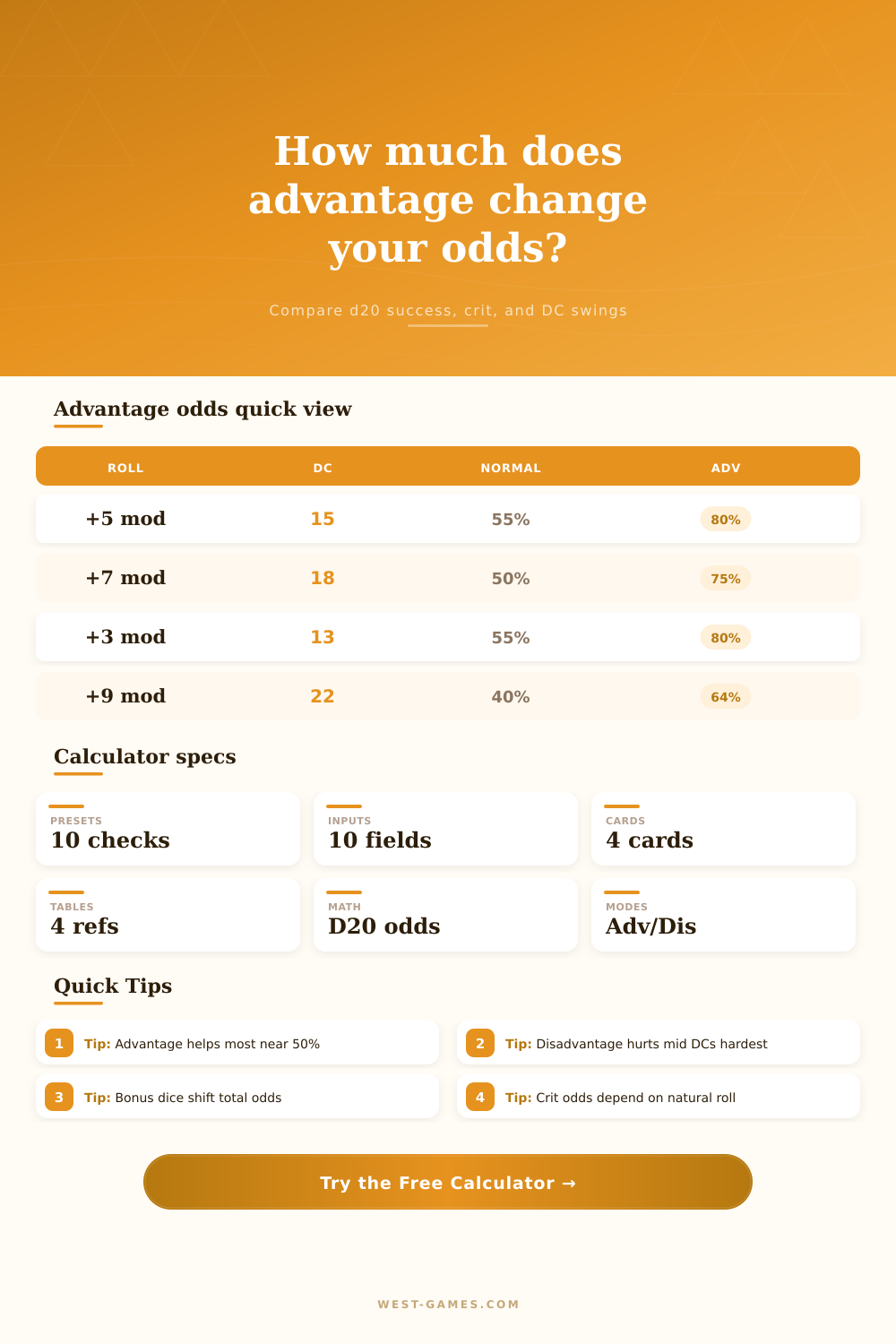
Here’s another missed attack. Your armor class is fifteen. You have a plus five modifier. By those numbers, that’s a fifty-five percent chance of hitting. Roll with advantage? That chance increase to eighty percent. At first glance, that seems magical. But it isn’t, it’s math disguised as magic. And understanding that jump, in this case, will change your gameplay completeley.
You won’t need to remember tables; instead, you’ll understand what you’re doing different when you roll with advantage and what that means for your strategy. The calculator above deals with all the complicated counting so you can get back to playing the game, not doing math. Adding this flat amount to your roll would be simple enough. You can just convert everything to a plus five bonus on rolls and call it a day if Advantage worked like that. But it doesn’t. It shifts whole probability curve upwards.
Why Advantage Changes Your Game
That effect is most pronounced when you’re hovering right around a 50% chance of succeeding or failing. Because the line between hit and miss becomes incredibly narrow in that area, it’s also where double-dipping will produce greatest swing. Advantage hardly matters at all once you’ve got a lock on something. It’s still completely worthless when you’re all but certain to fail. The tension exists squarely in the middle; that’s always the sweet spot.
This is also true for Disadvantage, even if the logic is brutally inverted. Here’s how: roll both dice and take the lower one. This pulls the mean way, way down. Most people think disadvantage is simply -5. And they are wrong! In fact, this mistake really blows up at moderate challenges. If there’s a 50% chance of success on a check, then there’s roughly a 75% chance of failure when disadvantage applys.
The shape of the curve bends against you so sharply that even flat bonuses can’t correct it. You might think, “Oh hey, I’ll add +3 to cancel that penalty,” but no, sorry, it still doesn’t work because the shape of the distribution has changed. These curves are subtly influenced by modifiers and bonus dice. Your whole range will shift up if you have a situational modifier or a proficiency bonus applied to it before you roll for advantage or disadvantage. Additional variance comes from bonus dice such as bardic inspiration or guidance that layer on top off that shift.
The tool takes this into account, listing out all possible outcomes including reroll conditions and critical thresholds. Not only does it show you if you’ll hit or miss, it tells you how often you’re likely to fumble or crit based purely on your natural rolls. This level of detail is what can set apart luck from reliable strategy.
A fighter has a high attack bonus; they’re already going to hit seven out of ten times normally. That’s pretty good. With advantage, it rises to nine out of ten, not an extraordinary increase, but it’s still some insurance against failure. Then you have a sneaky thief who needs to get by some poorly trained sentries, but they don’t have great Stealth. Their baseline might be thirty percent. Add advantage, and they suddenly can count on rolling nearly sixty percent (roughly). A long shot becomes worth attempting. Advantage means different things depending on the character and their situation. It depends on what you have to work with.
You should of view advantage alone without considering the difficulty class being attempted and other modifiers you possess. Some spell effects or home brew rules will have super disadvantage or advantage that is theoretical in nature. For example, rolling 3 dice and taking the worst or best is even more skewed. Depending on how the results lean, the average outcome change. This makes a critical hit extremely likely, or makes a fumble almost certain.
For reasons of game balance, most official games use only two dice. Beyond that, there’s so much variance that the game simply doesn’t play out evenly anymore. Strategy becomes nothing but luck; no one at the table is happy about that in the long term. But this knowledge lets you assess your risks intelligently. Do you know that disadvantage can decrease your odds below 25%? Then maybe you won’t use that option at all, instead choosing another way altogether. Maybe you’ll sacrifice a little precision for some security, or seek out environmental bonuses rather than rolling dice.
That’s where the utility comparison tables found within the tool come into play. They present the options side-by-side for a range of difficulties. They show how the extra benefit decreases as your initial odds increase, helping you decide when to press forward and when to pull back. At the end of the day, though, probabilities are no guarantee. Good odds don’t mean you won’t keep rolling bad numbers; sometimes it works out against all odds.
Understanding the mechanics isn’t about knowing how everything goes down because you’ll never do that. It’s about making informed decisions over time. It takes the guess work out of what tactics to choose. Knowing exactly how much each effect affects your chances makes a play more intentional than guessing. That change in mindset turns randomness into something that becomes a layer for strategy, a layer worthy of mastery. Chaotic dice don’t need to equal chaotic gameplay.