💰 Idle Game Offline Earnings Calculator
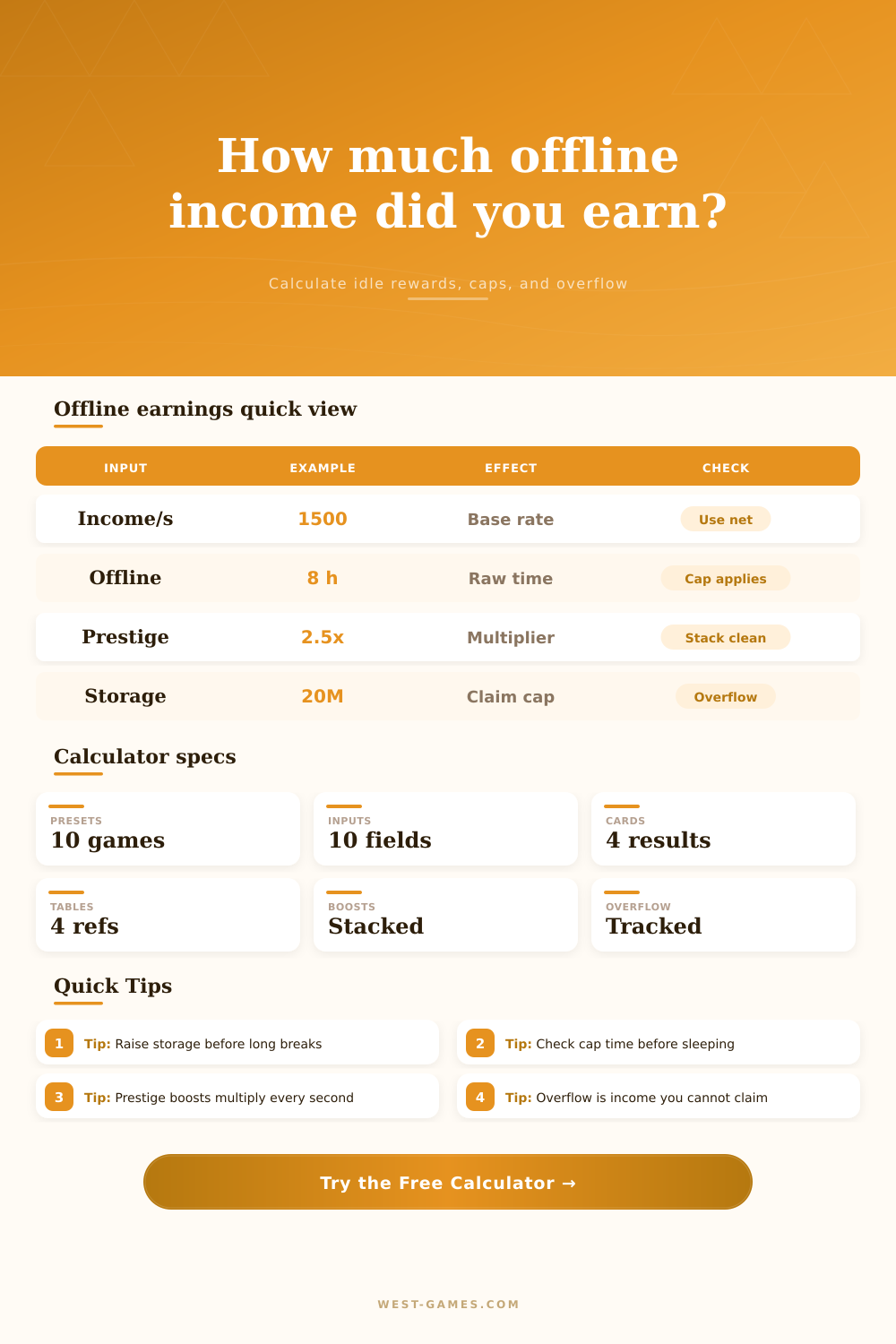
Estimate how much idle currency you can claim after offline time, offline caps, prestige multipliers, ad boosts, storage limits, and previously claimed rewards.
Same offline window with prestige set to 1x while keeping boosts and caps.
baselineShows the claim if the temporary ad or boost multiplier is removed.
boost checkTests whether a larger storage cap would rescue lost offline earnings.
cap checkShows the claim if the full offline duration counted before storage.
time check| Offline time | 6 hour cap | 12 hour cap | 24 hour cap | Planning note |
|---|---|---|---|---|
| 2 hours | 2 counted | 2 counted | 2 counted | Short check-ins usually avoid time loss. |
| 8 hours | 6 counted | 8 counted | 8 counted | Sleep sessions often need at least an 8 to 12 hour cap. |
| 16 hours | 6 counted | 12 counted | 16 counted | Workday plus sleep begins to punish small caps. |
| 36 hours | 6 counted | 12 counted | 24 counted | Long breaks need both cap upgrades and storage upgrades. |
A time cap limits how many offline hours generate currency before storage is checked.
| Prestige | Ad boost | Event bonus | Efficiency | Net multiplier |
|---|---|---|---|---|
| 1.0x | 1.0x | 0% | 100% | 1.00x total income |
| 2.0x | 2.0x | 0% | 80% | 3.20x effective offline income |
| 4.5x | 1.5x | 25% | 70% | 5.91x effective offline income |
| 12.0x | 2.0x | 50% | 60% | 21.60x effective offline income |
This calculator multiplies prestige, ad boost, event bonus, and offline efficiency together.
| Gross earnings | Storage cap | Already claimed | Claim now | Lost overflow |
|---|---|---|---|---|
| 8,000,000 | 20,000,000 | 0 | 8,000,000 | 0 |
| 35,000,000 | 20,000,000 | 0 | 20,000,000 | 15,000,000 |
| 35,000,000 | 20,000,000 | 5,000,000 | 15,000,000 | 15,000,000 |
| 90,000,000 | 50,000,000 | 15,000,000 | 35,000,000 | 40,000,000 |
Already claimed rewards reduce the remaining claim, while overflow is lost once gross earnings exceed storage.
| Profile | Typical cap | Efficiency | Storage pressure | Best check-in pattern |
|---|---|---|---|---|
| Early clicker | 2 to 6 hours | 50% to 80% | Low at first, then sudden | Claim after upgrades and before sleep. |
| Mobile idle RPG | 8 to 12 hours | 60% to 90% | Moderate when ad boosts stack | Use boosts on the largest daily claim. |
| Factory idler | 12 to 24 hours | 80% to 100% | High after production jumps | Upgrade storage when new generators unlock. |
| Endgame prestige | 24 hours or more | 50% to 100% | Very high with relic scaling | Compare storage gains against prestige timing. |
Use the preset closest to your game, then replace the values with the exact in-game numbers.
After a hard day at work, you step away from your computer only to come back later and discover your storage is full and most of your gold are gone. At one time or another, that’s what happens to all players of idle games. Passive income sounds great until you hit its hard limits. It’s not as if you’re getting paid in your absence, not entirely. You are also battling against unseen container size caps and time caps. Whether you perceive yourself to be rewarded for your absence depend on understanding those limits.
Three connected factors make up the game’s underlying mechanism: production rate, storage space and accumulated time. Production rate is easy to understand; it represent your baseline cash flow (the amount of money flowing into your bank every second). Your base income per second tell you how fast money flows in, but that number is meaningless if you don’t account for what happens when you aren’t there to catch it.
How Idle Games Work
Offline earnings are normaly penalized with an efficiency factor where your factories operates at a reduced pace while you’re gone. Eighty percent is standard. It means that, before the multiplier, every dollar you earn off-screen is equivalent to just 80 cents. That’s one source of distortion; there are others, too, all of which distort every other calculation you’ll make. So get that wrong early and everything else goes wonky.
And finally, there are the caps. These kick in when developers wants you to engage every day and force you offline with a time limit. This typically limits what you can accumulate to either eight or twelve hours, no matter how long you’ve been offline. In other words, if you take off for twenty-four hours because you went out of town, those additional twelve hours aren’t money-makers. They’re gone. They are zeroed out.
Put the number of hours you think you’ll be offline into the calculator above. It does the math for you based off your custom cap limits, so you don’t have to guess whether your “offline” time was productive or wasted time. Checking the countdown before shutting down protects you from wasting time.
The second way this catches people off guard involve multipliers. Instead of adding the bonuses together (two times prestige + two times ad = 3x), they usually multiply them (two times prestige * two times ad = 4x). In other words, all those prestige bonuses and ad rewards compound exponentially within a very narrow time frame. Four times money in no time flat.
This compounding effect is awesome for rapidly accumulating enough wealth to fill tiny stashes. It’s also hazardous if your wallet isn’t big enough to accommodate the heavy rain. With the right combination of game mechanics, you could of generate far more funds than you have space to store them. If you create more wealth than your containers can hold, it will overflow and cause losses.
Storage is the silent killer in idle games. Sure, you’re making hundreds of millions of coins an hour, but what’s the point when you don’t even have anywhere to put them? Your storage capacity is just 5M coins. You’ve got two million in there already. All you can claim are three more. Poof, dissapears for good.
Investing in larger storage can be more valuable than the marginal increase from speeding up production. No matter how much prestige you get, you’ll still lose whatever spills over. Get a bigger bucket first; then work on filling it.
But now, to illustrate your point of loss, here’s a table on the page that lays out combinations of session length and different time caps. You’ll get a sense for where you’re sitting in terms of “early” vs “endgame,” and what kind of profile that gives you (see below).
Early-on: Clickers. In the end-game, players focus on prestige farming. That’s a very different playstyle.
In the early game, storage is small, and frequent checks in are more important than straight income. At the end game, your production are huge. Your goal is to plan your off-line windows around storage upgrades and cap extensions.
To succeed at idle games, which are in part a test of patience (waiting for things to increase), you also has to manage resources. How do you increase production without outgrowing your capacity? You always feel behind, even if you work your virtual employee day and night, because you do not respect the limits on your growth. Before you spend again, take a second to understand exactly what it’s costing you. The first step to halting the hemorrhage is knowing where you’re bleeding.