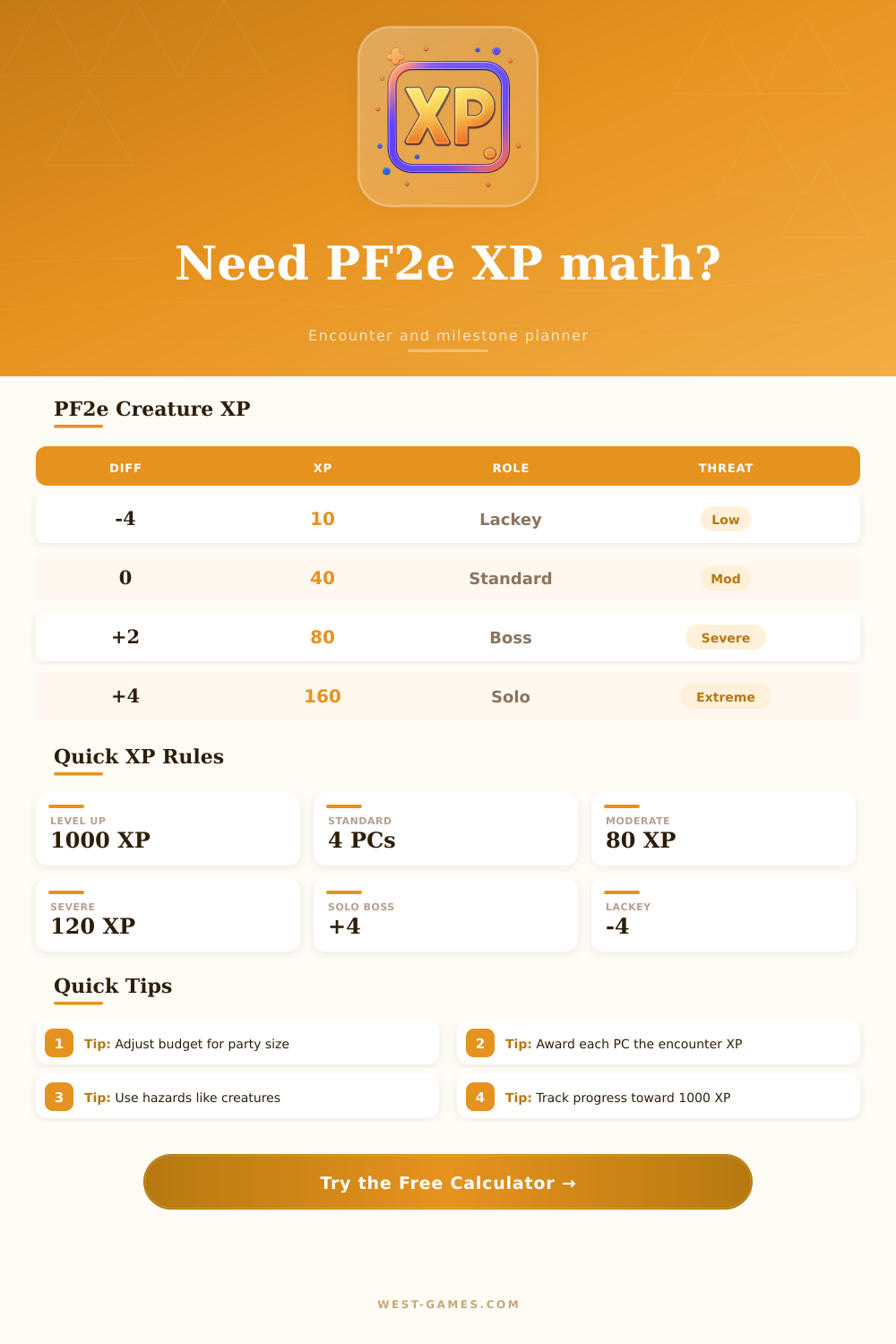
PF2e Encounter & Party XP Calculator
Build Pathfinder 2e encounters with party-size budgets, creature levels, hazards, accomplishment XP, per-character awards, and milestone pacing.
GM Core uses a 20 XP low-threat character adjustment; classic CRB tables use 15 XP.
Standard mode removes or restores the party-size budget adjustment before awarding XP.
Great for attrition rooms, foreshadowing, scouts, or short scenes where the table needs momentum more than danger.
The cleanest zone for routine PF2e building: party size, enemy count, and award math usually stay easy to explain.
Check action economy, terrain, recovery access, and enemy level spread before calling it a fair severe or extreme scene.
| Creature Level | XP | Typical Role | Calculator Note |
|---|---|---|---|
| Party level -4 | 10 | Low-threat lackey | Use in groups or as pressure around a stronger foe. |
| Party level -3 | 15 | Low or moderate lackey | Good for patrols and minion waves. |
| Party level -2 | 20 | Lackey or standard creature | Stable filler when you need more bodies. |
| Party level -1 | 30 | Standard creature | Often feels like a competent rank-and-file enemy. |
| Party level | 40 | Standard or low boss | Two equal-level enemies create a moderate baseline. |
| Party level +1 | 60 | Low or moderate boss | Best when supported by weaker allies. |
| Party level +2 | 80 | Moderate or severe boss | Can anchor an important encounter. |
| Party level +3 | 120 | Severe or extreme boss | Dangerous swing potential; watch defenses. |
| Party level +4 | 160 | Extreme solo boss | Use sparingly and check party tools first. |
| Threat | 4-PC Budget | GM Core PC Adjustment | Classic PC Adjustment | Use Case |
|---|---|---|---|---|
| Trivial | 40 XP or less | 10 XP or less | 10 XP or less | A speed bump, warning, or easy cleanup. |
| Low | 60 XP | 20 XP | 15 XP | A meaningful scene with low defeat risk. |
| Moderate | 80 XP | 20 XP | 20 XP | The everyday serious fight budget. |
| Severe | 120 XP | 30 XP | 30 XP | A climactic or resource-draining battle. |
| Extreme | 160 XP | 40 XP | 40 XP | A possible campaign-turning showdown. |
| Accomplishment | Common Award | When It Fits | Milestone Effect |
|---|---|---|---|
| Minor objective | 10 XP | Clue found, route opened, small risk solved. | Adds texture without speeding levels much. |
| Moderate objective | 30 XP | Important social win, faction progress, strong clue. | Can replace a low-threat encounter. |
| Major objective | 80 XP | Quest solved, chapter goal reached, major secret revealed. | Often equals a moderate encounter. |
| Story arc close | 120 XP | Dungeon cleared, villain defeated, settlement saved. | Moves the party decisively toward level-up. |
| Style | XP Per Session | Sessions Per Level | Best For |
|---|---|---|---|
| Slow burn | 120-180 XP | 6-9 | Sandbox travel, politics, downtime-heavy play. |
| Steady adventure | 200-280 XP | 4-5 | Most dungeon, mystery, and quest structures. |
| Fast campaign | 330-450 XP | 3 | Short arcs, convention pacing, high-density sessions. |
| Chapter leap | 500+ XP | 1-2 | Intentional jumps after major victories. |
Running a Pathfinder Second Edition campaign often feels like walking a tightrope between keeping players engaged and accidently killing them with a math error. You strive for deadly-but-not-lethal encounters and you try to reward work without giving out levels so fast they become meaningless. That fight isn’t usually over creative spark, but over math. Game Masters need to handle threat budgets and party adjustments carefuly when they can’t afford to take chances with their table’s life. They need a tool that does the guessing for them: a Pathfinder Second Edition Calculator.
That’s where the core mechanic comes into play: awarding experience points proportionally to a creature’s level compared to the party’s. Forty points are standard for an enemy equal to the party’s level. Four levels above the party? One hundred and sixty. In isolation, those figures appear straightforward. But throw different-sized parties into the mix with multiple threats and hazards and suddenly it start getting complicated.
How to Use a Pathfinder 2E Calculator
That’s where this calculator comes in. Plug in your threat budget, your monster counts, and let it do the math. You won’t have to guess how many extra minion or missing party members to add for the right balance.
More important than remembering the coefficients is understanding how they work. The baseline assumes a four-person party because it improve resource use while keeping action economy in check. Less pressure on the enemies means they’ll recieve experience more quickly since there are fewer targets to split their attention across. The opposite hold true for bigger parties, it dilutes the threat and requires increased budgets to keep things tense.
XP can be viewed as either a pacing device or a score. On Milestone systems, however, the number doesn’t trigger an automatic level-up. It’s simply there to give you a sense of where things are going in your game, it helps you determine if you’re structuring your sessions around the campaign arc. To that end, you might reward puzzle-solving and uncovering lore XP, rather than combat XP during a more hex-crawling exploratory game. That way both low- and high-combat games stays engaging without becoming boring. The table at the bottom of the page provides a point of reference for linking typical accomplishments to rewards. Use this to match physical risks to social rewards.
Then there are hazards. While a low-level hazard like a simple trap may be an annoyance, a higher-level one or a complex series of environmental challenges can eat up resources as well as a bunch of goblins. Treat hazards like you do creatures and give out XP based off level and complexity. They’ll contribute significantly to the total and help you not short-change the party with survival issues that need resource management and skill checks. You can also put these into the tool separately. This makes sure they don’t overwhelm the creature encounters while still contributing appropriately to the overall encounter.
The number of such modified encounters you can cram into a session is important as well. If you’re running three or four fights per session, with a battle rated at moderate threat, it provide just enough XP to let your characters advance at a solid pace. Bump that up to six severe encounters? You’ll be levelling up nightly. That’s not balanced; it’s pushing character strength and feat advancement out of whack. Two-hundred to three-hundred XP per session strikes the sweet spot for most tables. It allows for a pace that lets players breathe while still moving the story forward, this also provides time for character development and even some down time.
When new game masters gets overwhelmed, they start tinkering with everything. Instead of just bumping a number up or down or throwing a few lackeys at them, they tweak every variable. They do this until enemies are perfectly tuned for their group’s difficulty level. You should of didnt do that. Use default-level standard creatures as your initial threat, then adjust if they’re killing your party or getting walked on without a sweat.
You can use the calculator to visually see what these tweaks will do in real-time. An extra boss makes the difference between severe and extreme on the Threat Category slider. With a visual feedback loop like this one, it’s harder to accidently make your powers too strong and lose the balance of your fights.
To conclude. All this boils down to keeping control over the tempo of your campaign. This is how you decide when your characters should be at their strongest and when they should be feeling helpless. By getting the numbers straight, you can let the narrative guide the pacing instead of vice versa. No matter whether you’re running a one-off skirmish or an entire arc, knowing your budget will allow you to concentrate on what really matters: engaging role-play sessions and unexpected turns. The numbers remains in the background, as they should. They empower the drama instead of dictating it.