Diablo 4 Paragon XP Calculator
Estimate Paragon XP, XP/hour, difficulty impact, activity pace, glyph progress, and the point plan needed for your next board route.
| Difficulty / tier | Calculator XP factor | Use when | Planning note |
|---|---|---|---|
| Normal | 1.00x | Campaign or testing | Baseline for custom XP/hour entries. |
| Hard / Expert | 1.25x to 1.55x | Fast leveling before cap | Worth using only if clear speed stays high. |
| Penitent | 1.90x | Pre-Torment prep | Good bridge when enemies die quickly. |
| Torment I-II | 2.35x to 2.85x | Fresh Paragon farming | Strong range for early glyph sockets and first boards. |
| Torment III-IV | 3.45x to 4.15x | Endgame farming | Only faster if deaths and town time stay low. |
| Paragon band | Route goal | XP pressure | Calculator use |
|---|---|---|---|
| 0 to 100 | First sockets | Light to medium | Use presets to compare early activities. |
| 100 to 180 | Rare clusters | Medium | Track route points before adding boards. |
| 180 to 240 | Board polish | Heavy | Small XP/hour gains matter more here. |
| 240 to 285 | Late build power | Very heavy | Test safer tier vs push tier clear speed. |
| 285 to 300 | Completion | Extreme | Use realistic uptime and daily hours. |
| Activity | XP factor | Best target | Practical tradeoff |
|---|---|---|---|
| Nightmare Dungeon clears | 1.05x | Stable XP route | Simple loop with predictable completion time. |
| Pit speed clears | 1.18x | Glyph and Paragon mix | Strong when the tier is comfortably farmable. |
| Pit pushing | 0.85x | Unlocks and testing | Higher risk usually lowers XP/hour. |
| Infernal Hordes | 1.25x | Dense combat XP | Rewards uptime and strong area damage. |
| Helltide loop | 0.95x | Open-world farming | Good when events chain with little travel. |
| Whisper route | 0.82x | Mixed objectives | Useful if cache goals matter too. |
| Plan item | Input used | Result impact | When to adjust |
|---|---|---|---|
| Glyph socket points | Reserved socket path | Raises route need | Increase when adding a new board socket. |
| Rare or magic nodes | Cluster reservation | Build power planning | Increase for stat-threshold glyphs. |
| Board travel | Connector path | Consumes flexible points | Reduce when boards are overextended. |
| Legendary nodes | Node reservation | Checks point funding | Increase when the node is core to the build. |
| Glyph rank target | Pit tier and deathless rate | Estimates Pit runs | Raise Pit tier if upgrade attempts slow down. |
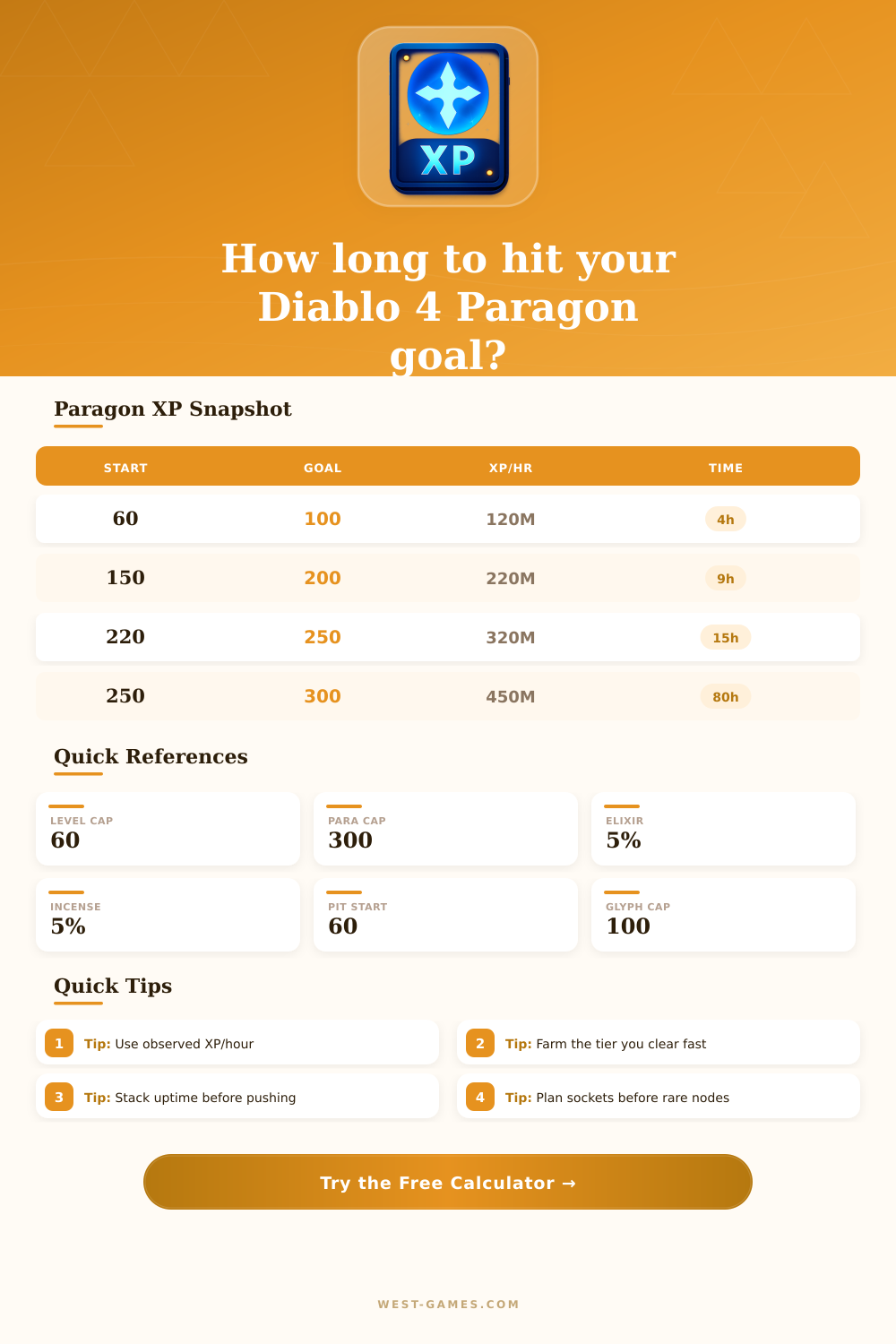
Level up to sixty and then its go time. The character progression bar are gone. In its place is the Paragon board, a grid of nodes that provide power but requires patience. There are three hundred points. How long will it take? Will I be grinding for hours? Before entering any data, you might gets lost in the math. But after typing your base speed, along with all the bonuses you’re stacking on top, the calculator above do the heavy lifting for you. No need to guess at conversions or coefficients. It turns a vague grind feeling into a concrete schedule you can livig with.
Everyone get this wrong early on. Everyone chases big number because it sounds good. Yes, Torment IV gives you an insane XP factor over Normal difficulty, but… only if you can get through the content fast. If you’re sitting around, waiting for stuff to cool down or dying every ten minutes while trying to repair your gear, then your actual hours-per-XP will drop like a rock. And that’s where everybody make a mistake. Speed beats pride. Oftentimes, staying deathless in a low tier will earn you far more Paragon XP per hour than pushing a high tier repeatedly into the ground. It’s all in the table on page; and uptime is far more important then raw factors.
Plan Your Grind Before You Start
To use it, you type in your base XP/hour (without any modifiers). This is very important, that way, the estimate isn’t based entirely on speculation but rooted in your actual experience. How much do you expect to get from a clean run? Next, plug in the bonuses. Season blessing change… They can be huge, or nothing at all, depending on when you log in. But things like elixirs/incense offer consistent percentage boosts. These two categories combine into your effective XPH: how fast are you really going? How long will it take to reach your target Paragon number? Does it seem reasonable, or should you change something about the way you’re farming?
The other complication is with Glyph sockets. That won’t work if you’re aiming for Paragon point two hundred but have no points left to get key socket. That’s not going to work. The planner section allow you to bank points for legendary effects and rare nodes, then plan for how far they’ll take you. That way, you can hit your desired Paragon number exactly, and match the number of points with your build path. Failing that, you may reach your numerical goal without having enough power to do anything. By planning your points ahead of time, you avoid such frustration. It makes you think about the board as a linked web instead of just a number.
There are two other tradeoffs: the Pit of Artifacts and Infernal Hordes. The Pit has some danger (pushing too far in) but also reward speed clears to upgrade glyphs. Hordes rewards a lot of combat xp and scales up nicely depending on uptime. That’s why the calculator compares these two activities side by side, so you know what works best based off your skill level. If you have a lower deathless run rate then it’ll highlight that you get better results from a safer tier. There is a practical tradeoff here between consistency and difficulty.
There is another wrinkle involving seasonal content like event loops and temporary bonuses. If you’re stuck in some far-off zone, those Helltides events may fall flat; if you’ve got minimal travel time to the next node in the chain, it makes for a good event loop. The activity comparison helps you weigh these options against stable Nightmare Dungeon clears. The same activity comparison lets you weigh those choices. Maybe a chaotic event lose out to a predictable loop, by only a hair. Knowing that alters your weekend plans.
Levelling in Paragon isn’t a matter of time logged. It’s about getting the most out of every minute spent playing. Knowing what you put in and turning it into results turns blind grinding into strategic planning. The math will provide you with the numbers, but it’s you who applies the discipline to follow through with the plan. You should of begin with a reasonable baseline, respect your uptime and follow the math to your next move.