⚒ FFXIV Crafting Rotation Calculator
Test a manual Final Fantasy XIV crafting sequence step by step with progress, quality, CP, durability, buffs, Inner Quiet, food, specialist bonuses, and macro split checks.
HQ Materials
0-50%Starting quality reduces how many touch actions your manual rotation needs before Byregot's Blessing.
Food Profile
CP CapsFood is modeled as a percentage gain with a cap, so extra CP may change the whole sequence.
Specialist Soul
+StatsSpecialist planning adds small craftsmanship, control, and CP bonuses for job-specific crafts.
Macro Split
15 LinesFFXIV macros have limited lines, so long production rotations usually need two or more macros.
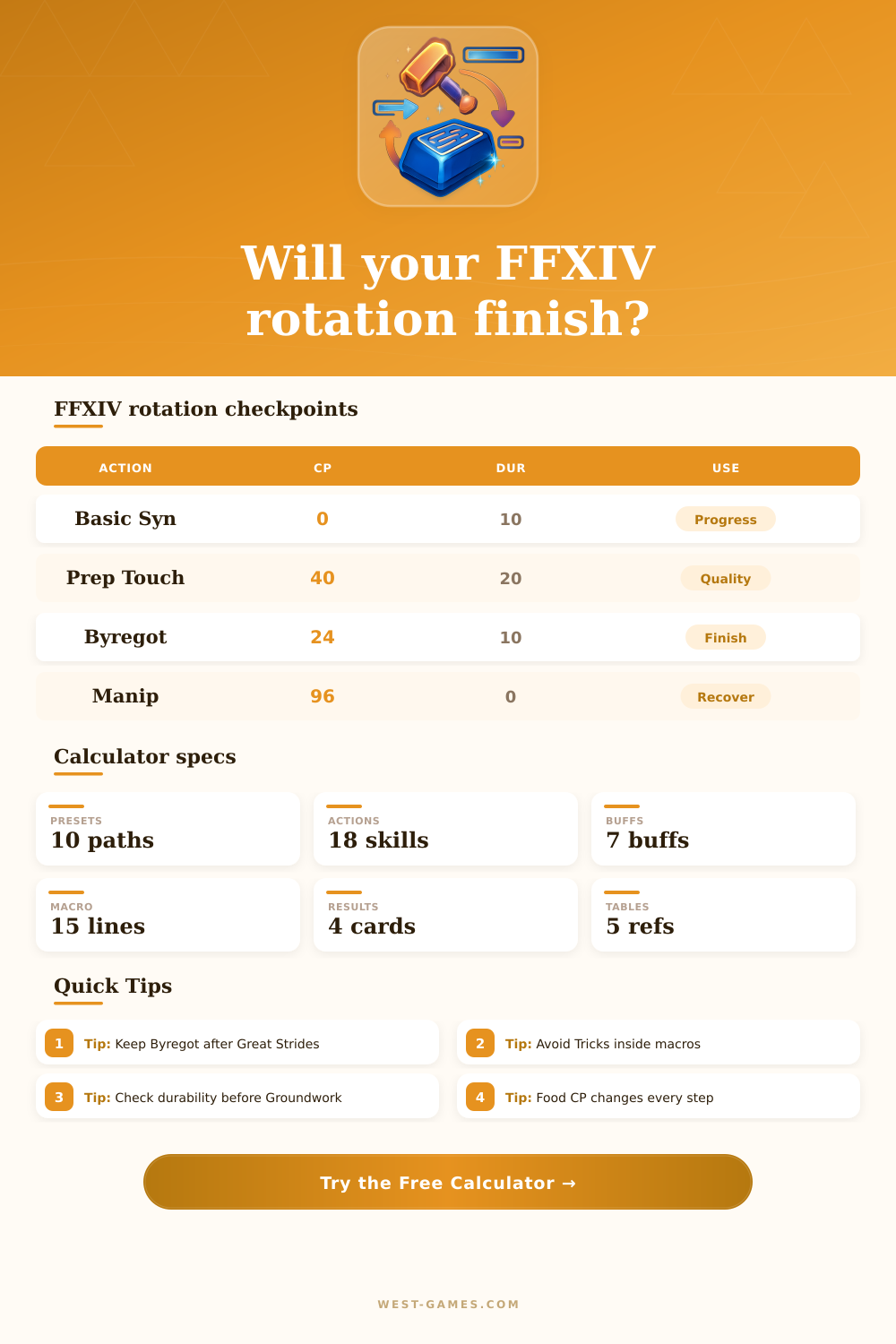
| Action | Type | Efficiency | CP | Durability |
|---|---|---|---|---|
| Basic Synthesis | Progress | 120% | 0 | 10 |
| Careful Synthesis | Progress | 180% | 7 | 10 |
| Groundwork | Progress | 360%, halved if short durability | 18 | 20 |
| Basic Touch | Quality | 100% | 18 | 10 |
| Preparatory Touch | Quality | 200%, +2 Inner Quiet | 40 | 20 |
| Byregot's Blessing | Quality finisher | 100% + 20% per Inner Quiet | 24 | 10 |
| Buff | CP | Steps | Planning effect |
|---|---|---|---|
| Innovation | 18 | 4 | Quality actions +50% |
| Veneration | 18 | 4 | Progress actions +50% |
| Waste Not | 56 | 4 | Durability cost reduced |
| Waste Not II | 98 | 8 | Long durability reduction |
| Manipulation | 96 | 8 | Restores 5 durability after steps |
| Great Strides | 32 | 3 | Next touch quality doubled |
| Condition | Quality | Macro? | Use case |
|---|---|---|---|
| Normal | 1.00x | Yes | Production macros and repeat crafts |
| Good | 1.50x | No | Manual touch or Tricks decision |
| Excellent | 4.00x | No | Manual Byregot timing test |
| Poor | 0.50x | No | Avoid quality finisher if possible |
| Average | 1.08x | No | Expected manual estimate |
| Durability | Typical recipe | Risk | Helpful tools |
|---|---|---|---|
| 35 | Consumables and materials | Very tight | Waste Not, Manipulation |
| 40 | Older short crafts | Tight | Prudent Touch, Master's Mend |
| 70 | Gear and main crafts | Moderate | Groundwork, Prep Touch |
| 80 | Starred gear profile | Flexible | Long quality setup |
| Check | Threshold | Pass | Warning |
|---|---|---|---|
| Line count | 15 actions | 1 macro if 15 or fewer | Split at a buff refresh |
| Condition actions | 0 desired | No Tricks or Intensive | Manual timing needed |
| CP reserve | 0 or more | Macro can execute | Food or melds required |
| Completion step | Before durability loss | Craft finishes | Add synthesis or durability |
The macro check assumes one crafting action per macro line. Add your own wait values in game.
But there’s nothing like quiet time waiting for Final Fantasy XIV to load so you can get into another round of crafting. One wrong move after clicking that start button and it’s all over, all your materials is wasted. It happens to us all. This applies even to veteran crafter who’ve made hundreds or even thousands of items without having to double check what they’re doing. Sometimes it’s not about being innately talented; sometimes it’s about seeing the dance in your head first.
That’s why it pays to test out your rotation ahead of time. The way crafting works is that there are three shrinking resources: Progress take you towards finishing, Quality increases your chances of creating an HQ item, Durability prevents the item from breaking.
Why You Should Test Your Craft Plan First
The rookie mistake is to try to simply get the item crafted. They ignores the Creative Touch window, use Basic Synthesis as long as it lasts, then just before it breaks they craft something new. That’s wasted points. The best rotation maximizes value per CP. How do you do this? Push progress well. Stack quality buffs. Don’t let durability hit zero.
We is running the numbers. But knowing what those numbers mean will completely alter how you approach the game. Using the calculator (above), you can input your own stats, choose a recipe profile and test your plan against some of the games hidden variables. Does your sequence run out of CP before completing? Does your durability fall below zero by step forty-two? Does your rotation not fit within fifteen lines, aka: do you need to split your macros? You only recieve fifteen-line macros. Splitting them results in missed buff windows, and that little thing causes more ruined crafts than any bad luck ever could.
The secret counter is Inner Quiet which records the number of times you cast Preparatory Touch. As long as you have enough CP to spend, Byregot’s Blessing will multiply that quality by the number of Prep Touches you stacked. If you burn your CP too soon on something like Waste Not or early Veneration, you’ll be left without anything for the finisher. The tool reveals the cost-benefit analysis for you and lets you know down to the tick when your CP fall out from under you and you should of reconsidered how you’re spending those points.
The other killer of high level crafting that is often deadly silence is durability. Groundwork costs twenty durability, every single cast. That’s great when you start with a recipe of seventy durability. But then spam it a little too early and now you’ve got one percent durability left for the last few steps because some random fluctuation might knock you over the edge. You can manipulate your way back up but that will take time and costs ninety-six CP. You don’t want to waste that unless you have to. It needs to be woven into your casts and you do so carefully.
The page lays all this out nicely in its reference tables, showing how many CP is spent beyond what seems worth it. The other wrinkle in food is that it’s also not a flat bonus. It caps CP gains, and if you stack too much craftsmanship/control, it may result in diminishing returns depending on your starting stats. With a specialist soul, it only take small stat increases to tip you into one of those rounding thresholds which completely alter the result. Mentally tracking down these edge cases is tough so a digital second set of eyeballs helps.
Ultimately, crafting is all about restraint and rhythm. Move slowly enough to be aware of conditions, yet quickly enough that you remain in the buff window. Good condition yield huge quality bonuses, but never let it make you lazy; have a backup plan. Bad condition will crush your carefully constructed macro unless you’re prepared for adaptation.
The only way to know what works is by testing out your rotation, failure happens safely in a text box rather than when the real craft goes down the drain with rare materials. Breathe deeply before crafting. Crunch the numbers. Check your CP buffer. Double-check your durability floor. Click start confidently, knowing you’ve worked through the puzzle before the game even loaded the recipe. That’s why the masters is out in front.