🏈 NFL Trade Calculator
Compare NFL player value, position scarcity, age curve, contract years, cap weight, draft picks, league mode, roster context, and multi-player package balance.
| Pick tier | Base value | Dynasty note | Redraft note |
|---|---|---|---|
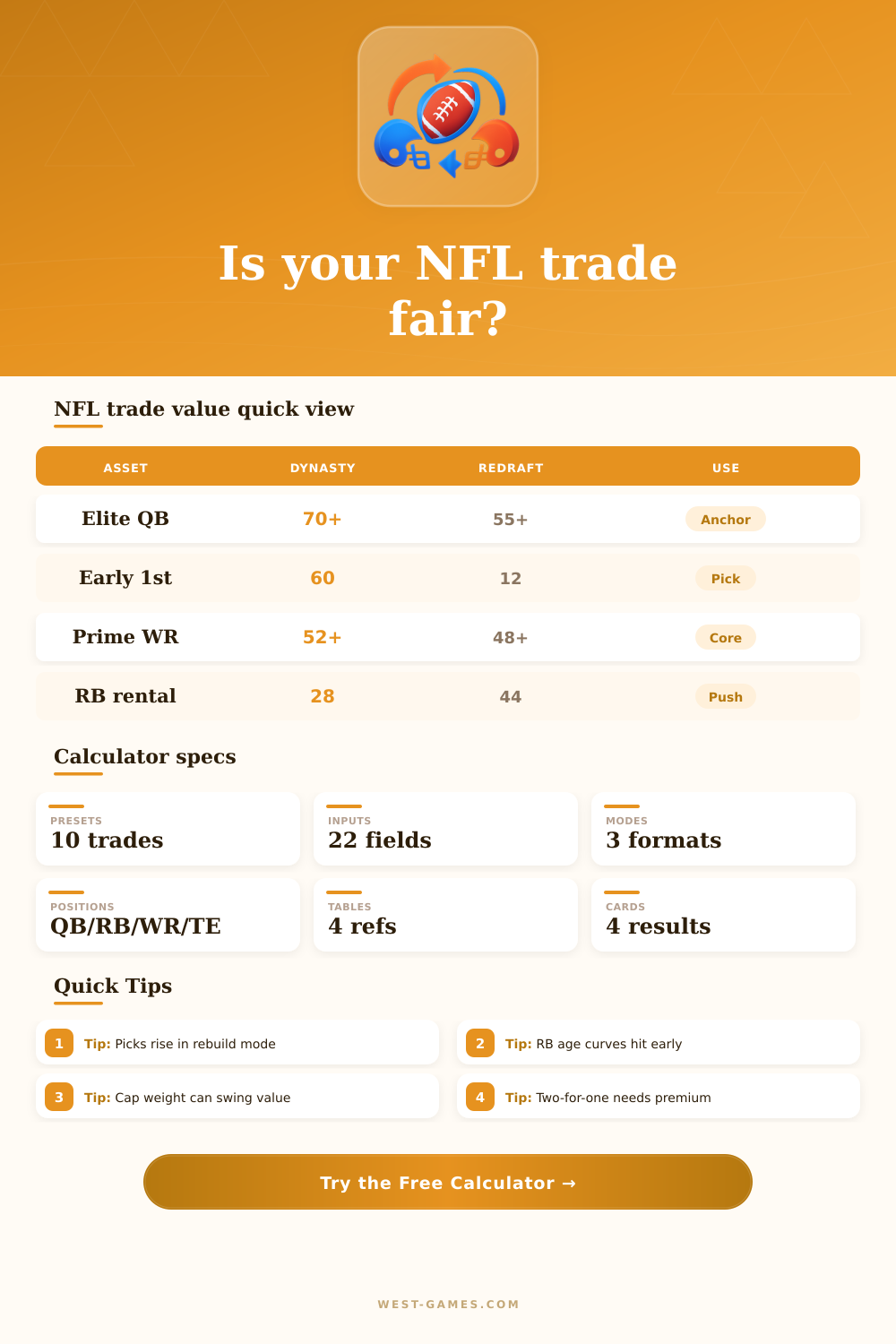
| Early 1st | 60 | Premium cornerstone pick | Low value unless keeper rules apply |
| Mid 1st | 48 | Starter prospect range | Small future sweetener |
| Late 1st | 36 | Useful playoff-team pick | Minor add-on |
| Early 2nd | 24 | Upside or depth tier | Deep keeper add-on |
| Mid/Late 2nd | 18 / 13 | Roster churn value | Usually low weight |
| 3rd/4th | 8 / 4 | Throw-in value | Near replacement value |
Pick values are multiplied by league mode, roster context, market timing, and pick-count discount.
| Position | Scarcity driver | Prime range | Age caution |
|---|---|---|---|
| QB | Superflex and longevity | 25-32 | Late decline, but cap risk matters |
| RB | Starter volume and injury churn | 22-26 | Value drops fastest after 27 |
| WR | Target share and long runway | 23-29 | Older WRs need strong projection |
| TE | Elite weekly edge | 25-30 | Depth TEs lose value quickly |
The calculator blends tier, position, age, projection, contract, cap weight, format, and scoring profile.
| Context | Raises value | Lowers value | Best use |
|---|---|---|---|
| Contender | Projection, elite starters, deadline assets | Distant picks and inactive depth | Win-now playoff push |
| Balanced | Stable players and flexible picks | Extreme age or cap risk | Neutral trade check |
| Rebuild | Youth, contract runway, early picks | Older rentals and cap-heavy players | Rostering future value |
| Offseason | Pick liquidity and youth | Short rental projection | Rookie draft planning |
Context is applied to both packages so the same trade can look different for a contender and a rebuild roster.
| Margin | Score feel | Calculator label | Trade action |
|---|---|---|---|
| 0-5% | Very close | Fair offer | Use need fit as tiebreaker |
| 5-12% | Small lean | Slight edge | Add a minor pick or depth piece |
| 12-25% | Clear lean | Package edge | Rework the premium asset side |
| 25%+ | Lopsided | Big gap | Reset with a different anchor |
A two-for-one or three-for-one package needs extra value because the team receiving the best player also gains roster flexibility.
For 30 seconds, there is silence in the chat room and then either outrage or elation. That is the moment that an NFL trade has gone from football strategy to perception. There you are sitting across from a manager who view a rental running back as a paycheck while you view them as a depreciating asset that will inevitably get injured. By converting your gut feelings into comparable data points, the calculator above helps you cut through the noise. It make each side agree on the math before ego enters the equation.
This approach is what most managers do… Obsessing exclusively over expected season point totals. That’s the wrong metric. Points are merely a single component of a broader formula: Age + Position Scarcity + Roster Context. Two-hundred-and-fifty points mean something very different when they belong to a 23-year-old wideout versus a 31-year-old running back. The latter carries present value (production) at the expense of future uncertainty (risk).
How to Make Smart Trade Decisions
In order to reflect these realities, tool uses age curves that punish older backs harder then older QBs. A runner could dissapear in a matter of months, while a QB can drop off gradually over five years.
For example: The value of every piece on the board changes based off your league format. Draft picks (and youth) is more valuable in dynasty leagues because they offer long-term stability. A first rounder becomes an anchor as he’ll be able to replace multiple starter through the years. That same pick has very little value in a redraft league unless you are specifically saving it for next year. Your choice of mode tells the calculator how much weight each input should of have. Redrafting for a playoff run? That’s different than rebuilding in a dynasty format. You want to ensure what you put in matches what you’re trying to achieve, or the numbers will deceieve you.
Context matters here again: to some managers (contenders), an asset with instant win-now value is more valuable than one who’s a year or two away. That manager will also place a premium on proven production. To other managers (rebuilders), future flexibility is everything, and that person will discount the old guy no matter what he’s doing right now. The tool allows you to apply that context, which adjust the way it balances contract length and cap weight. For example, a huge cap hit could be a deal breaker if you have a balanced roster, but fine if you’re a contender looking to burn cash in pursuit of a Super Bowl run. On the flip side, a stack of picks sounds like treasure in rebuild mode, but it feels like clutter if you need to start winning right now.
Another hidden factor driving trade value is position shortage. Elite players at certain positions has more power compared to their peers at other positions. For example, there are fewer tight ends than wide receivers. So, you need to pay dearly for trading an elite tight end. You simply can’t expect to replace his level of production without giving up a lot in return. The reference tables, which come with the tool, spell this out in plain view. Why is a strong tight end potentially worth more then a good receiver? It is because of market realities; it has nothing to do with preferences.
For example, draft picks complicate things further. An early round pick is worth its weight in gold, capable of turning around a franchise. A late rounder is frequently a sweetener attached to finishing off a trade. The calculator offers a discount on stacking several lower tier picks since their incremental value drop rapidly. This ensures you don’t turn a stack of fourth rounders into something equal to high second or third rounder. That keeps your fairness score honest, grounded by real roster requirements instead of potential, on paper.
Fair is in the eye of the beholder… Ultimately, a trade can be fair as long as both parties is happy with it. The tool will tell you how close a trade is to being fair through its fairness score and verdict. However, it cannot determine whether you’re willing to take the risk. Perhaps you love the running back’s injury history and don’t care what the numbers say. You do you. But having the math on your side lets you use some power when negotiating trades. It means you get to ask for that additional pick, or it lets you hold out for your star player.
The key is that championships aren’t decided Sunday afternoons; they’re decided in trades. You’ll stop gambling on hunches and begin to make calculated moves once you understand what’s going into the decision and follow the logic of how value is measured. When you hit send the chat room will still be silent, but this time you’ll have a solid reason for knowing the numbers play out in your favor.