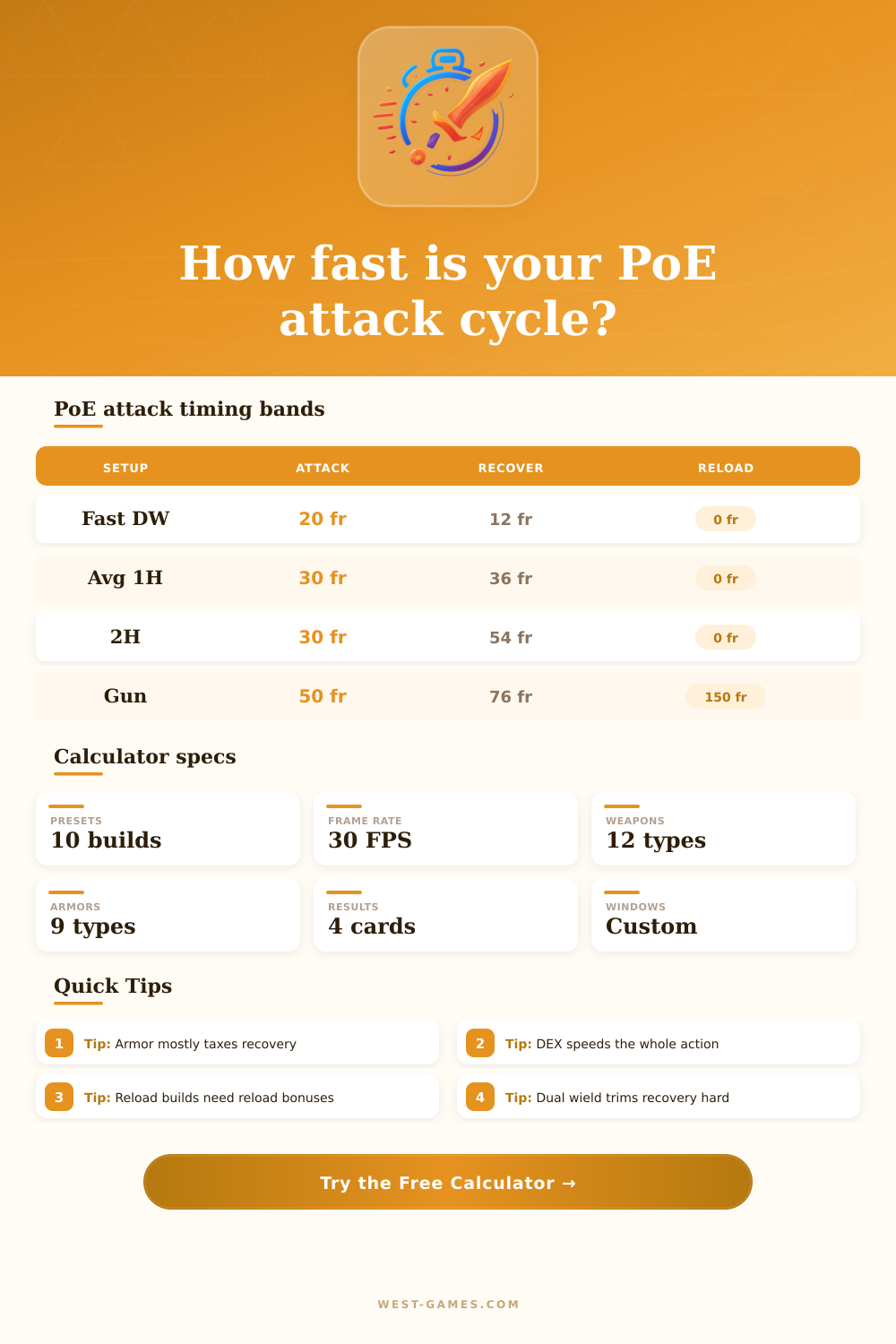
⚔️ Pillars of Eternity Attack Speed Calculator
Plan PoE I weapon timing, armor recovery penalties, dexterity, action speed, dual wielding, reload phases, frames, seconds, and DPS windows.
Current setup
0.00sCalculate to compare timing.
No armor
0.00sShows recovery without armor penalty.
Dual wield test
0.00sApplies a 50% recovery cut.
Reload trained
0.00sAdds a reload speed package.
| Weapon profile | Attack frames | Recovery frames | Reload frames | Use case |
|---|---|---|---|---|
| Fast 1H | 20 | 24 | 0 | Daggers, stilettos, rapiers, fists |
| Average 1H | 30 | 36 | 0 | Swords, axes, maces, spears |
| Slow 1H | 40 | 48 | 0 | Slow single-hand weapons |
| Two-handed melee | 30 | 54 | 0 | Great swords, estocs, pikes |
| Hunting bow | 20 | 24 | 0 | Fast ranged recovery loop |
| War bow | 30 | 36 | 0 | Heavier bow damage profile |
| Pistol | 40 | 60 | 120 | Short firearm burst and reload |
| Arquebus | 50 | 76 | 150 | Slow high-impact firearm shot |
| Blunderbuss | 50 | 76 | 192 | Pellet weapon with long reload |
| Arbalest | 50 | 76 | 90 | Crossbow reload weapon |
Frame values are editable planning baselines, converted at 30 frames per second.
| Armor | Penalty | Best for | Speed note |
|---|---|---|---|
| Clothing or robes | 0% | Casters, monks | No recovery tax |
| Padded | 20% | Light hybrid builds | Small delay |
| Hide | 25% | Frontline skirmishers | Still fairly quick |
| Leather | 30% | Rogues, rangers | Noticeable but light |
| Scale | 35% | Balanced defense | Middle penalty |
| Breastplate | 40% | Off-tanks | Recovery starts to drag |
| 45% | Durable melee | High recovery tax | |
| Plate or brigandine | 50% | Main tanks | Largest standard penalty |
Armor affects recovery in this model, while DEX and action speed also compress attack and reload time.
| Modifier | Bucket | Typical entry | Calculator field |
|---|---|---|---|
| Dexterity | Action speed | 3% per point from 10 | DEX score |
| Deleterious Alacrity | Action speed | Spell or effect value | Other action speed |
| Two Weapon Style | Recovery | Recovery-only boost | Recovery bonuses |
| Dual wielding | Recovery | Large recovery cut | Dual wield setting |
| Speed enchant | Recovery | Weapon speed text | Speed enchant |
| Durganized gear | Recovery | Late-game speed tuning | Durgan setting |
| Gunner | Reload | Firearm reload bonus | Reload bonuses |
| Sure-Handed Ila | Reload | Chanter reload package | Reload bonuses |
Recovery and reload bonuses are separate so melee, bow, and firearm builds do not get blended together.
| Preset | Weapon | Armor | Speed focus | Calculator reason |
|---|---|---|---|---|
| Rogue Dual Stilettos | Fast 1H | Leather | Dual recovery | Shows how fast weapons scale when recovery is trimmed. |
| Fighter Plate Sword | Average 1H | Plate | Armor drag | Shows heavy armor recovery tax on a steady weapon. |
| Barbarian Great Sword | Two-handed | Scale | Hit size | Compares slower cycles with better damage per swing. |
| Ranger War Bow | War bow | Hide | Ranged recovery | Separates bow recovery from reload weapons. |
| Chanter Arquebus | Arquebus | Reload | Highlights reload time as the largest phase. | |
| Monk Unarmored Fists | Fast 1H | Clothing | Action speed | Shows the ceiling of low-recovery melee timing. |
Use the presets as starting points, then overwrite damage, bonuses, and hit quality to match your character sheet.
When you dual-wielded stilettoes in Pillars of Eternity, you expected them to strike like lightning … but they were sluggish loops of animation. That’s the gap between what you expect and what it delivers. That’s where build optimization starts.
Speed isn’t one stat in this game. It’s a layered equation made up of dexterity scaling, weapon animations, armor penalties, and certain reload mechanics. Knowing how those elements play off each other will help you predict how quickly you’ll move in combat. Guesswork about whether something feels slow or fast is less reliable than knowing the mechanics.
How to Make Your Character Faster
After plugging in your preferred gear options, the calculator spits out numbers for you. It even separates out different stages of the attack cycle and does all the counting for you. That way you don’t need to remember which shot took how many frames and what was the reloading time for crossbows and firearms. Or the recovery time you needed between attacks.
Most people pay too much attention to damage-per-hit stat without considering how long it actualy takes to get that hit off. When you miss, every wasted attack add up. With high-damage weapons, those frames can feel like a long time spent sitting there defenseless. If your weapon swings slowly then a missed attack will cost you more time than if your weapon had a faster swing time. The tool puts a number on this for you, and lets you know whether you have the burst damage pattern you want or not.
This is where dexterity comes into play, since it reduces the time required from beginning to end for each of those actions. So while a character with higher dexterity will still only do low damage through their dextrous attacks, they’ll get their attacks off faster and recover quicker afterward. You’d think something like strength or intelligence would be better suited for physical damage, but spending twice as much time registering an attack really lowers its effective damage output.
The calculator apply these modifiers sequentially. If you see a +30% speed bonus on top, you’ll notice it squeezes things tighter then just getting rid of some frames. The second wrinkle is that Armor also specifically penalize recovery time over attack speed. That’s an important detail because of dual-wielding builds.
Because dual-wielding reduces your recovery frames so heavily, you get to swing often. Heavy armor do the opposite: It extends your remaining recovery frames. This means you’re canceling out some of that speed benefit. So yeah, you can have plate AND two swords… but you won’t be fighting like a ninja.
With this tool, you can turn on/off different armor types and instantly see how much drag you’re adding to your rotation. Light armors keeps your recovery short. That’s why rogues/monks don’t run around in heavy plates even though there’s defensive value.
Another entirely new mechanic is the reload time found on firearms and arbalests. While melee fighters fret over their recovery from swing to swing, gunners fret over the lengthy delay after every bullet. The calculator split this up so you can view whether your bonuses to reloading are having any effect. Sure, a strong arquebus round may pack a mighty wallop, but if the reload occupies most of your cycle, then you’ll take a big hit in terms of average damage-per-second in extended fights.
For those using guns, reload-reducing traits or chanter abilities is often better than general attack speed boosts. You want to find the right balance between how often you fire and how much damage it does. What window of DPS are you looking at? Some early fights may be as short as ten seconds where burst is best. Others may extend to minutes (such as some later encounters) where sustained throughput is preferred. You can plug in your preferred fight length here so you can adjust to match and understand the trade-offs. What appears mediocre on a 30 second window could excel across three minutes if it has superior sustain.
Start with the pre-sets which reflect known builds, and modify the inputs from there based off what your actual gear is like. It’s not just about how fast you go, but about using good timing and making use of your characters strengths. Knowing when to hit things and for how long would of tied it all together.