⚔️ Minecraft Attack Speed Calculator
Estimate Java weapon cooldown, damage scaling, crit readiness, sweep timing, DPS, status-effect speed changes, and hits in a combat window.
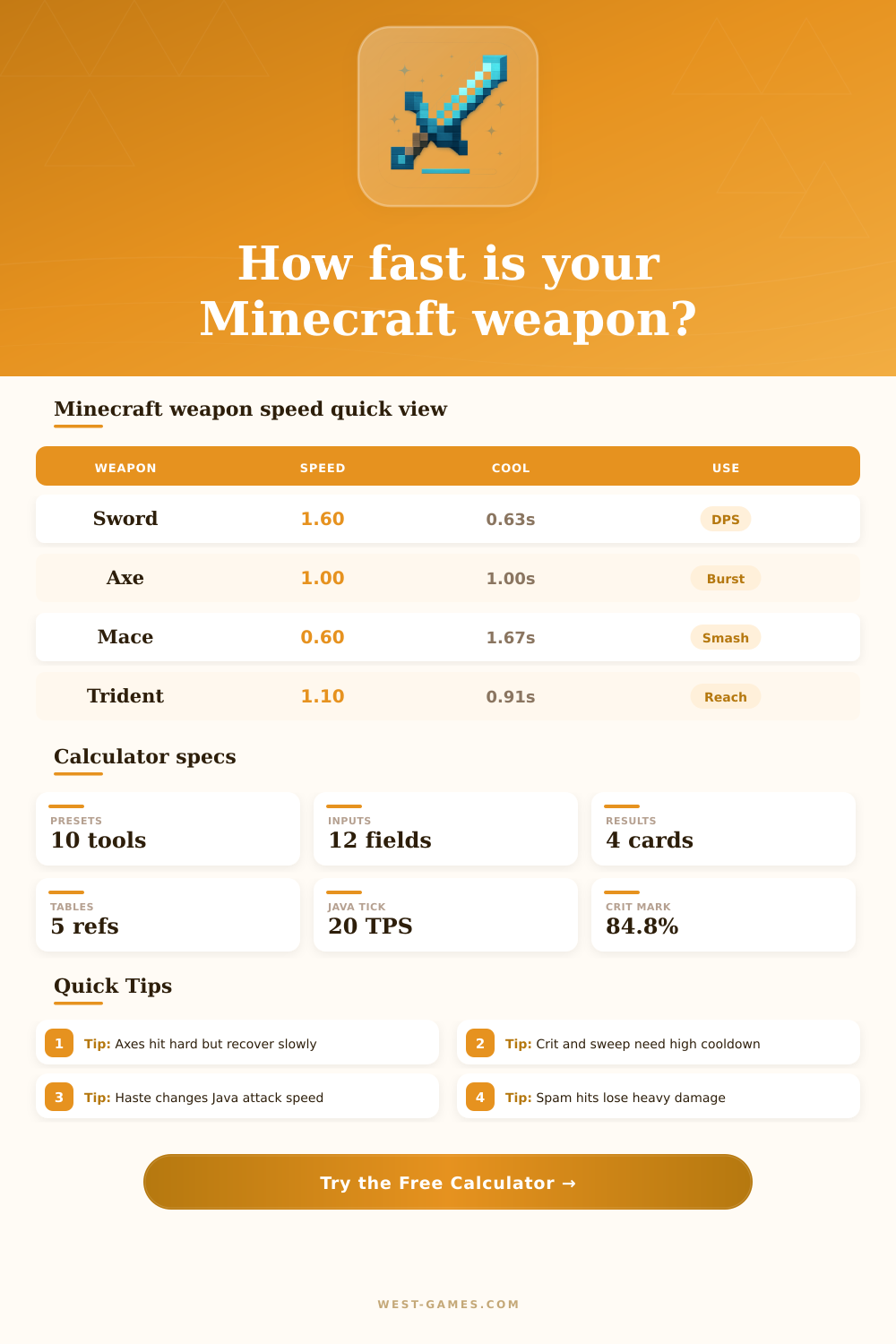
| Weapon | Base damage | Attack speed | Full cooldown | Combat role |
|---|---|---|---|---|
| Netherite Sword | 8 | 1.60 | 0.63 sec | Strong sustained melee |
| Diamond Sword | 7 | 1.60 | 0.63 sec | Standard PvE and PvP sword |
| Iron Sword | 6 | 1.60 | 0.63 sec | Midgame balanced hits |
| Stone Sword | 5 | 1.60 | 0.63 sec | Early combat baseline |
| Stone Axe | 9 | 0.80 | 1.25 sec | Heavy early burst |
| Iron Axe | 9 | 0.90 | 1.11 sec | Shield pressure and burst |
| Diamond Axe | 9 | 1.00 | 1.00 sec | High hit damage |
| Netherite Axe | 10 | 1.00 | 1.00 sec | Highest standard axe damage |
| Trident | 9 | 1.10 | 0.91 sec | Melee plus thrown utility |
| Mace | 6 | 0.60 | 1.67 sec | Slow hit, smash potential |
Values are Java Edition planning defaults. Custom servers, commands, datapacks, snapshots, and Bedrock mechanics can differ.
| Cooldown | Damage multiplier | Timing use | Combat note |
|---|---|---|---|
| 100% | 100% | Full hit | Best default DPS comparison |
| 84.8% | 77.5% | Crit and sweep line | Needs movement conditions too |
| 75% | 65.0% | Fast trade | Noticeable damage loss |
| 50% | 40.0% | Spam pressure | Often weak per click |
| 25% | 25.0% | Panic taps | Mostly knockback timing |
Damage multiplier uses the common Java cooldown curve: 0.2 + cooldown squared times 0.8.
| Effect | Level | Attack speed change | Calculator action |
|---|---|---|---|
| Haste | I | +10% | Shortens cooldown |
| Haste | II | +20% | Raises practical APS |
| Mining Fatigue | I | -10% | Lengthens cooldown |
| Mining Fatigue | III | -30% | Large elder guardian slowdown |
| Custom modifier | Any | Manual % | Stacks with effect fields |
The calculator clamps extremely low attack speed to keep timing finite and readable.
| Attack type | Cooldown check | Movement check | Damage impact |
|---|---|---|---|
| Normal full hit | 100% | None | Base damage line |
| Critical hit | About 84.8%+ | Falling and eligible | 1.5x damage |
| Sweep attack | About 84.8%+ | Grounded, slow movement | Nearby sweep hit |
| Mace smash | Cooldown still matters | Falling more than 1.5 blocks | Adds fall-distance damage |
| Spam hit | Below target | Any | Cooldown damage penalty |
The readiness threshold alone does not force a crit or sweep. Minecraft also checks sprinting, falling, ground state, blindness, water, and similar conditions.
| Cooldown target | Wait time | Damage per hit | Planned APS | DPS |
|---|
Rows use the current weapon, bonuses, crit setting, armor reduction, edition mode, and status-effect speed values.
When you lose to someone who clicks faster but hits you fewer times it might seem like you’re getting cheated. This is likely due to not understanding how combat work in Java Edition. Speed alone is not rewarded anymore. Now, it’s about patience and knowing when to strike.
Each time you take a swing before the attack meter are full, it will deal much less damage then the last. The reason most people gets beaten isn’t because they click too slow; it’s because they don’t pay attention to invisible timer. For example it handles math on each status effect and piece of gear. So you don’t have to think about combo effect of Mining Fatigue and haste on your odds of critical hits. You can see when power becomes more important then frequency.
Why Timing Matters More Than Speed
With a basic sword there’s a huge difference in damage between an early and full charge swing. The tool tells you exactly how many dps you’re sacrificing when rushing. I think most people assumes that clicking faster equates to winning. The numbers say that you actualy have to wait longer between clicks. That requires a mental shift since you really has to fight the urge to just frantically mash the attack button.
Swords and axes don’t work like each other. Swords has fast attacks while axes are slow. The trade off is axes takes longer to fill their cooldown meter, but they provide higher burst damage. For players used to quick sword fights this can feel jarring. But those slow attacks mean that they deals increased burst damage to single target. That slow pace makes the axe feel heavy in your hands. If you lose the beat of the axe you get punished hard. Rushing an axe attack does little damage as the cooldown multiplier drop. This makes timing even more important then reaction time where you’re making precision trades for volume.
There’s more nuance, however: critical hits. To get a critical hit in Java Edition, you must have sufficient charge on your attack meter, as well as be falling. Using the calculator, you’ll know what minimum charge level is required for those sweet multiplier bonus. It’s not simply about striking something hard. It’s about striking when, how, and with what physics. Fully charging up your hit while standing still and on ground won’t earn you the critical bonus. You have to get moving, jump, and land. These readiness checks is factored into the tool so you can determine whether your play style accommodates regular crits or you’re merely getting lucky every now and again.
The input system also accounts for status effects such as potion buffs and beacon haste that speed up how quickly that meter fill. This means the cooldown will happen more quickly, making it a bit less painful to wait. Meanwhile, mining fatigue has the opposite effect… Stretching out the time between swings so they feel longer. Using these modifier inputs lets you simulate what it’s like to play in an arena environment. Not every scenario occur in a vacuum. Some situations see you buffed; some see you debuffed. Knowing which will alter when your optimal swing window will occur helps you remain competitive.
It’s not muscle memory. It’s discipline. Discipline yourself against the urge to click the moment the meter turns red. Wait. Let it reach yellow or even better, white. Victory is in that fraction of a second pause. You should of waited for it. And the calculator can tell you why all that patience pays off. When you finally witness the damage caused by those rushed hits, you’ll never look at your mouse clicking the same way again. Slow down to speed up. The rhythm becomes the main focus again.