🔥 ARK Smelting Calculator
Plan raw metal, forge type, refining forge speed, industrial forge speed, fuel choice, stack size, batch count, ingot target, and total smelt time.
| Forge | Default speed | Fuel style | Planning use |
|---|---|---|---|
| Refining Forge | 20 sec/ingot | Wood, sparkpowder | Early and midgame batches |
| Industrial Forge | 1 sec/ingot | Gasoline | Large mountain hauls |
| Custom forge | Editable | Any fuel | Mods and boosted servers |
| Parallel forges | Count x rate | Fuel per lane | Shortens wall-clock time |
| Fuel | Burn time | Best forge | Notes |
|---|---|---|---|
| Wood | 30 seconds | Refining Forge | Creates charcoal while burning |
| Sparkpowder | 60 seconds | Refining Forge | Cleaner long runs |
| Thatch | 7.5 seconds | Short emergency | Many refills needed |
| Gasoline | 900 seconds | Industrial Forge | Long industrial batches |
| Input | Default | What it changes | When to edit |
|---|---|---|---|
| Raw metal stack | 300 | Stacks and slot pressure | ASA or modded stack rules |
| Usable slots | 8 / 60 | Metal per batch | When fuel shares inventory |
| Forge count | 1+ | Wall-clock time | Multi-forge rooms |
| Manual batch cap | Auto | Batch display | Planned refill cycles |
| Preset | Forge | Metal | Fuel | Goal |
|---|---|---|---|---|
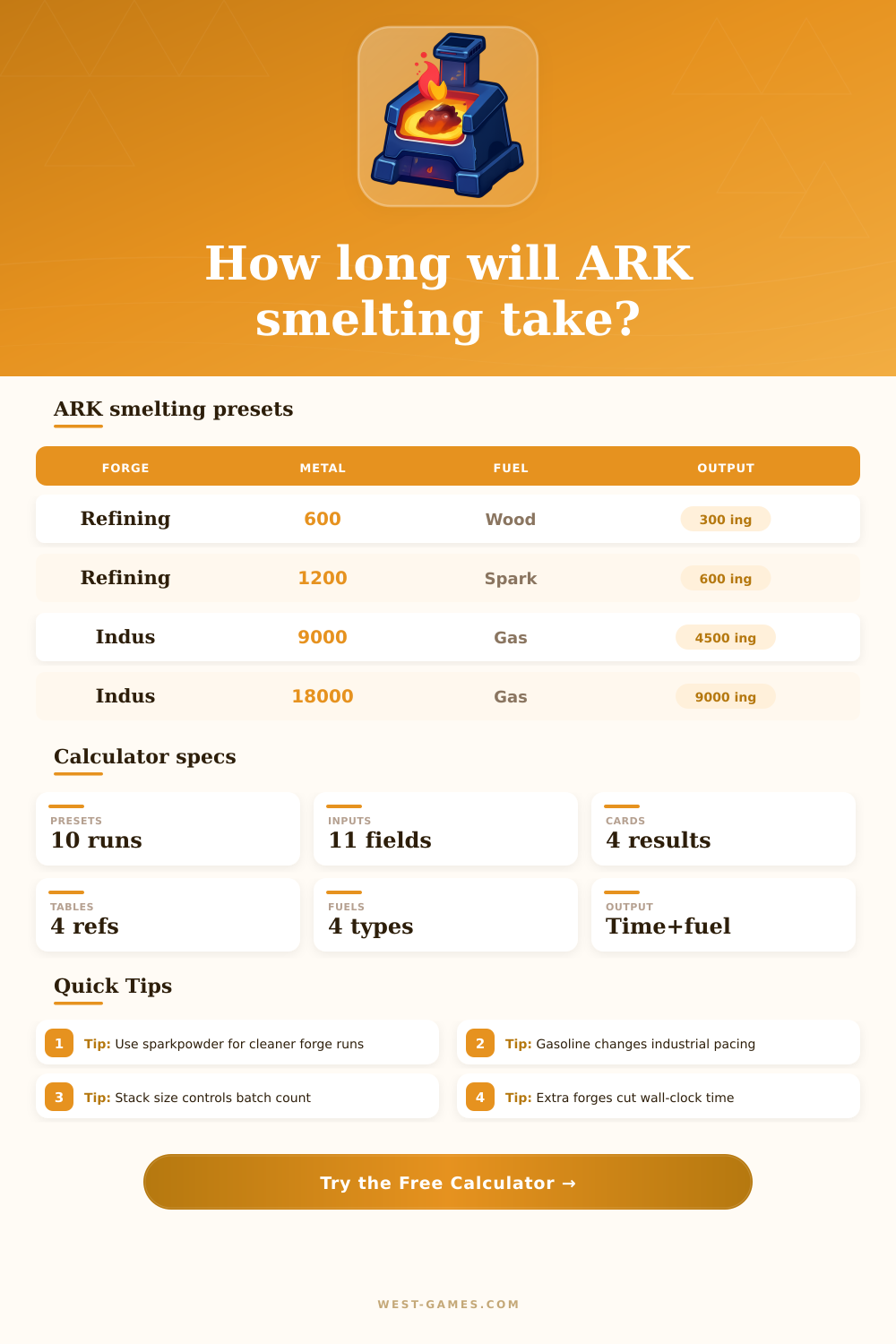
| Beach Base Starter | Refining | 300 | Wood | 150 ingots |
| Sparkpowder Forge | Refining | 1200 | Sparkpowder | 600 ingots |
| Three Forge Line | Refining | 3600 | Sparkpowder | 1800 ingots |
| Industrial Starter | Industrial | 9000 | Gasoline | 4500 ingots |
| Tribe Metal Weekend | Industrial | 48000 | Gasoline | 24000 ingots |
| Target item group | Ingot pressure | Raw metal needed | Smelting read | Useful check |
|---|---|---|---|---|
| Smithy tools | Low | Hundreds | Single forge works | Fuel buffer matters less |
| Saddles and weapons | Medium | Thousands | Multiple forges help | Watch slot count |
| Fabricator push | Medium-high | Several thousand | Sparkpowder is tidy | Target exact ingots |
| Vault and turrets | High | Large hauls | Industrial forge shines | Gasoline duration |
| Tribe building run | Very high | Many hauls | Parallel lanes needed | Batch count and refills |
Your inventory’s almost maxed out. You’ve got three thousand units of raw metal from some nasty place. All this effort suddenly hangs on whether you can get it smelted fast enough before the raiders come, or your dinosaur companion wanders away and dies. It’s a situation that demands careful preparation, not blind chance.
Knowing the forges isn’t just knowing ‘put this metal in this thing.’ It’s learning to use fuel duration, time, and inventory space as one unit. Doing so determine the difference between a calm production run or a hellish night of frantic refueling. While most people’s minds is set solely to “smelt fast,” you can also consider what happens when fuel runs dry before metal is finished being smelted, or not everything fits in the slots simultaneously.
How to Smelt Metal Fast and Easy
It won’t make any difference until it does, though. The calculator we offer account for your server settings, but knowing why it’s doing what it’s doing will save hours of game time.
Parallel processing are the core mechanic here. Basically, every forge you have running is treated as its own lane. So if you’re running two refining forge at once, that’s not only less time spent overall, it also doubles how much stuff you can get through. The total smelting time are divided by the number of forges you have running. Because of this, building a second forge is usually a better investment then waiting for the big load to finish in first forge.
It sounds simple, but it does require some consideration when it comes to managing fuel distribution, each lane has to be fed enough wood or sparkpowder to keep it running. Not having fuel for one forge will bring down your whole efficiency math. This is a frequent error among players who simply hoard fuel in their storage box rather than distribute it to even out all their active smelting stations.
On the other hand, wood burns hot, but only for about 30 seconds each before producing charcoal. This charcoal has its own uses in creating torches and other carbon-based materials. Meanwhile, sparkpowder burns for a full minute each, but there is no leftover material to use. Therefore, the burn rate depends on what you choose to burn. It’s a give-and-take between efficiency vs. Resource production that still need someone tending the fire periodically, unless you have an industrial forge running off of gasoline, which doesn’t actualy need anyone attending to it at all (running for 15 minutes on each tank).
That means gasoline is a game changer for late-game players using industrial forges. But gasoline do require specialized components and chemistry bench to make, meaning that getting enough oil and/or refined fiber can bottleneck efforts to keep production going. The trick here is balancing industrial forge speeds with the logistics needed to sustain the fuel source.
Another factor that adds some depth to the calculations is stack size: While the default stack size on normal servers is 300 units per stack of raw metal, many private servers raise it much higher. This means you can get more metal into each slot. You will open and close your inventory fewer times to get metal into a forge. This saves time by requiring fewer batches.
The calculator takes your personal stack size into account as well, so if you’re on a server with double stacks then you’ll be refilling the forges half as often, and thus doing less manual labour. Play around with the inputs in the tool and you should notice its effect right away.
Real world play means being interrupted, stepping away from your computer, fighting dinosaurs, etc., so think about putting in a buffer. With a 10% fuel buffer, I still need to account for the total time required; instead, there’s a small safety margin that keeps me from completely failing at the end of a long run due to underestimation. By planning this stuff out beforehand instead of just guessing while you’re smelting, you eliminate guesswork and go straight to execution.
This transforms what would of been a stressful chore into a predictable production line. You’ll know exactly when everything is going to be done without having to babysit each individual ingot until the very end.