🎮 Video Game Currency Converter
Convert premium currency into pulls, stamina, battle pass tiers, store bundle units, and target progress with editable game presets, bonuses, losses, and cross-game ratios.
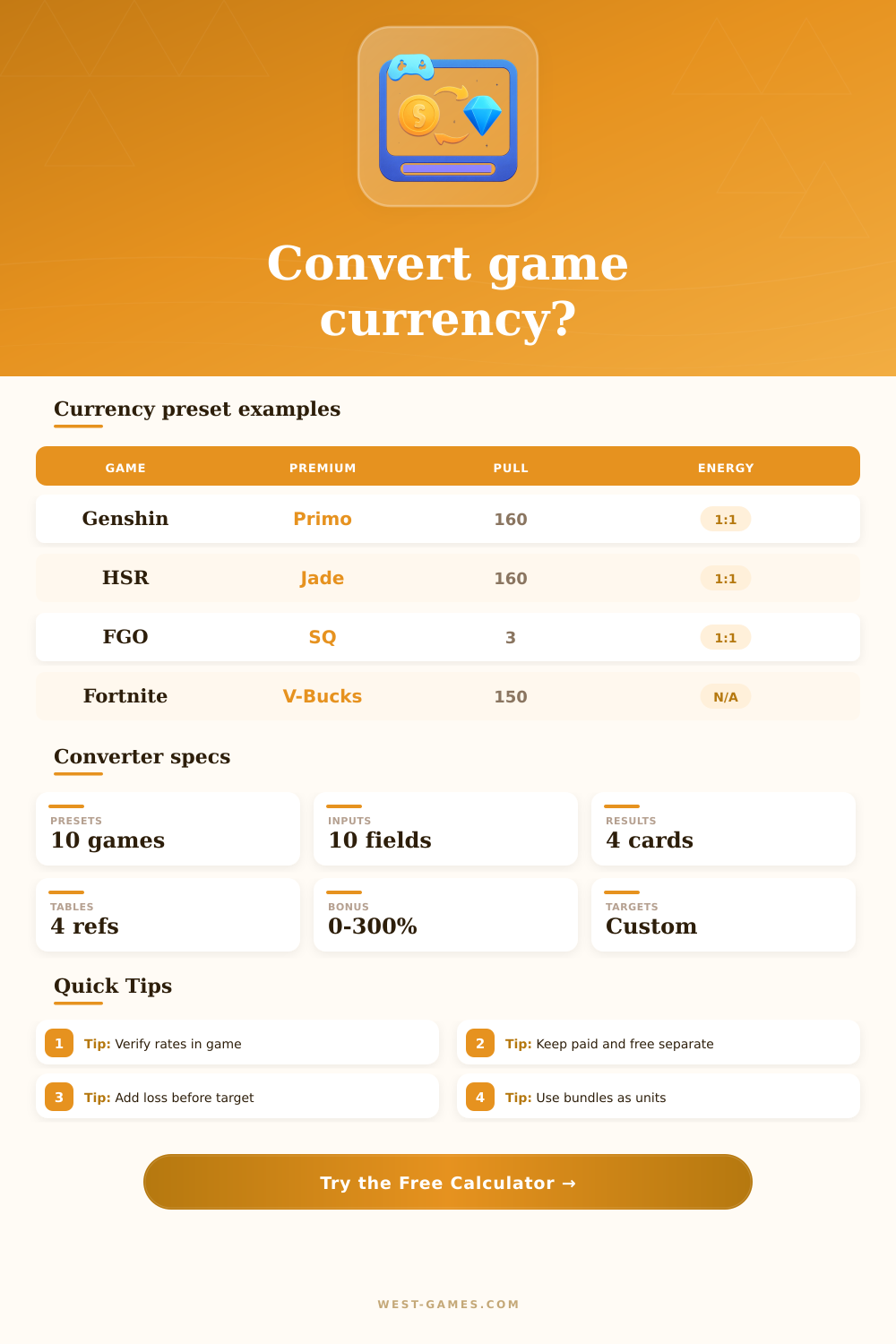
| Preset | Premium label | Pull or unit label | Default pull rate |
|---|---|---|---|
| Genshin Impact | Primogems | Intertwined Fate | 160 |
| Honkai Star Rail | Stellar Jade | Star Rail Pass | 160 |
| Zenless Zone Zero | Polychrome | Master Tape | 160 |
| Wuthering Waves | Astrite | Tide | 160 |
| Fate Grand Order | Saint Quartz | Summon | 3 |
Preset values are editable. Check the active in-game exchange screen before relying on any event-specific rate.
| Preset | Premium label | Unit label | Default unit rate |
|---|---|---|---|
| Arknights | Orundum | Headhunt | 600 |
| NIKKE | Gems | Recruit | 300 |
| Fortnite | V-Bucks | Pass tier | 150 |
| Valorant | VP | Tier unit | 200 |
| Custom Game | Premium | Target unit | 100 |
Non-gacha presets use the pull field as a general target unit rate for tiers, tokens, or unlock units.
| Mode | Best for | Effect | Example read |
|---|---|---|---|
| Whole usable units | Pulls and tiers | Rounds down | 60.8 becomes 60 |
| Show decimals | Ratios | Keeps precision | 60.8 stays 60.8 |
| Round up target | Gap planning | Rounds up | 60.1 becomes 61 |
| Bundle chunks | Store units | Always floors | 6.7 chunks = 6 |
| Setting | Use case | Formula piece | Planning note |
|---|---|---|---|
| Bonus 10% | Event boost | Amount x 1.10 | Adds before loss |
| Loss 5% | Exchange waste | Amount x 0.95 | Subtracts after bonus |
| Target 90 | Hard pity plan | Units / 90 | Shows percent ready |
| Bundle 1600 | Chunk tracking | Net / 1600 | No cash value used |
I have some currency, but I don’t know if it’s enough for this legendary character. It causes anxiety when answer is not clear. Converting currency isn’t tangible. You don’t realy know if it will equal something meaningful, like a pull or a tier of a battle pass.
The calculator above take out the guesswork with a simple question: how much do you want to convert? Input starting value and desired rate. Then let the tool crunch numbers for you. There is presets for each game, which pre-loads typical conversion rates. While these are good places to start, check them against the current in-game event screen since values fluctuates often.
How the Calculator Helps You Plan
It’s less about hitting the convert button, and more about understanding what goes in. Because games typically limit spending token sources, separating them out is necessary. One will contain free daily bonuses; the other will contain purchases. Apply an event-specific bonus percent here, exchange friction as a loss percent there. It reflects actual experience much closer than single conversion rate does.
Real life has rounding errors and timed expirations that lower your end result. That’s where reference table on the page comes into play. It details how various titles values their high-end resource offerings. Why does it feel like you have thousands of gems in this game? But you only get a few pulls in that game.
Why can’t I grind and refill my stamina in some games, while in others I can do it for pennies (a fraction of a wish)? Why is there an energy wall in front of grinding in these games. Everyone feels valuable. Understanding what type of system you’re in alters your approach to spending / hoarding resources.
The pity system is often overlooked in player budgeting plans. Players will plan for an average roll, and neglect to account for insurance against bad luck. That’s where the target gap comes in. This visualizes just how far short you are of your target, and how much further you have to go to be safe. It takes abstract out of those numbers and makes it a real distance to travel.
Finally, battle pass tiers get complicated because every one is a time/money sink. It’s tempting to skip some and go straight for the big prizes, but that means not getting any of the other goodies along the way, including duplicates with protection mechanisms and potentially valuable materials. You can set your tier rates into the converter to see if it’s better to climb the ladder yourself or just spend directly on pulls. Not always, but sometimes the roundabout approach saves more resources than going straight for the top prize.
The thing about store offers is they’re never sold individually. It’s always by the bundle, and they come in chunks that force you to overbuy or leave money on the table. So treating each bundle as its own block lets you think about your real purchase power, instead of some raw number that includes leftover shrapnel you can’t spend. Maybe you have nine whole purchases’ worth of currency, but there aren’t even eight entire bundles left for you to check out.
One tiny little option that makes a huge difference on accuracy is the rounding mode. You can get better resolution if you want decimals. This is for when you are comparing ratios between different games. The other thing to remember: if you’re pulling whole tickets then you must use the floor function, there’s no such thing as half of a ticket in the machine. Don’t do this and you’ll overestimate your readiness, which means you might go to the banner without any luck.
What about the loss field? Because this is everything that can go wrong from saving up to spending, I think it’s worth paying special attention to. In other words, it covers things like currency that has been lost due to a poor exchange rate (in a narrow window of opportunity) or a bonus multiplier that didn’t last as long as expected. A small % added in this field acts as a shock absorber for when reality fails to meet expectations. Expect less then you get; never expect perfection.
Money equals units. What it won’t do is say “you should buy this” or “this isn’t worth it.” That’s up to you. Your budget, the attachments you have to certain characters, that’s all subjective and left for you to decide.
What this will tell you is how much something costs in actionable units. Where do I stand? How many units can I afford? You take away the guesswork and manage a finite supply with concrete expectations. You no longer worry about how much you can or cannot afford; instead, you know.
Once you do finally hit the convert button, however, you’re not simply plugging numbers into a formula. You’re plotting your path from here to there. And that clarity helps you make plans rather than reacting in the moment, and that’s valuable.