💎 RuneScape Drop Rate Calculator
Estimate RS3 boss and slayer target odds from base drop chance, luck tier, kill count, kills per hour, target copies, roll opportunities, and optional dry-streak mitigation.
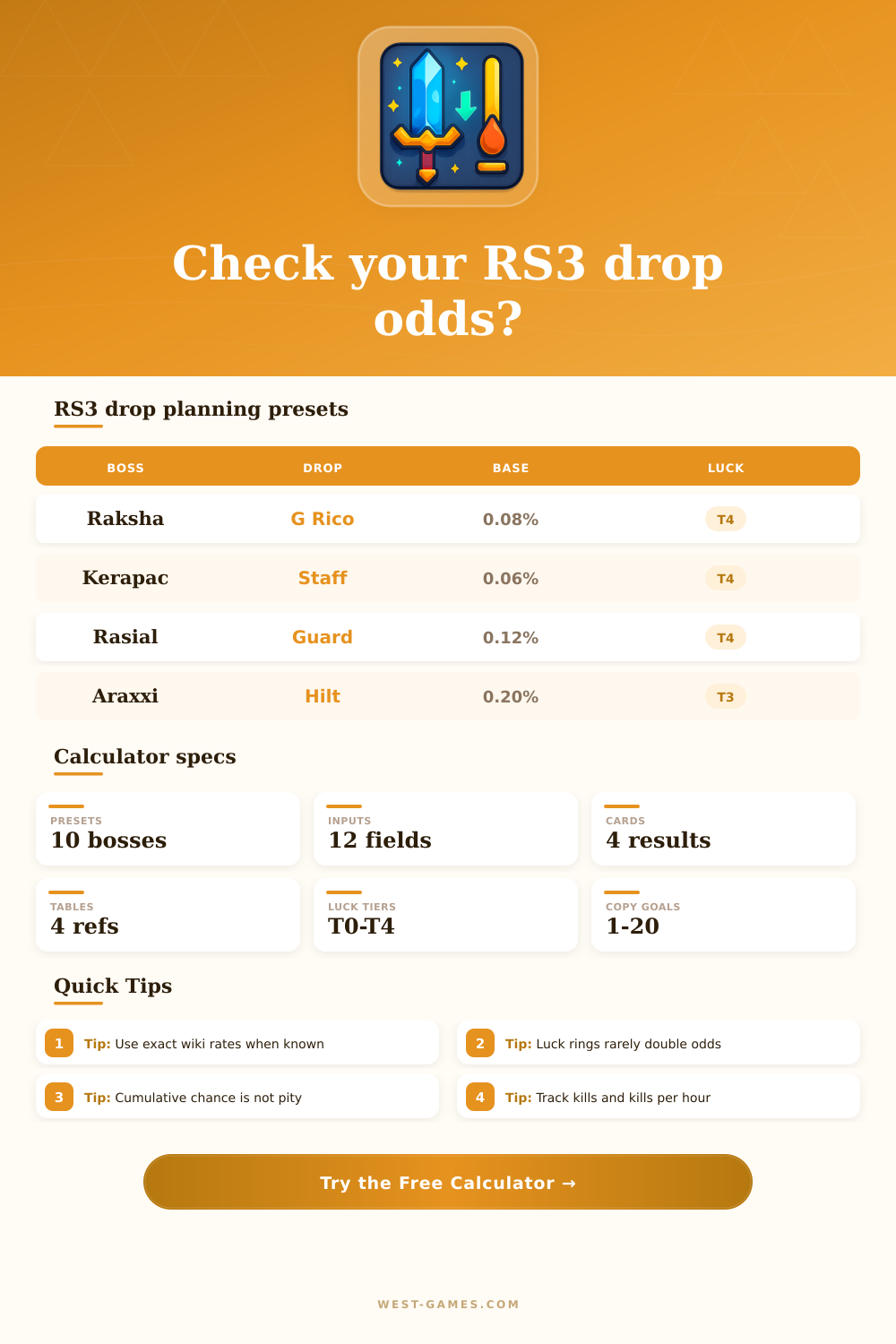
| Preset | Target type | Base chance | Usual inputs |
|---|---|---|---|
| Raksha | Codex rare | 0.080% | Solo rolls, T4 luck |
| Rasial | Weapon rare | 0.120% | Solo kills, T4 luck |
| HM Kerapac | Staff piece | 0.060% | Solo or team share |
| Zamorak | Bow piece | 0.075% | Enrage plan |
| Arch-Glacor | Core rare | 0.050% | Streak style |
| Araxxi | Hilt target | 0.200% | Path and leg goals |
These presets are practical calculator defaults. Replace the base chance with the exact current drop table for precision.
| Luck choice | Planning boost | Typical item | Use with care |
|---|---|---|---|
| No luck | 0.0% | None | Baseline odds |
| Tier 1 | 0.2% | Low-tier luck | Small effect |
| Tier 2 | 0.4% | Mid-tier luck | Small effect |
| Tier 3 | 0.6% | Ring of fortune | Supported tables |
| Tier 4 | 1.0% | Luck of dwarves | Supported tables |
The calculator models luck as a small editable boost, not as a universal guarantee. Some RS3 drops ignore luck modifiers.
| Mode | What changes | Best fit | Warning |
|---|---|---|---|
| None | Fixed odds | Most drops | No pity assumed |
| Dry linear | Dry streak lift | House-rule plan | Approximation |
| Threshold | Lift after dry count | Known pity-like rules | Check target |
| Streak | Streak/enrage lift | Telos or Glacor plans | Not universal |
If the target has no published mitigation, leave this off. Turning it on is useful for scenario planning, not proof of the live formula.
| Chance level | Approx attempts | Meaning | Dry chance |
|---|---|---|---|
| 50% | 0.69 x rate | Coin-flip point | 50% |
| 63.2% | 1.00 x rate | Expected-rate mark | 36.8% |
| 90% | 2.30 x rate | High confidence | 10% |
| 95% | 3.00 x rate | Very high | 5% |
| 99% | 4.60 x rate | Extreme grind | 1% |
For one-copy goals with fixed odds, the expected-rate mark still leaves about a 36.8% chance of receiving zero copies.
In RuneScape, that particular sting of trying to farm a rare drop begins with anticipation, followed by frustration after three hours spent gazing at the identical boss screen. Your kills increases; your inventory stays stubbornly blank. It usually isn’t because of a lack of effort. Rather, it’s typically an issue of misunderstanding probability.
Many player approach drops as though they’re a vending machine: If you keep pressing buttons long enough, the prize eventualy spills out. In real life, however, game is far crueler. Now there’s a caveat: Each drop rate are an independent event. In other words, with each kill you reset the odds back to zero. You still have a one percent chance whether it’s your first kill or your thousandth kill. You also still have a one percent chance if you’ve been grinding for twenty hours as opposed to five minutes. Why? Because the game doesn’t remember your struggle, math isn’t different in any way. This is why folks get their feelings hurt when they go on a long dry streak; the math hasn’t changed whatsoever but it feels like it did.
Understanding Drop Rates in RuneScape
And that’s where the calculator comes in: it does all that complicated probability mathematics when given your own variables. No more looking at logarithmic formulas or geometric distribution curves; just type in how fast you go and how much time you want to spend on it. It takes the abstract concept of “odds” and turns it into an hour-based number; the number that matters for your schedule. Sure, knowing you’ve got a 50% chance after 1,000 kills is nice to know, but knowing that means playing for 25 hours are the difference.
Things are complicated by Luck items, where many players swear by luck of the dwarves/rings of fortune which they feel double their chances outright. Most luck gear doesn’t operate like that. Usually, luck gear functions through some sort of reroll mechanic on supported tables. Maybe the ring will cause the game to take another look at the list if you didn’t get the drop. But that’s still just a small percentage boost, not a huge multiplier, and that makes a big difference. That one percent boost on something rare sounds significant in theory but only barely cuts down your expected play time.
Most of the time, players don’t consider pace until it’s too late, and they just look at base drop rates assuming quicker bosses mean better picks. When time cost is high though, speed trumps raw percentage. A boss with slightly lower drop rate but significantly higher kills per hour might be the better pick based off your weekend schedule. You can fiddle with the “kills per hour” to understand the impact of team coordination, death recovery, and banking on your overall estimated time. It makes you think about the real world friction that will slow down your farming session.
This is the part where I tell you that dry streaks can be psychological traps. You haven’t seen it for two weeks so you assume that you’re out of luck. If there are mitigation mechanics involved, then you can enter current dry streak length in the tool to view its effect on cumulative probability. While some bosses have pity systems/enrage timers that boost the odds after reaching specific thresholds, other bosses has no pity at all. Knowing whether your target falls into one of these categories is crucial. You will waste your time and get frustrated if you assume it has a pity system when it doesn’t.
That shifts things when copying something between several different account/collection logs. The chance of a single drop matches our expected value; this is why it is called the “expected” value. However, the probability of a third copy grows very quickly with the first two drops because every additional drop increase the mathematical difficulty of getting that drop within the same amount of time. As the probability accumulates, it hits diminishing returns. That’s what makes it take so much longer then just multiplying your playtime by three if you want three copies.
Planning prevents burnout. Knowing the odds allows you to determine if the grind is worth it or if you want to switch things up while staying on pace. Use the calculator above to run the numbers, then make an informed call as opposed to guessing. It’s still going to require hours, but now at least you’ll know exactly how much it may cost you before you log in. That makes it more than just mindless clicking.
It becomes a strategic decision; and though the grind is still tough, at least the path ahead is clear without the mask of false hope. You should of known that sooner.