🩸 TOB Drop Rate Calculator
Estimate OSRS Theatre of Blood purple chance from normal or hard mode, team size, player score, MVP points, deaths, target unique weight, raid count, and clear time.
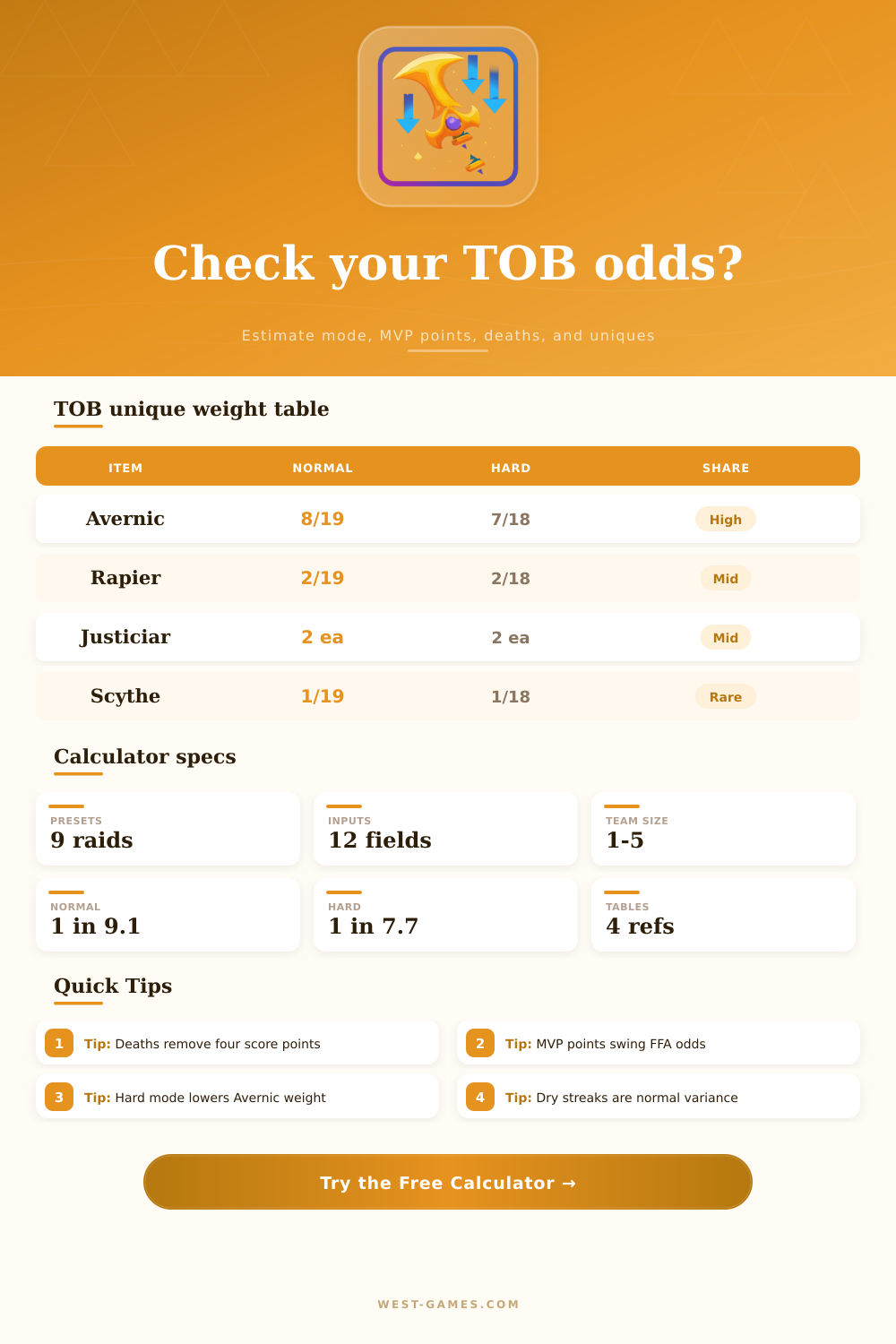
| Unique | Normal | Hard | Planning note |
|---|---|---|---|
| Avernic defender hilt | 8/19 | 7/18 | Lower share in hard mode |
| Ghrazi rapier | 2/19 | 2/18 | Same weight, larger share in hard |
| Sanguinesti staff | 2/19 | 2/18 | Same weight, larger share in hard |
| Justiciar faceguard | 2/19 | 2/18 | One of three armour pieces |
| Justiciar chestguard | 2/19 | 2/18 | One of three armour pieces |
| Justiciar legguards | 2/19 | 2/18 | One of three armour pieces |
| Scythe of vitur | 1/19 | 1/18 | Rarest table weight |
Target unique odds are personal purple chance multiplied by the selected item's active table weight.
| Score source | Points | Where used | Effect |
|---|---|---|---|
| Six rooms completed | 18 | Player and team | Base contribution score |
| Total MVP pool | 14 | Team max score | Allocated between teammates |
| Each skipped room | -3 | Player and team | Reduces score fraction |
| Each death | -4 | Player and team | Reduces purple chance |
| Max player score | 32 | Player share | 18 room + 14 MVP points |
MVP point entries can be fractional when you are estimating an average over many raids.
| Mode | Base team rate | Total weight | Model note |
|---|---|---|---|
| Normal mode | 1 in 9.1 | 19 | 11.0% at full score |
| Hard mode | 1 in 7.7 | 18 | 13.0% at full score |
| Hard time | Same unique rate | 18 | Common loot bonus only |
| Entry mode | No uniques | None | Excluded from this calculator |
This calculator focuses on normal and hard mode unique pre-rolls, not Entry Mode common loot.
| Preset | Mode | Team | Use case |
|---|---|---|---|
| Normal Trio Learner | Normal | 3 | Clean learning baseline |
| Normal 4-Man Stable | Normal | 4 | Common farm comparison |
| FFA MVP Push | Normal | 4 | High personal points |
| Hard Trio Clean | Hard | 3 | Hard mode no-death check |
| Hard Scythe Hunt | Hard | 4 | Long rare chase |
Preset buttons are starting points; replace times, deaths, and MVP points with your own log.
OSRS players must be patient while chasing a Scythe of Vitur in Theatre of Blood. You suffer through death after death at the hands of Verzik himself or teammates yelling about their health bar. On top of that, you’re up against an unfair-feeling chance. While mathematics is in your favor, many players have heard tales of running hundreds of raids without finding a single purple item. Such tales exist, yet they are statistical oddities that color your view of the game engine itself.
This calculator help to understand when you’ve suffered through bad luck versus when you’ve experienced bad strategy. Rather than being frustrated by a dry streak, you’ll know what to expect.
How to Use the Drop Calculator
Before we get to the numbers, you should of understood how the score system works. Unlike a slot machine where drops is purely random per raid, Theatre of Blood use a score system that determines your share of the loot. Six rooms of play are weighed against each other, along with additional points from tough boss fights called “MVPs,” but the score goes down if you skip a room or die. Depending on this score, you will receive a portion of the loot pool if an item drop.
Each time you die, you lose four points. It doesn’t sound like much until you consider that it seriously degrades your personal odds of getting that item. While you’re cursing and dodging poison, the tool does all heavy math behind the point deduction and conversion into something you can use: a percent chance.
Input your number of deaths and average MVP points and it’ll translate those into a concrete figure. Players mostly see the base drop rate. Think they get a 1 chance for a team unique. And then forget that’s just hurdle one: The team roll. Hurdle two is the name roll. That depends on how much you contribute to it compared to everyone else on the team. You’re sitting there with four other players and everybody does perfect. Each of you has about 25 percent of the name roll, but if you died twice, skipped a room, and let rest of your team carry the load, you’ve got much less. That’s what the calculator shows really well.
You don’t need more DPS if you can survive; because surviving protects those points that decide who wins. There’s another strategic element: whether to run Hard mode versus Normal. Hard mode has about a 1/7.7 base drop chance different than the baseline Normal. However, it make clears take longer on average and increases the difficulty level. More important than the increased chances, though, is the time component. Adding twenty minutes per raid due to occasional wipes or careful play mean you may do fewer raids in an hour. This results in less total exposure to any given item drop.
These tradeoffs get laid out side by side in reference tables that come packaged with the calculator. You can see that they shift things slightly differently on different items. Not enough to matter most of the time, but it does mean something if you’re grinding for a while. Similarly, think about what number of raids you’re realisticly prepared to run until your motivation starts to drop.
The expected raid count output provides a median estimate, so half the time you’ll see it sooner while half the time you’ll see it later. Don’t worry if you experience a dry streak, that’s part of variance and doesn’t indicate the system has broken. It simply indicates you’ve fallen into the tail end of the distribution curve. Use the tool to set some realistic expectations by seeing how many raids you might need based off various confidence levels (e.g., how many raids until there’s a 90 percent chance of getting the drop?). This can help avoid burnout when things don’t play out as planned.
But in the end, chasing uniques is more of a fight with yourself than one against the game mechanics; or rather, it’s both. The calculator gives you the road map, now go drive the damn thing yourself. Understanding the dynamics of the score points (and how each death eats into your chances) helps you make better choices (when to play safe), and when to push for speed. Trust the math, not the anecdote. Keep your eye on the long game, and know that every clean run add up, even though the purple light may not flash right away. That’s what most people are missing.