🌊 Wuthering Waves Pity Calculator
Estimate your target chance from banner type, current pity, guarantee state, available pulls, featured odds, and an adjustable soft pity model.
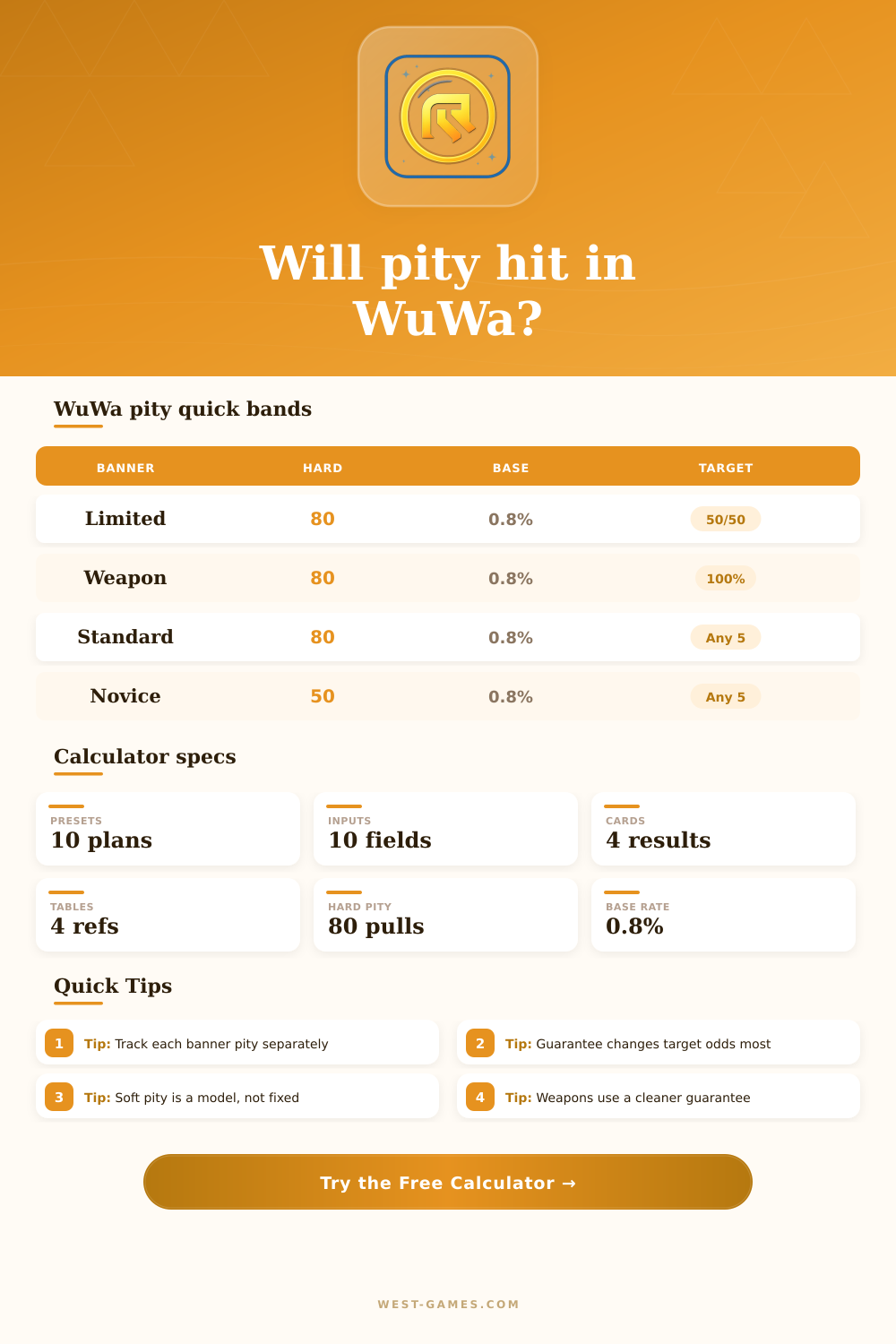
| Convene type | Hard pity | Target odds | Best input |
|---|---|---|---|
| Limited Resonator Event | 80 | 50% unless guaranteed | Guarantee state matters |
| Featured Weapon Event | 80 | Featured weapon guaranteed | Use always guaranteed |
| Standard any 5-star | 80 | Any 5-star counts | Use 100% target share |
| Specific standard target | 80 | Pool share based | Set target share manually |
| Novice / beginner | 50 | Any beginner 5-star | Use matching pity cap |
The calculator keeps every rule editable so it can model special banners, collab pools, and personal target definitions.
| Pity count | Model behavior | Risk note | Action |
|---|---|---|---|
| 0-39 | Base rate zone | Early 5-stars are rare | Plan long |
| 40-59 | Still mostly base | Variance dominates | Keep tracking |
| 60-64 | Near ramp | Model sensitive | Check soft start |
| 65-74 | Rising odds | Many hits cluster here | Recalculate often |
| 75-80 | Hard-pity approach | Forced 5-star soon | Check guarantee |
Soft pity is modeled as a smooth ramp from the chosen start point to hard pity, not as a claimed official per-pull table.
| Resource | Pull value | Use for | Calculator field |
|---|---|---|---|
| Radiant Tide | 1 pull | Character event | Extra Tide count |
| Forging Tide | 1 pull | Weapon event | Extra Tide count |
| Lustrous Tide | 1 pull | Standard pools | Extra Tide count |
| Astrite | 160 per pull | Convertible reserve | Astrite on hand |
| Special Tide | 1 pull | Collab pools | Matching banner only |
Only count resources that can actually be spent on the selected banner type.
| State | Meaning | Target share | Result |
|---|---|---|---|
| No guarantee | Limited 50/50 live | Usually 50% | May need two hits |
| Guaranteed | Lost prior 50/50 | 100% next hit | Target on next 5-star |
| Always | Weapon or any target | 100% | No 50/50 loss path |
| Ignore target | Any 5-star is success | 100% | Measures 5-star chance |
| Pool target | Specific standard pick | User entered | Lower single-copy odds |
When guarantee is active, the next 5-star target chance overrides the normal featured share for that hit.
But now that you’re going to go ahead and pull for it anyway, now that it’s about real money rather than abstract odds of success, now it’s about personal finance. That means Astrite and Tides in your bank, and you need to get this certain character before the banner expires. It is not just any five star, but the one you want specificaly. That changes everything.
The worry isn’t just about obtaining some five-star at random; it’s about acquiring exactly the unit you desire. That’s where our pity mechanic simulator calculator come in. It helps connect your expectations with reality and shows how account condition matches up with the game’s pity mechanics.
Plan Your Spends With a Calculator
Most players treat the base drop rate as the only number that matters. Most people see 0.8% chance and think it’s just like playing the lottery, each pull is its own lottery ticket, all equally likely. They forget about how system itself creates a safety net around that.
There is a hard pity cap of eighty pulls. This means your average result over time increase because you’re guaranteed at least one five-star. But it also introduces concept of soft pity. The probability doesn’t increase until an unknown point between sixty-five and eighty pulls (Kuroko never releases their specific formula). However, according to the model, they’re very likely to shoot up somewhere in that area. That makes planning essential.
You aren’t starting at zero pulls if you walk into a banner with forty pulls under your belt; that changes things. And that’s where the tool come in: it allows you to set your existing pity number, adjusting expectation calculations to reflect your actual position instead of some hypothetical fresh start.
This is probably the most important variable that folks aren’t considering, the guarantee state. Losing the 50/50 split isn’t resetting your progress towards acquiring the feature unit. It’s just changing the next contract terms. What you’re going to shoot for with your next five-star hit are the same thing you wanted before. And this way, it makes a loss a strategic asset.
Now you know what the terms is for the next eighty-pull cycle. Losing the fifty-fifty means your next five-star will be target you wanted. The risk for your effective pulls also drop dramatically. You don’t need to worry about pulling a standard pool character instead. The calculator takes this into account and adjusts the featured share percentage accordingly. So when the guarantee is active, it tells you how cheap the second copy (or heck, the first one) is.
These numbers translate to real life through resource management. For example, there’s a fixed conversion rate from Astrite to pulls: 160 per ticket. That means for planning, you can consider tickets and currency as a single resource pool. You know exactly how much you can afford to spend, whether it’s saving up for a big spend or farming for a specific domain every day.
Setting a boundary based off this knowledge is better than blowing all your stockpiles trying to grab another copy of something that you’re only half sure will ever come back anyway. There’ll be another banner sometime. Plan accordingly. Leave yourself with a buffer just in case.
Hard pity is capped at eighty pulls. There are a couple of reference tables at the bottom of the page which break down how various banner types deals with those guarantees. It helps explain why character pulls tend to be more stressful than weapon events. But there isn’t a published rule, there’s just an estimated curve of soft pity, and that’s why the calculator lets you play around with where you think the ramp starts.
For some people, they thinks it happens sooner; for others, there’s enough variance that they think it ramps up later on. That’s another reason why having that input is helpful because you can tweak it and stress-test your own theory under both more and less generous assumptions. It also will help you decide when you should stop at one copy versus push through to two.
Even if you factor in soft pity, do the chances still look slim that you’ll get a second copy before your pull limit? In that case, maybe it’s better to hold onto those Tides instead. Because gacha games thrive on variance, knowing where you’re comfortable taking risks will help you make more clear-cut decisions.
But the point of this all is not just to minimize pulls, but to maximize enjoyment without breaking your resource sustainability. Having separate tracking for each banner pool means your pity progress won’t get wiped out with rotation. Plug in your starting number and you’ll see how many pulls are needed, a tangible goal to aim at. Then you can look at what you’ve saved and weigh that against the pull count.
Are you looking at needing seventy more? But right now, you only have thirty? Well, you either drop Astrite now or hold off. Either way, it’s immediate.
The numbers don’t lie, but you should of understood them to read them right. With absolute clarity on the location of the safety net, you can avoid getting caught up in the ups and downs of short term gain/loss and play the long game instead. It’s less about crossing fingers and more about making an educated investment into your team. That difference between hoping versus planning is what separate the experienced from the always cash-strapped.