🎮 MLBB MMR Calculator
Estimate Mobile Legends hero MMR movement from rank stars, lane or role, match result, grade, enemy average, party size, star protection, and star-raising points.
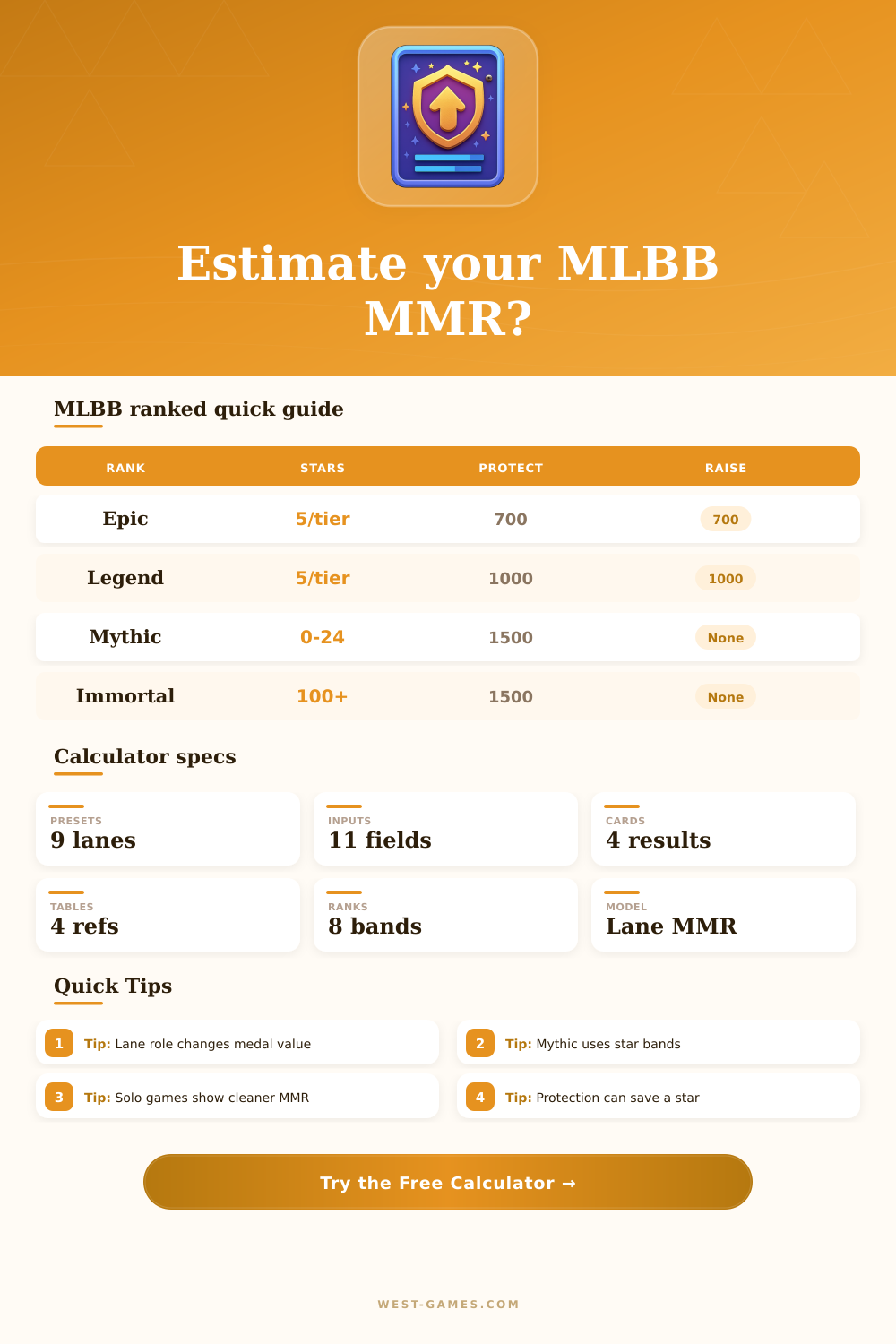
| Rank band | Star range | Protection | Star raising |
|---|---|---|---|
| Grandmaster | 5 per tier | 500 pts | 500 pts |
| Epic | 5 per tier | 700 pts | 700 pts |
| Legend | 5 per tier | 1000 pts | 1000 pts |
| Mythic | 0 to 24 | 1500 pts | None |
| Honor | 25 to 49 | 1500 pts | None |
| Glory | 50 to 99 | 1500 pts | None |
| Immortal | 100 plus | 1500 pts | None |
The thresholds are planning assumptions for ranked star protection and star-raising behavior; event cards and season rules can change visible outcomes.
| Lane | Credit focus | Volatility | Calculator note |
|---|---|---|---|
| Gold | Damage and farm | Medium | Late-game carry value |
| EXP | Side pressure | Medium | Wins through map trades |
| Jungle | Lord and turtle | High | Objective swings matter |
| Mid | Rotation tempo | Medium | Assist and wave timing |
| Roam | Vision and setup | Lower | Grade can undercount value |
| Fill | Team balance | Medium | Uses blended weighting |
Lane weighting keeps the calculator from treating every medal exactly the same across roles.
| Signal | Win effect | Loss effect | Meaning |
|---|---|---|---|
| Chocolate | Severe trim | Large drop | Penalty risk |
| Bronze | Reduced | Harsher | Low impact |
| Silver | Small trim | Slight drop | Mixed value |
| Gold | Baseline | Baseline | Solid match |
| MVP | Boosted | Softened | Top impact |
| Legendary | High boost | Softened | Carry signal |
The calculator separates MMR estimate from official medal rewards, which are not published as a fixed formula.
| Factor | Win gain | Loss drop | Readout |
|---|---|---|---|
| Lower enemies | Smaller | Harsher | Expected win |
| Even average | Baseline | Baseline | Fair lobby |
| Higher enemies | Larger | Softer | Upset value |
| Solo | Cleanest | Cleanest | Personal signal |
| Duo or trio | Trimmed | Trimmed | Coordination |
| Five-stack | Lower swing | Lower swing | Team expected |
Party size lowers the movement swing because premade coordination is already priced into the match context.
And then you play a game that seems like its totally in your hands. After securing early objectives, your team pushes forward with right number of players for fights. And then, the moment of truth, when the stars move on the screen. Occasionally they leap forward just as predicted. Other times, they barely flicker or stutter around, even though you were clearly dominating. That disconnect is what makes ranked Mobile Legends gaming frustrating.
What we see on screen (those stars) are just surface reflection of a deeper system, one that monitors our hidden Matchmaking Rating at multiple roles and heroes. Getting to know this layer below change how we engage every queue, particularly in those lower tier where progress can feel invisible for extended periods. By using that, it’s able to find which variables matters most to the actual progression. It takes into account things such as your hero archetype and lane role to alter weight of their performance.
How Hidden Matchmaking Rating Works in Mobile Legends
If you’re a Roam support or a Gold Lane carry, receiving an excellent grade will affect your hidden rating different depending on your role, because the game weighs different types of contributions differently. That support may have scored lower individually, but they secured vision. That kind of contribution is weighed different by the game under the hood, so the calculator will factor in that difference.
It even takes into consideration party size. While most players don’t know this, it helps you climb stable ranks much more than many people realize. Solo queue has the purest read on your skill level. Did you adapt to a random team comp? If you queue up in duos or larger squads, the system assume some coordination. So it will trim MMR swings slightly toward each side. This is why when you play with friends, your climb tends to be slower and steadier than solo queue. As a group, you may have a higher winning percentage, but the rating system know that. It can see synergy between pre-made players but not necessarily individual brilliance. And so it adjusts its volatility to account for lobby size first, then considers stats.
These calculations also take into account recent form. Although it’s subtle, it still counts. It will help cushion a consecutive loss if you’ve already been on bad streak. The reason is that it doesn’t want you to fall off entirely. On the flip side, a good winning streak adds pressure. Your next game becomes heavier. Many players don’t consider momentum factor and only consider their current star count. Unfortunately, that leads them to quit in a panic during normal dips in form.
The page lays out how each rank handles their thresholds and protection points within their respective reference tables. So you get a roadmap for where to push aggressively and where to be careful. It is more complex because of match grades. And people make them too simple. They think, “If I get MVP in a loss, I won’t lose any stars.” But it doesn’t work like that.
Yes, your hidden rating is softened by an MVP grade. If the visible star goes away, you still keep some long-term progress. If you’re already rock-bottom in your tier, though, then no. It would of protected you. Without those protection points, you will lose your safety net. Knowing whether or not you’re safe depends on understanding what’s being protected, the overall rating vs. The rank position. Good players understand the difference; great players use that knowledge to make moves toward their next goal.
It even accounts for opponent strength. Stomping a much weaker team doesn’t get as much credit as beating a slightly higher ranked lobby. They’re both victories, but you get different results from each one. It rewards the difficulty, not just winning at all costs. This balances out the ecosystem and means you shouldn’t focus only on your own performance metrics, but also take a look at what kind of opponents you’re facing. You are consistently playing against lower-ranked foes. You won’t gain much, no matter how well you perform.
But in the end, it’s not about running after X amount of stars. It’s about mastering the unseen rating that fuels those stars. There’s no changing the algorithm. But you can operate within its logic. Find your lane(s). Know where teamwork trumps personal skill. Appreciate hard-fought wins. From there, begin viewing each match as a data point feeding into this intangible rating instead of simply a win/loss binary, then the grind transforms from an emotional roller coaster to a strategic progression. Instead of testing your luck, every queue will be one step toward understanding the exact reason you made it to Mythic.