🎯 Valorant Hidden MMR Calculator
Infer hidden MMR from recent RR gains and losses, visible rank, opponent rank pressure, ACS signal, round differential, streak form, party size, and convergence gap.
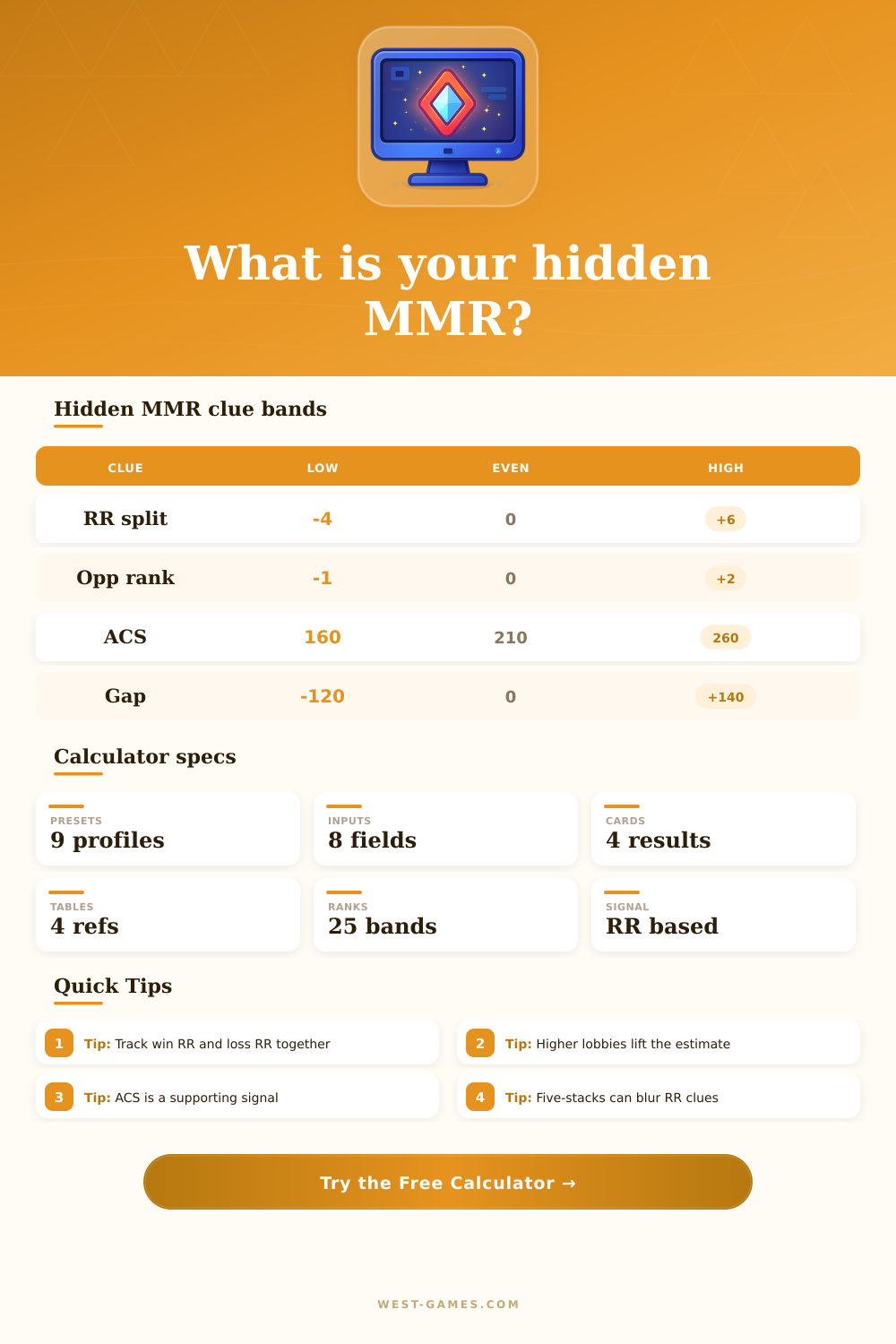
| Recent RR split | Likely meaning | Gap estimate | Rank feel |
|---|---|---|---|
| +25 / -13 | Hidden far higher | +220 | Fast climb |
| +22 / -16 | Hidden higher | +140 | Favored gains |
| +19 / -18 | Near aligned | +20 | Normal climb |
| +16 / -20 | Hidden lower | -100 | Slow climb |
| +13 / -24 | Hidden much lower | -230 | Correction |
Use typical values across several competitive matches. One remake, AFK, or extreme party lobby can distort the signal.
| Band | Model center | Internal range | Notes |
|---|---|---|---|
| Iron | 250 | 100-499 | High volatility |
| Silver | 800 | 700-999 | Common reset band |
| Platinum | 1400 | 1300-1599 | Gap shows fast |
| Ascendant | 2000 | 1900-2199 | Tighter lobbies |
| Immortal+ | 2400 | 2200+ | Small RR swings |
The number scale is a readable model, not Riot's private scale. It is meant to compare hidden versus visible rank pressure.
| ACS range | Signal | Use in model | Warning |
|---|---|---|---|
| Under 160 | Weak | Negative support | Role context matters |
| 160-199 | Below lobby | Small drag | Can still win rounds |
| 200-239 | Stable | Neutral | RR split decides |
| 240-279 | Strong | Positive support | Do not overrate one game |
| 280+ | Carry | High support | Needs repeat sample |
Controller and sentinel value can be undercounted by ACS, so the role selector adds a small correction.
| Gap | Label | Expected RR | Meaning |
|---|---|---|---|
| +180+ | Surging | Big gains | Rank trails skill signal |
| +80 to +179 | Favored | Gain edge | System pulls upward |
| -79 to +79 | Aligned | Balanced | Rank and MMR agree |
| -80 to -179 | Dragging | Loss edge | Visible rank is ahead |
| -180 or less | Correcting | Heavy losses | Needs wins to stabilize |
A positive gap means hidden MMR is above your visible rank anchor. A negative gap means RR may feel stingier.
If you’ve played hard games of Valorant, then you know what I’m talking about. You’re sitting in Silver III, clutching rounds with good aim. However, whenever you lose, you get down by twenty points. And whenever you win, it’s just like you gained fifteen back. It doesn’t feel fair because it is often not about your skill in that specific moment.
According to the game, your displayed ranking isn’t reflecting what’s going on inside. The community calls it Hidden MMR, or Matchmaking Rating. This is an invisible metric that Riot Games use to place you in a lobby with players at a fair level. This happens before your displayed ranking update to show a different tier. Knowing how this system operate shifts how you perceive each match outcome.
What Is Hidden MMR?
But what about that other number? How do we know where that’s hiding? Well, there’s some data you can see that will give you an idea with the help of calculator up top. Asymmetries between your RR gains and losses are the strongest indicator here. For example, if you always gain more points for winning then you lose for losing then your Hidden MMR probably lies somewhere above the value indicated on your badge. That means the system believe you’re closer to your “true” skill, and it’s attempting to move you toward that point. If it feels like your losses sting much harder than your wins feel sweet, then you are probably playing above your internal skill level. This mismatch causes a sort of lag effect: While matchmaking system adjust itself behind the scenes, your actual badge stays where it’s at.
Your baseline comes from inputting your average RR swing in the tool, but context also matter. Who you’re going up against is key. Do you consistently get matched against players from higher tier? That’s why the model think your Hidden MMR is inflated. It thinks you’re ready for tougher competition so it feeds it to you. So it’s more important to look at recent lobbies (as opposed to obsessing over a single stat line) to paint a clearer picture.
Your Average Combat Score also plays a supporting role here. Raw kill counts are tempting metrics, but don’t capture all the value of positioning and using abilities. For example, a duelist who sprays bullets everywhere might have a lower ACS compared to a controller player, but carry more strategic weight.
There’s also another wrinkle here: Party size. Solo queue offer the purest data set since the matchmaking system only needs to find an opponent at or near your level and has no additional constraints. In contrast, when you’re playing in a five-stack (particularly if it’s a broad range of ranks), the algorithm mashes your MMR together with that of your party-mates into a kind of group average. Your own standing can be entirely hidden as a result. You can carry your weaker friends to victory, boosting your RR but not necessarily your own Hidden MMR. Asking about party spread lets the tool filter out this sort of noise. This way, you can see what you could do on your own versus how you do as part of a team.
Recent form and streaks do have an effect, too, albeit perhaps not as much as you think. It doesn’t alter the math that says this is what your skill level is; if you’re on a hot streak the system take that into account when placing you more confidently in subsequent matches, based off several wins or losses in a row. If you win or lose only twice, there’s no real proof from a tight sample size. To get the actual trend line, you’ve got to track a series of ten to twenty matches. Reacting to a single bad game isn’t going to tell you anything better than tracking multiple results.
Knowing how far off you are from what your MMR would suggest gives you an idea if you’re patient or frustrated. A positive number suggests you’re surging. This means you have higher stats than your badge, so you’ll see quicker climbs and easier opponents until things level out. A negative number says you’re dragging, meaning your badge is higher than your stats. This indicates you will face tougher lobbies and slower RR increases while the system levels you out. It isn’t meant to be manipulated; it is meant to show where you stand different than the rest of the players.
Your badge isn’t your ranking, it’s your label. The true ranking is the one you can’t see behind it. That is where the competition truly occurs. Stop resisting the mismatch. You should of let the information work for you, and you’ll climb steadily instead of blindly relying on luck.